
Ingredients
The fish
- 1.2 kgtørrfisk – air-dried skrei cod, hard as a plank
- cold fresh water, changed daily
- 30 gfood-grade caustic soda (sodium hydroxide) per 10 litres of water, for a roughly 3% lye bath
To cook
- 3 tbspcoarse salt
- a heavy oven dish with a lid, or a large pot
To serve
- 250 gsmoked streaky bacon, cut in lardons and fried crisp, with its fat
- 400 gdried green peas, soaked overnight and boiled to a coarse puree (ertestuing)
- 1 kgalmond potatoes, boiled
- 2 tbspcoarse mustard
- brunost or a spoonful of geitost sauce, in some regions
- lefse or flatbrod
- aquavit and beer
Directions
- Saw or cut the dried cod into pieces about 15 cm long. It is too hard to cut once soaked, so do it now.
- Soak the pieces in cold fresh water for 5–6 days in a cool place, changing the water every single day, until the fish has swelled to roughly three times its dried weight and is pliable.
- Make the lye bath: wearing goggles and gloves, always adding the caustic soda to the water and never the reverse, dissolve the soda in cold water in a plastic or stainless vessel – never aluminium.
- Submerge the soaked fish in the lye for 2 days at a cool temperature. The flesh will swell further, turn translucent and jelly-like, and become soapy to the touch.
- Lift the fish out and soak it again in daily changes of cold fresh water for 4–6 days, until the flesh no longer feels slippery or soapy and tastes clean and faintly salty. This step is what makes it food, not chemistry, and it cannot be shortened.
- Lay the drained fish skin-side down in a single layer in the oven dish, salt it generously, cover tightly with a lid or foil and add no water at all.
- Bake at 200°C (400°F) for 30–40 minutes. The fish cooks in its own liquid and is done when it turns from opaque white to glassy and amber-tinged and the flakes separate at the touch of a fork. Overcooked lutefisk dissolves to soup.
- While it bakes, fry the bacon until crisp and keep the fat hot, and warm the pea puree.
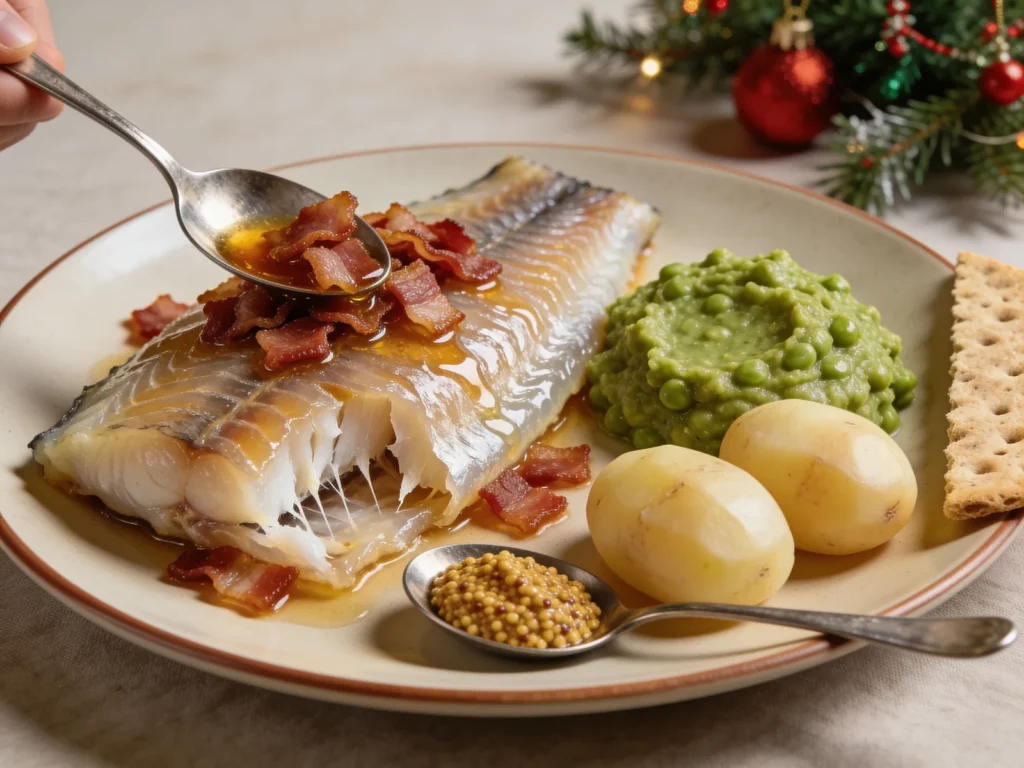
- Lift the pieces carefully with a fish slice onto warm plates – it is extremely fragile – and serve at once with bacon and its fat spooned over, mushy peas, boiled potatoes, mustard and flatbrod.
Technique
- Caustic soda is genuinely dangerous: it causes severe burns and blindness. Use goggles, gloves and good ventilation, never use aluminium or reactive vessels, and never leave the bath where children or animals can reach it.
- The final freshwater soak is a food-safety step, not a flavour step. Fish still soapy to the touch or with a pH above about 8 has not been soaked long enough and must not be eaten.
- Lutefisk contains almost no salt of its own and very little structure – salt it well and cook it covered without added liquid or it will fall apart entirely.
Substitutions
- Almost every Norwegian household now buys lutefisk already lye-treated and soaked from a fishmonger in November and December. This is entirely normal and you need only the final baking step.
- Birch ash lye is the original alkali, made by leaching wood ashes with water, and is still used by a few traditional producers.
Variations
- Trondheim style, served with bacon fat, mustard and a strong dose of white pepper.
- Western Norway style, served with a sweet brown cheese sauce alongside.
- Steamed rather than baked, wrapped in a cloth over boiling water, which some cooks say holds the flakes together better.
History
Dried whitefish, traditionally cod, rehydrated and treated with lye before cooking, a preservation and preparation method documented in Nordic countries since at least the medieval period, when drying fish heavily was a practical way to store it for long periods without refrigeration, particularly through harsh Scandinavian winters. Several unverified legends attempt to explain the lye-treatment step itself, including one story involving fish accidentally soaked in a barrel of lye-contaminated water during a fire and eaten out of necessity, though none of these accounts are documented history. The lye treatment gives the fish a distinctive, gelatinous texture that divides opinion even within Norway, and lutefisk today survives mainly as a nostalgic Christmas-season dish rather than an everyday food.
Frequently asked questions
What is Lutefisk?
Lutefisk is a main from Norway: lye-treated dried cod, translucent, with bacon and peas; Christmas. Dried whitefish, traditionally cod, rehydrated and treated with lye before cooking, a preservation and preparation method documented in Nordic countries since at least the medieval period, when drying fish heavily was a practical way to store it for long periods without refrigeration, particularly through harsh Scandinavian winters. Several unverified legends attempt to explain the lye-treatment step itself, including one story involving fish accidentally soaked in a barrel of lye-contaminated water during a fire and eaten out of necessity, though none of these accounts are documented history. The lye treatment gives the fish a distinctive, gelatinous texture that divides opinion even within Norway, and lutefisk today survives mainly as a nostalgic Christmas-season dish rather than an everyday food.
How long does Lutefisk take to make?
Lutefisk takes 30 min hands-on, spread over 12 days of preparation and 12 days soaking, plus 40 min cooking of cooking. The recipe makes 4 servings. It is rated hard to make.
What can I substitute in Lutefisk?
Yes, within limits. Almost every Norwegian household now buys lutefisk already lye-treated and soaked from a fishmonger in November and December. This is entirely normal and you need only the final baking step. Birch ash lye is the original alkali, made by leaching wood ashes with water, and is still used by a few traditional producers.
What is the most important thing to get right in Lutefisk?
Make the lye bath: wearing goggles and gloves, always adding the caustic soda to the water and never the reverse, dissolve the soda in cold water in a plastic or stainless vessel – never aluminium.