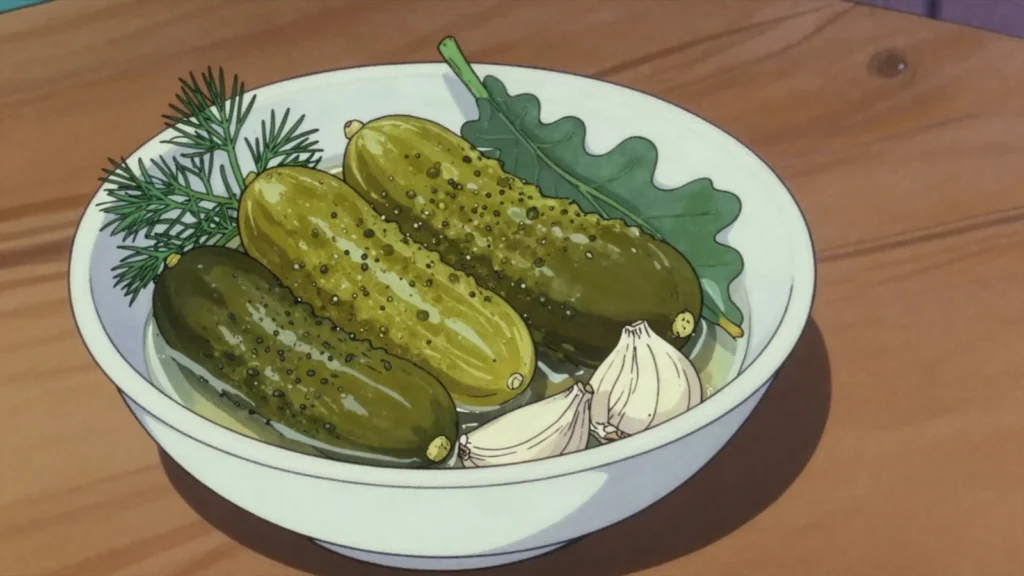

Ingredients
The cucumbers
- 1.5 kgsmall pickling cucumbers
- firm, unwaxed, freshly picked if possible
- see the note
- blossom ends trimmed
The brine
- 2 litreswater
- filtered, or boiled and cooled
- not chlorinated tap water
- 80 gnon-iodised salt
- that is 4 percent
- weigh it, see the note
The aromatics
- several dill seed heads
- with stalks, see the note
- 1 headgarlic, cloves peeled
- a piece of horseradish root, sliced
- or horseradish leaves
- several oak, cherry or blackcurrant leaves
- see the note
- 1 tablespoonblack peppercorns
- several bay leaves
- 2dried chillies, optional
Equipment
- a crock, wide jars, or a food-grade bucket
- not aluminium or copper
- a weight
- a cloth or loose lid
Directions
- Use small firm pickling cucumbers. They go soft and hollow in brine. Use them as fresh as you can get them. Week-old cucumbers make soft ones.
- Soak the cucumbers in cold water for two hours first. They take up water and firm up. Trim a few millimetres off the blossom end of every cucumber. Pectin is what holds a cucumber firm.
- Add oak, cherry, blackcurrant or horseradish leaves. They keep the cucumbers crisp. Use small young cucumbers. Keep the fermentation cool. Use them fresh.
- Use dill seed heads with their stalks. Dill seed from a jar works if you have no heads. Salt crystals differ enormously in density. Salt selects for lactic bacteria over spoilage organisms. Do not reduce the salt.
- Layer the cucumbers with the leaves, dill, garlic and spices. Pack them firmly. Stand them upright if the vessel allows. Leave several centimetres at the top. Stand the vessel in a tray. Pour the cool brine over to cover everything. Everything must stay under the brine.
- Cover it with a cloth or a loose lid. Never seal a fermenting jar tightly. Warm ferments fast and gives soft hollow cucumbers. Cool ferments slowly and gives crisp ones. They must be kept refrigerated and eaten within days. Taste one with a clean fork. It should be sour, salty and still have a crunch.
- Skim it off. Discard the batch. It comes from weak brine or warm fermentation. Serve them cold, whole or sliced. They keep months cold, under the brine. Top up with brine of the same strength if the level drops. They do not freeze.
Technique
- Use them as fresh as you can get them. A cucumber starts softening the moment it is picked — day-old cucumbers make crisp pickles and week-old ones make soft. This matters more than any other single factor. Soaking them in cold water for two hours first genuinely helps ones that are a day or two old.
- Trim a few millimetres off the blossom end of every cucumber, opposite the stem. That end carries enzymes that break down pectin, which is what holds a cucumber firm, and they are the main cause of soft pickles. If in doubt, trim both ends.
- Add oak, cherry, blackcurrant or horseradish leaves. Their tannins inhibit those same pectin-breaking enzymes and keep the cucumbers crisp — a real chemical effect, which is why the leaves are in every traditional recipe rather than being decoration. Horseradish also has antimicrobial properties.
- Use small firm unwaxed pickling cucumbers with bumpy skin. Salad cucumbers are bred for size and water and go soft and hollow in brine; wax blocks the brine entirely.
- Hollow cucumbers float and sound ones sink — test them in a bowl of water before packing. Hollowness comes from over-mature or long-stored cucumbers, or a fermentation that ran too fast and gassy.
- Cooler is better for cucumbers. Warm fermentation gives soft hollow ones; cool gives crisp.
- Weigh the salt at four percent — eighty grams to two litres. Do not reduce it: weak brine lets the wrong organisms grow, and cucumbers are particularly prone to going soft and slimy in it. Use non-iodised salt, and filtered or boiled-and-cooled water, since chlorine suppresses the fermentation.
- Cool the brine completely before pouring it on. Hot brine cooks the cucumbers and kills the bacteria, leaving soft unfermented cucumbers in salt water.
- Everything must stay under the brine, and never seal a fermenting jar tightly — fermentation produces carbon dioxide and a sealed jar can burst. Leave several centimetres of headspace and stand the vessel in a tray.
- Use dill seed heads with their stalks rather than fronds; the mature heads carry far more flavour. Dill goes to seed exactly when cucumbers are pickled, which is not a coincidence. A tablespoon of dill seed per jar substitutes.
- Bright green turning to dull olive is the sign it is working — the acid changes the chlorophyll. A white opaque centre means it has not finished; translucent all through means it has.
- At three to five days they are malosolny — lightly salted, barely soured, still bright — and eaten deliberately at that stage as a summer delicacy rather than an unfinished pickle. Keep those refrigerated and eat them within days.
- A flat white wrinkled film is kahm yeast: harmless, unpleasant, skim it. Fuzzy coloured growth is mould, which sends threads below the surface, so scraping the top does not remove it and some moulds produce toxins — discard the batch. A ropy or slimy brine is the specific failure cucumbers are prone to, from weak brine or warm fermentation, and also means discard.
- Fermented and vinegar-pickled are different things, and Belarusian, Russian and Polish keep the words apart — kvashanyya against marynavanyya. English calls both a pickle and confuses everyone.
- Keep the sour brine. It goes into rassolnik and is drunk as a hangover remedy — the atlas records the practice without endorsing the claim.
- Top up with brine of the same strength if the level drops, and always use a clean fork.
Substitutions
- Gherkins or Kirby cucumbers replace pickling cucumbers.
- Any tannin-rich leaf works — oak, cherry, blackcurrant, grape, horseradish.
- Dill seed from a jar replaces fresh seed heads.
- Green tomatoes, small courgettes or patty pan squash ferment in the same brine.
- Horseradish root and leaves are interchangeable here.
- A three percent brine ferments faster and gives a milder, softer pickle.
Variations
- Malosolnyya agurki are the same cucumbers stopped after three to five days.
- Ogórki kiszone in Poland are the same thing.
- Marynavanyya agurki are the vinegar-pickled version.
- Cucumbers fermented with rye bread in the brine are made in some households.
- Rassolnik is the soup built on them and their brine.
- Kvashanaya kapusta applies the same logic to cabbage.
History
Barrelled in Belarusian cellars each summer; oak and horseradish leaves keep them crisp through winter.
Frequently asked questions
What is Kvashanyya agurki?
Kvashanyya agurki is a fermented & pickled from Belarus: cucumbers fermented in brine with dill, horseradish and oak leaves. Barrelled in Belarusian cellars each summer; oak and horseradish leaves keep them crisp through winter.
How long does Kvashanyya agurki take to make?
Kvashanyya agurki takes 30 minutes plus 1 to 4 weeks of preparation and 10 minutes of cooking. The recipe makes makes 2 large jars. It is rated medium to make.
What can I substitute in Kvashanyya agurki?
Yes, within limits. Gherkins or Kirby cucumbers replace pickling cucumbers. Any tannin-rich leaf works — oak, cherry, blackcurrant, grape, horseradish. Dill seed from a jar replaces fresh seed heads. Green tomatoes, small courgettes or patty pan squash ferment in the same brine. Horseradish root and leaves are interchangeable here. A three percent brine ferments faster and gives a milder, softer pickle.
What is the most important thing to get right in Kvashanyya agurki?
Use dill seed heads with their stalks. Dill seed from a jar works if you have no heads. Salt crystals differ enormously in density. Salt selects for lactic bacteria over spoilage organisms. Do not reduce the salt.