
Ingredients
Meats
- 600 gpork shoulder, in cubes
- 1chicken, jointed
- 300 gsmoked sausage, sliced
- 200 gbacon or pork ribs
- or rabbit, traditionally
The pot
- 1 kgsauerkraut, drained
- 200 glong grain rice
- 3onions, chopped
- 4 tablespoonslard or oil
- 2 teaspoonssweet paprika
- 2bay leaves
- 1 teaspoonblack peppercorns
- 1 teaspoondried savory
- about 600 ml stock
- salt and black pepper
To seal
- 300 gplain flour
- about 150 ml water
- 1 teaspoonsalt
To serve
- bread
- red wine
- at the Christmas table
Directions
- Steam and aroma stay entirely inside. It is sour, firm and strongly flavoured. Drain the sauerkraut thoroughly. Keep some of the brine back too. Squeeze it out if it is very wet. Chop it roughly if the pieces are long.
- Taste it to judge the sourness. Rinse it briefly if it is too sharp. Heat the lard in a wide heavy pan. Brown each meat separately in batches. Do not crowd the pan at any point. Lift each one out as it browns. Chicken skin needs longer than pork cubes.
- Add the chopped onions to the same pan. Cook them for a good ten minutes. Add the paprika off the heat now. Stir it through the hot onions. Paprika burns within seconds in hot fat. Use a deep heavy pot with a tight lid. Put a layer of sauerkraut in the bottom.
- Add a layer of mixed meats over it. Scatter some of the onion over that. Repeat those layers to the top. Finish with a layer of sauerkraut. Scatter it thinly between them. Do not put it all in one layer.
- Use less rice than seems right. Adding the liquid takes restraint. Pour the stock in around the edge. It should come about halfway up. Add the bay leaves and peppercorns. Scatter the savory over the top. Mix the flour, salt and water.
- Knead it into a firm stiff dough. It should be stiff rather than soft. Roll it out into one long rope. Press the rope around the rim of the pot. Set the lid down on top of it. Press the dough up against the lid. Work all the way round the join. Make sure there is no gap anywhere. Baking it takes several hours.
- Heat the oven to 160C before baking. Bake it for about three hours. Do not open it up at any point. Season it properly at the layering stage. Take it out and let it stand awhile. Give it twenty minutes before opening.
- Bring the sealed pot to the table. Crack the dough seal with a knife. Break the dough away all round. Lift the heavy lid right off it. Serving it is done straight from the pot. Spoon down through all the layers. Make sure everyone gets meat and kraut. Serve plenty of bread alongside. It keeps three days refrigerated.
Technique
- A rope of plain dough seals the lid on and bakes hard, so nothing escapes for three hours: everything cooks in the meats’ own juices, the flavours concentrate rather than evaporating and the rice absorbs all of it.
- The dough is a gasket rather than a pastry and is not meant to be eaten; it is cracked off at the table, which releases the aroma all at once and is part of the occasion.
- Nothing can be tasted or adjusted once the pot is sealed, so everything must be seasoned properly at the layering stage, which is why that stage matters so much.
Substitutions
- Rabbit is traditional in Bansko and can replace some of the pork or chicken.
- Bought sauerkraut works well in place of barrel-fermented cabbage.
Variations
- Some cooks rinse the sauerkraut to reduce the sourness and Bansko cooks tend not to.
- An earthenware pot is traditional, though any heavy lidded pot works.
- Savory, called chubritsa, is the defining Bulgarian herb in it.
History
A speciality of Bansko in the Pirin mountains, sealed with dough and baked for hours for the Christmas table.
Frequently asked questions
What is Kapama?
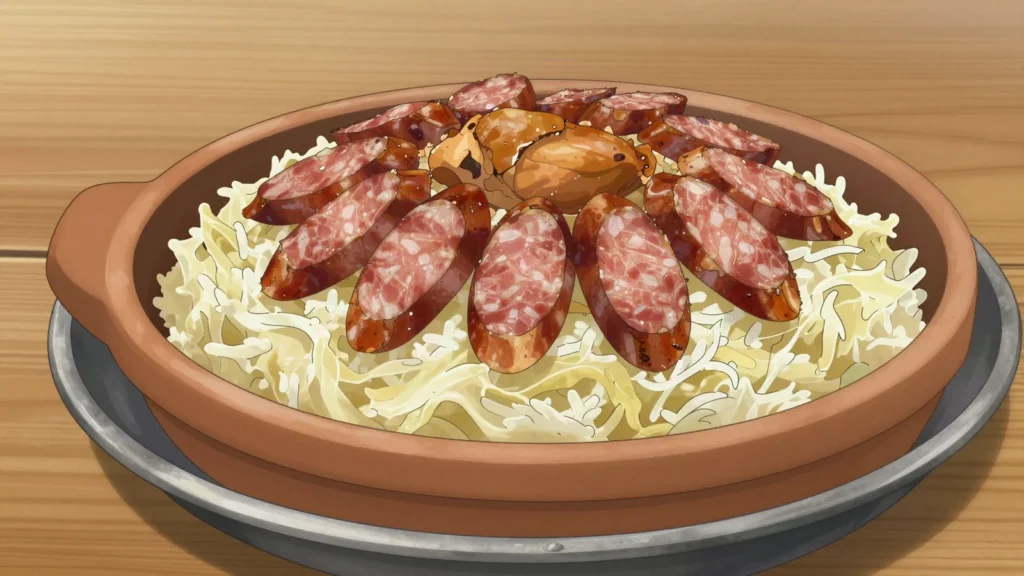
Kapama is a main from Bulgaria: layers of meats, sauerkraut and rice sealed in a pot and baked. A speciality of Bansko in the Pirin mountains, sealed with dough and baked for hours for the Christmas table.
How long does Kapama take to make?
Kapama takes 45 minutes of preparation and 3 hours of cooking. The recipe makes serves 8. It is rated hard to make.
What can I substitute in Kapama?
Yes, within limits. Rabbit is traditional in Bansko and can replace some of the pork or chicken. Bought sauerkraut works well in place of barrel-fermented cabbage.
What is the most important thing to get right in Kapama?
Taste it to judge the sourness. Rinse it briefly if it is too sharp. Heat the lard in a wide heavy pan. Brown each meat separately in batches. Do not crowd the pan at any point. Lift each one out as it browns. Chicken skin needs longer than pork cubes.