
Ingredients
Wrappers
- 300 gplain flour
- 150 mlboiling water
- ½ tspsalt
Filling
- 300 gminced pork
- 200 gChinese cabbage, very finely chopped
- 1 tspsalt, for the cabbage
- 60 gnira, chopped
- 2 clovesgarlic, crushed
- 1 tbspgrated ginger
- 1 tbspsoy sauce
- 1 tbspsake
- 1 tspsesame oil
- 1 tspsugar
- white pepper
To cook
- 1 tbspoil
- 100 mlwater
- 1 tspplain flour
Dipping
- soy sauce
- rice vinegar
- rayu chilli oil
Directions
- Chop the cabbage very finely, toss it with the salt, leave it 20 minutes, then squeeze it out hard in a cloth.
- Squeeze the cabbage genuinely dry. Water left in it leaks during cooking, steams the filling into a loose mess and softens the wrapper from the inside.
- Mix the pork with the soy, sake, sesame oil, sugar, garlic, ginger and pepper, and beat it in one direction for a minute until it turns sticky.
- Beating in one direction develops the protein and gives a springy filling that holds together, instead of a crumbly one that falls apart.
- Fold in the squeezed cabbage and the garlic chives.
- For the wrappers, pour the boiling water into the salted flour, mix, knead for 10 minutes, rest 30 minutes, then roll very thin and cut 9 cm circles.
- Put a teaspoon of filling in the centre of a wrapper and wet the edge with water.
- Fold it in half and pleat only the front edge, five or six pleats, pressing each against the flat back edge.
- Pleat one side only. The flat back gives the dumpling a straight base to stand on, and that flat bottom is what lets it fry evenly.
- Stand each finished gyoza on a floured tray as you go.
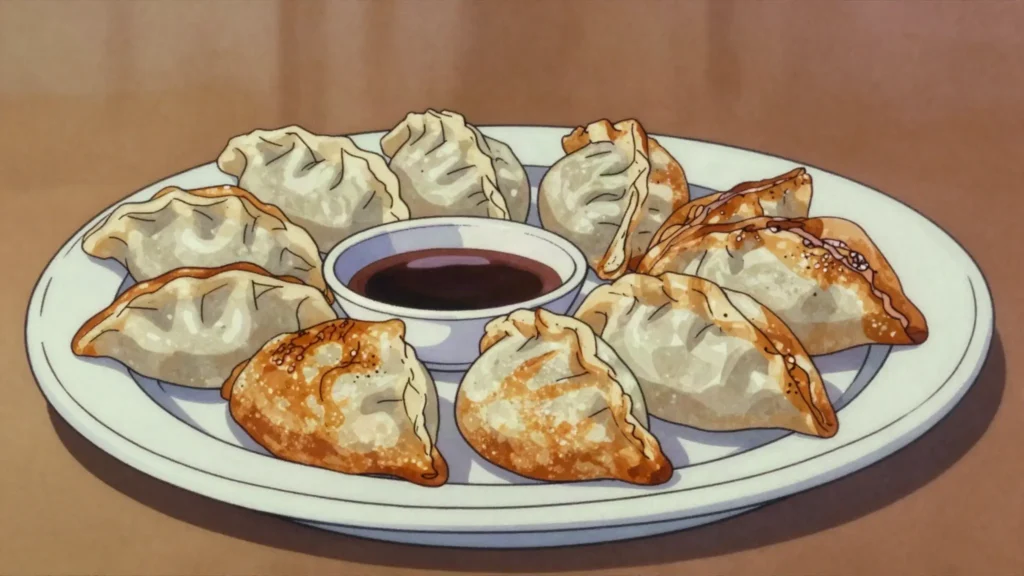
- Heat the oil in a non-stick or well-seasoned pan and set the gyoza in rows or a circle, flat side down.
- Fry for 2 minutes without moving them, until the bottoms are golden.
- Mix the teaspoon of flour into the water, pour it in, and cover immediately.
- That flour in the water is what makes the hanetsuki, the lace skirt: it crisps into a thin golden web joining the dumplings together.
- Steam covered for 6 to 7 minutes, until the water has gone.
- Uncover, add a little more oil around the edge, and fry for another minute or two until the bases are deep brown and crisp and the skirt has set.
- Invert the whole panful onto a plate so that the crisp side is uppermost.
- Serve with soy sauce, rice vinegar and rayu mixed at the table.
- Soldiers repatriated from Manchuria after 1945 recreated Chinese jiaozi in Utsunomiya, which still claims the highest gyoza consumption in Japan.
Technique
- Japanese gyoza have thinner wrappers, more garlic and less filling than the Chinese jiaozi they came from.
- Nira, garlic chives, are the signature. Ordinary chives are not the same thing and taste of far less.
- Freeze them raw on a tray and cook from frozen, adding two minutes to the steaming.
Substitutions
- Shop-bought gyoza wrappers, which are excellent and used by almost everyone.
- Prawn or minced chicken in place of pork.
Variations
- Sui-gyoza, boiled and served in broth.
- Age-gyoza, deep-fried.
- Hamamatsu style, arranged in a ring with bean sprouts piled in the middle.
History
Pan-fried dumplings, filled with a mixture of ground pork, cabbage, garlic and chive, cooked so the bottom develops a crisp, golden crust while the top remains soft and steamed, documented across Japan with direct roots in Chinese jiaozi dumplings, brought to Japan significantly through returning soldiers and civilians following the end of World War Two, who had encountered the dish during Japan’s wartime presence in China. Its specifically pan-fried preparation, cooking the dumplings in a covered pan with a small amount of water before finishing uncovered to crisp the base, distinguishes Japanese gyoza from the more commonly boiled or steamed jiaozi found in China itself. Gyoza remains one of the most popular dishes in Japan today, commonly served as a side dish alongside ramen or rice.
Frequently asked questions
What is Gyoza?
Gyoza is a snack from Japan: pan-fried pork-and-chive dumplings with crisp bottoms, ramen-shop companion. Pan-fried dumplings, filled with a mixture of ground pork, cabbage, garlic and chive, cooked so the bottom develops a crisp, golden crust while the top remains soft and steamed, documented across Japan with direct roots in Chinese jiaozi dumplings, brought to Japan significantly through returning soldiers and civilians following the end of World War Two, who had encountered the dish during Japan’s wartime presence in China. Its specifically pan-fried preparation, cooking the dumplings in a covered pan with a small amount of water before finishing uncovered to crisp the base, distinguishes Japanese gyoza from the more commonly boiled or steamed jiaozi found in China itself. Gyoza remains one of the most popular dishes in Japan today, commonly served as a side dish alongside ramen or rice.
How long does Gyoza take to make?
Gyoza takes 1 hr of preparation and 12 min per batch of cooking. The recipe makes about 40 dumplings. It is rated medium to make.
What can I substitute in Gyoza?
Yes, within limits. Shop-bought gyoza wrappers, which are excellent and used by almost everyone. Prawn or minced chicken in place of pork.
What is the most important thing to get right in Gyoza?
Beating in one direction develops the protein and gives a springy filling that holds together, instead of a crumbly one that falls apart.