
Ingredients
The beef
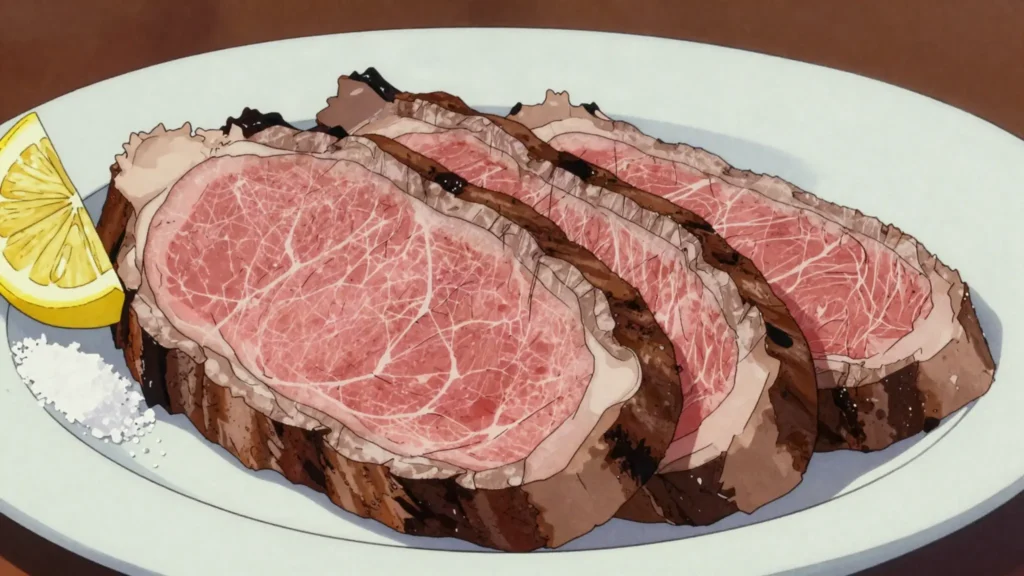
- 300 gwagyu beef
- sirloin or ribeye
- cut about 2 cm thick
- or thin slices for sukiyaki
- at room temperature
- note that 75 g per person is a portion
The seasoning
- flaky sea salt
- or Japanese sea salt
- freshly ground black pepper
- or sansho pepper
- wasabi, freshly grated if possible
For cooking
- a heavy cast iron pan
- or a hot grill
- a small piece of the beef fat
- trimmed from the edge
- or nothing at all
To serve
- steamed short-grain rice
- a simple pickled vegetable
- grated daikon with ponzu
- a light miso soup
- watercress or a sharp leaf
Directions
- Take it out of the fridge beforehand. Give it thirty minutes at room temperature. Use a heavy cast iron frying pan. Heat it until it is genuinely hot. Do not add oil or butter to the pan.
- Trim a small piece of fat from the edge. Rub it over the hot pan and discard it. That is all the fat you will ever need.
- Season it simply and season it late. Salt and pepper is the whole treatment. Use good flaky salt if you have it. Season just before it hits the pan. Do not marinate the wagyu at all.
- Lay the beef in the very hot pan. You should hear an immediate fierce sizzle. Turn on the extractor fan as well.
- Sear it for about ninety seconds a side. So it needs less time than you expect.
- Cut it into small pieces or thin slices. Cut across the grain of the muscle. Serve it with steamed short-grain rice.
- Serve grated daikon with ponzu alongside. Serve a simple pickle as well. Sukiyaki uses very thin slices of wagyu. Keep it wrapped and very cold. It freezes reasonably if wrapped tightly.
Technique
- Wagyu means Japanese cattle — four native breeds, overwhelmingly Japanese Black. It is a breed term, not a place term, and that causes real confusion. Much beef sold as wagyu outside Japan is crossbred, often with Angus, and has far less marbling than Japanese purebred. Labelling rules differ by market, so the word alone tells you very little. Ask about origin, purity and grade.
- Kobe is not a synonym for wagyu. It is a brand requiring Tajima-strain Japanese Black raised in Hyogo Prefecture and meeting specific grading thresholds, and very little is exported. Restaurants abroad claim it far more often than it exists. Matsusaka and Omi work the same way, like wine appellations.
- The stories about massaged cattle, beer and music are largely marketing rather than standard practice. The marbling comes from genetics and from a long careful feeding period — thirty months or more, well beyond most beef cattle.
- Seventy-five grams is a portion. Treating wagyu as a Western-sized steak is the commonest mistake and it wastes the meat: the fat content is overwhelming in quantity, which is exactly why Japan serves it in small pieces as one course among several.
- Add no oil or butter to the pan. Wagyu renders enormous quantities of its own fat, and added fat just makes it swim and smoke. Rub the hot pan with a trimmed piece of the beef fat if you want anything at all.
- It cooks faster than lean beef, because the rendering fat conducts heat quickly. Ninety seconds a side is often enough, and it should be rare to medium rare — cooked further, the fat renders out entirely and you are left with dry meat, which is worse than a good ordinary steak.
- Rest it briefly, three or four minutes at most. A long rest lets the fat set again, which is the opposite of what you want.
- Do not marinate it or serve it with a heavy sauce. Something sharp alongside — grated daikon with ponzu, a pickle, wasabi — is essential, but covering the beef defeats the purpose.
- It will smoke heavily. Open a window and run the extractor before you start, and expect the smoke alarm.
- Higher grade is not automatically better eating. A5 requires very high marbling and many people find it too rich in any quantity; A4 is often more enjoyable, and that is a common view rather than a compromise.
- Japan largely avoided eating meat for centuries under Buddhist and Shinto influence, with official bans at various times, and cattle were working animals. The Meiji government lifted the ban in 1872 as a deliberate modernising signal. Wagyu as beef is only about a hundred and fifty years old.
Substitutions
- Australian or American wagyu, usually crossbred, is far cheaper and more available than Japanese purebred. It is genuinely good beef and it is not the same thing.
- A well-marbled ordinary sirloin cooked the same way gives an excellent steak; the atlas does not pretend it is wagyu.
- Thin slices replace steaks for sukiyaki, shabu shabu or yakiniku, all of which suit the meat better than a large steak.
- Sansho pepper replaces black pepper for a more Japanese seasoning.
- Grated daikon with ponzu, a sharp pickle, or watercress all serve as the acidic element; something of the kind is needed.
- Most wasabi sold outside Japan is coloured horseradish. Real grated wasabi is milder, sweeter and quite different.
Variations
- Sukiyaki cooks paper-thin wagyu in a sweet soy broth at the table, dipped in raw beaten egg.
- Shabu shabu swirls thin slices briefly in a light hot broth.
- Yakiniku grills small pieces over charcoal at the table with dipping sauces.
- Wagyu nigiri, a thin seared slice over sushi rice, is a modern restaurant preparation.
- Gyudon, the beef and onion rice bowl, uses ordinary beef but is the everyday Japanese beef dish.
- Beef tataki, seared briefly outside and raw within, is another way of serving good beef in small quantity.
History
Draft cattle became beef breeds after the 1872 Meiji lifting of the meat ban; Kobe, Matsusaka and Omi built strict lineage-based branding.
Frequently asked questions
What is Wagyu Beef?
Wagyu Beef is a main from Japan: intensely marbled beef from Japanese black cattle, seared in small rich portions. Draft cattle became beef breeds after the 1872 Meiji lifting of the meat ban; Kobe, Matsusaka and Omi built strict lineage-based branding.
How long does Wagyu Beef take to make?
Wagyu Beef takes 20 minutes of preparation and 10 minutes of cooking. The recipe makes serves 4 as a small course. It is rated medium to make.
What can I substitute in Wagyu Beef?
Yes, within limits. Australian or American wagyu, usually crossbred, is far cheaper and more available than Japanese purebred. It is genuinely good beef and it is not the same thing. A well-marbled ordinary sirloin cooked the same way gives an excellent steak; the atlas does not pretend it is wagyu. Thin slices replace steaks for sukiyaki, shabu shabu or yakiniku, all of which suit the meat better than a large steak. Sansho pepper replaces black pepper for a more Japanese seasoning. Grated daikon with ponzu, a sharp pickle, or watercress all serve as the acidic element; something of the kind is needed. Most wasabi sold outside Japan is coloured horseradish. Real grated wasabi is milder, sweeter and quite different.
What is the most important thing to get right in Wagyu Beef?
Take it out of the fridge beforehand. Give it thirty minutes at room temperature. Use a heavy cast iron frying pan. Heat it until it is genuinely hot. Do not add oil or butter to the pan.