
Ingredients
Dough
- 1 kgplain flour
- 200 gsugar
- 200 gbutter, softened
- 4eggs
- 15 ginstant yeast
- 350 mlmilk
- 1 tspaniseed, ground
- zest of 1 orange
- 1 tspsalt
Filling
- 400 gguava paste, dulce de leche or blackberry jam
To finish
- 1egg yolk beaten with milk
- royal icing in several colours
Directions
- Warm the milk with the ground aniseed and let it infuse for 10 minutes, then strain it.
- Aniseed is what marks these out from ordinary sweet bread, and infusing it in the milk spreads it evenly instead of leaving hard seeds in the crumb.
- Make an enriched dough with the flour, sugar, yeast, eggs, orange zest, salt and the warm aniseed milk, then work in the softened butter a piece at a time.
- Add the butter only once the dough is already smooth. Put in at the start it coats the flour and the dough never develops enough strength to hold a shape.
- Knead for 12 to 15 minutes until smooth and elastic, then prove for 1 hour 30 minutes until doubled.
- Divide the dough and roll each piece into a fat oval about 20 cm long.
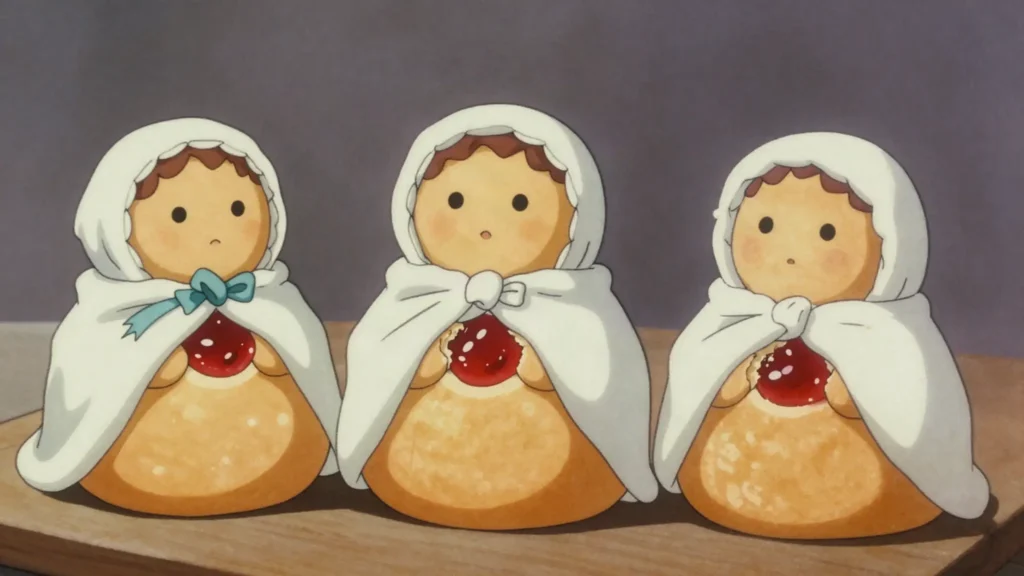
- Pinch a narrower neck about a third of the way down to make a head, and flatten the body slightly.
- The shape is a swaddled child, which is what guagua means in Kichwa. That neck is the entire silhouette, and without it you have a bread roll.
- Cut a slit along the underside of the body, open it out, pipe in the guava paste or jam, then pinch it closed and turn it back over.
- Fill it from underneath. Filled from the top, the seam splits open in the oven and the jam runs out across the face.
- Prove for a further 45 minutes.
- Brush with the egg yolk glaze.
- Bake at 180°C (355°F) for 20 to 25 minutes, until deep golden.
- Cool them completely before decorating, because icing slides straight off warm bread.
- Pipe faces and swaddling bands in coloured royal icing.
- They are baked for the Day of the Dead in early November and eaten with colada morada, and in Ecuador that pairing is not optional.
Technique
- Colada morada, the drink they are eaten with, is a spiced purple fruit drink thickened with black maize flour.
- Guagua is Kichwa for baby, the same root that gives Chile and Argentina their word for a bus.
- Many families bake plain unfilled ones for small children and keep the jam versions for adults.
Substitutions
- Any thick fruit jam that will not run.
- A brioche dough at a pinch, adding the aniseed and orange zest to it.
Variations
- T’anta wawa, the Peruvian and Bolivian equivalent.
- Plain and unfilled, dusted with sugar.
- Made as one large loaf for the whole family.
History
Baked for the Day of the Dead in November and eaten with colada morada, an Andean rite of the dead.
Frequently asked questions
What is Guaguas de pan?
Guaguas de pan is a bread & pastry from Ecuador: sweet bread shaped like swaddled babies, filled with jam. Baked for the Day of the Dead in November and eaten with colada morada, an Andean rite of the dead.
How long does Guaguas de pan take to make?
Guaguas de pan takes 40 min plus 2 hr 15 min rising of preparation and 25 min of cooking. The recipe makes about 10. It is rated medium to make.
What can I substitute in Guaguas de pan?
Yes, within limits. Any thick fruit jam that will not run. A brioche dough at a pinch, adding the aniseed and orange zest to it.
What is the most important thing to get right in Guaguas de pan?
Aniseed is what marks these out from ordinary sweet bread, and infusing it in the milk spreads it evenly instead of leaving hard seeds in the crumb.