
Ingredients
Dough
- 250 gsamneh or clarified butter, soft
- 120 gicing sugar
- 400 gplain flour
- 3small tears of mastic, optional
To finish
- about 30 blanched pistachios
Directions
- Beat the samneh on its own for 5 minutes first, until it visibly whitens.
- Add the icing sugar and beat for another 10 minutes, until the mixture is pale and mousse-like and holds a soft peak.
- This long beating is the whole technique. Nothing else lifts the biscuit, and Levantine bakers judge the mixture by whether it holds that peak before the flour goes anywhere near it.
- If you are using mastic, grind the tears to a powder with a spoonful of the sugar and beat it in.
- Grind mastic with sugar rather than alone. It is a resin and it gums up instantly against a bare pestle, but with sugar it powders cleanly.
- Fold in the sifted flour just until it comes together into a soft, smooth dough.
- Rest it for 30 minutes at cool room temperature.
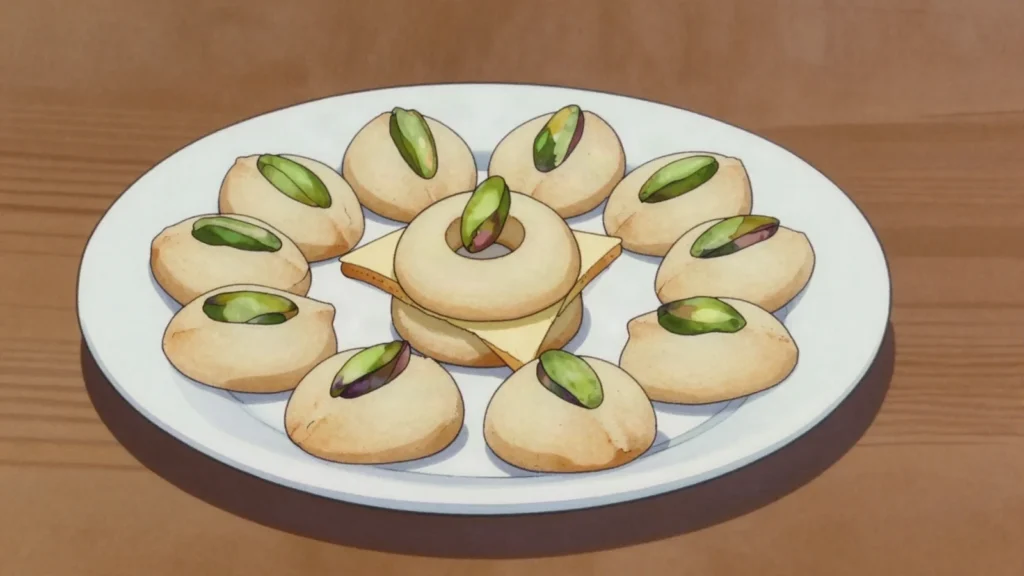
- Roll ropes about as thick as a finger and join the ends into rings, or bend them into S curves, or simply roll balls.
- The ring is the older shape, and it is why the biscuit appears stacked into a wreath in Levantine bakery windows.
- Press a blanched pistachio into the join of each.
- Bake at 150°C (300°F) for 20 minutes.
- Take them out while still pale, with no colour anywhere except perhaps the faintest cream at the very base.
- Cool them completely on the tray before lifting, because they hold together only once cold.
- The Egyptian ghorayeba is the same biscuit, usually round and finished with an almond rather than a pistachio.
Technique
- The ratio of fat to flour is very high, and that alone is what makes it short. Reducing the samneh gives an ordinary biscuit.
- The name transliterates a dozen ways across the Levant, all from the same root meaning strange or swooning.
- It is made for Eid in Syria, Lebanon, Jordan and Palestine, in slightly different shapes in each.
Substitutions
- Butter, clarified and cooled until soft and creamy.
- Omit the mastic entirely if you cannot find it; it is a grace note, not a foundation.
Variations
- Ghorayeba, the Egyptian version.
- Scented with rose water or orange blossom.
- Filled with pistachio paste before shaping.
History
Made across the Levant for Eid, its texture depending on clarified butter rather than egg.
Frequently asked questions
What is Ghraybeh?
Ghraybeh is a dessert from Syria: pale melting shortbread of ghee and sugar, often marked with a pistachio. Made across the Levant for Eid, its texture depending on clarified butter rather than egg.
How long does Ghraybeh take to make?
Ghraybeh takes 30 min plus 30 min resting of preparation and 20 min of cooking. The recipe makes about 30 biscuits. It is rated medium to make.
What can I substitute in Ghraybeh?
Yes, within limits. Butter, clarified and cooled until soft and creamy. Omit the mastic entirely if you cannot find it; it is a grace note, not a foundation.
What is the most important thing to get right in Ghraybeh?
This long beating is the whole technique. Nothing else lifts the biscuit, and Levantine bakers judge the mixture by whether it holds that peak before the flour goes anywhere near it.