
Ingredients
Milk
- 5 litreslow-fat cow milk, or milk skimmed to about 1 to 1.5 per cent fat
- ¼ tspmesophilic starter culture, or 100 ml live matsun
- 2.5 mlsingle-strength liquid rennet (use a microbial rennet to keep the cheese vegetarian), diluted in 50 ml cool unchlorinated water
Stretching and brining
- 4 litreswater at 70 to 75°C (165°F), for the stretch bath
- 1 litrewater with 180 g salt (an 18 per cent brine), cooled
Optional finish
- cold smoke over fruitwood at under 25°C (75°F) for 4 to 6 hours
Directions
- Warm the milk to 32°C (90°F), stir in the starter and ripen for 45 minutes; the acidity you build now is what will let the curd stretch later.
- Add the diluted rennet, stir for 30 seconds, and leave undisturbed for 40 to 50 minutes, until the curd gives a clean break.
- Cut the curd into 1 cm cubes, rest 5 minutes, then stir gently and raise the temperature to 38°C (100°F) over 20 minutes. Hold and stir for another 20 minutes until the grains firm up.
- Drain off the whey, gather the curd into a slab, and let it mat in the warm pot, turning it every 20 minutes for 2 to 3 hours until the pH falls to about 5.2. Test a small piece in hot water: when it stretches into a shiny rope instead of tearing, it is ready.
- Cut the ripened curd into slices and drop them into the 70 to 75°C (165°F) water. Work them with a wooden spoon until they fuse into one glossy, elastic mass.
- Lift the mass and stretch it repeatedly into a long rope, folding and pulling with wet hands, dipping it back in the hot water when it stiffens. Then pull the rope out into a wide sheet and shear it lengthways into threads 1 to 2 mm thick.
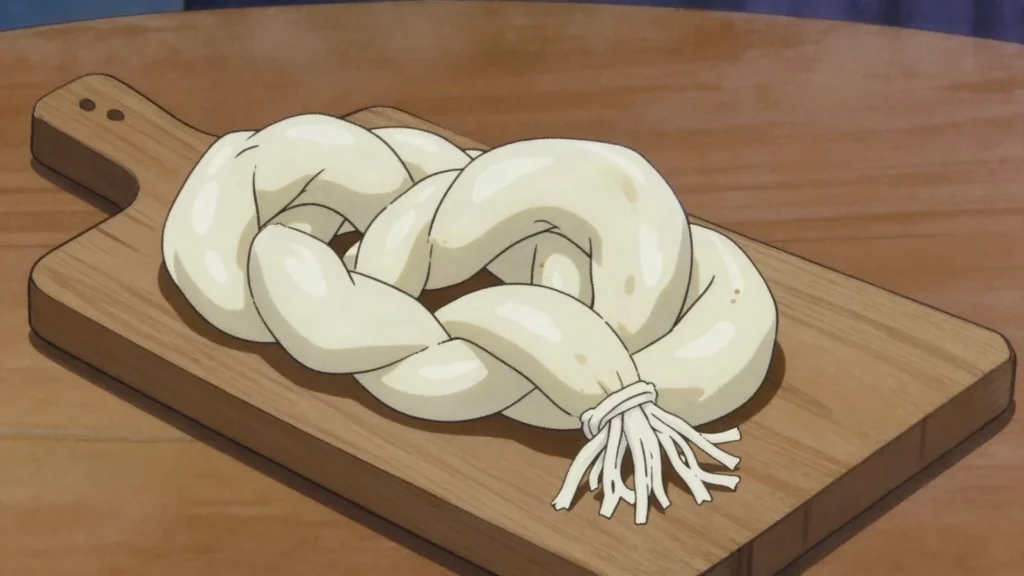
- Gather the threads into a hank, twist it and braid it while still warm and pliable; once it cools it will not take a shape.
- Drop the braids into the cold 18 per cent brine for 12 to 24 hours, depending on thickness, then drain. Eat within a week, or cold-smoke the braids for the smoked version sold with beer.
Technique
- Chechil is deliberately made from low-fat milk. Fat interferes with the protein fibres, so a full-fat milk gives a soft, pasta filata cheese that will not shred into fine threads.
- The stretch test is the only reliable readiness check. Rush the acidification and the curd shreds into crumbs; overshoot and it dissolves in the hot water.
- It is very salty by design, sold at bars across Armenia and the South Caucasus as something to pull apart and eat with beer. Soak it briefly in cold milk or water if it is too salty to eat straight.
- Use microbial or fermentation-produced rennet if you need the cheese to be vegetarian; the traditional coagulant is animal-derived.
Substitutions
- For a much quicker approximation, use 1 kg of fresh unsalted mozzarella curd from a cheesemaker, stretch it in hot water and shred and braid it the same way.
Variations
- Smoked chechil, cold-smoked to a deep amber, is the version most often exported and is noticeably saltier.
- In Syunik the braid is sometimes made with a layer of herbs or nigella seeds worked into the threads before plaiting.
History
Brined pulled-curd cheese plaited into ropes; the smoked version travels well and is sold along Armenian roadsides.
Frequently asked questions
What is Chechil?
Chechil is a cheese & dairy from Armenia: salty string cheese pulled into threads and braided, sometimes smoked. Brined pulled-curd cheese plaited into ropes; the smoked version travels well and is sold along Armenian roadsides.
How long does Chechil take to make?
Chechil takes 1 hr active of preparation and 3 hr making plus 1 to 2 days brining of cooking. The recipe makes about 600 g of braided cheese, from 5 litres of milk. It is rated hard to make.
What can I substitute in Chechil?
Yes, within limits. For a much quicker approximation, use 1 kg of fresh unsalted mozzarella curd from a cheesemaker, stretch it in hot water and shred and braid it the same way.
What is the most important thing to get right in Chechil?
Drain off the whey, gather the curd into a slab, and let it mat in the warm pot, turning it every 20 minutes for 2 to 3 hours until the pH falls to about 5.2. Test a small piece in hot water: when it stretches into a shiny rope instead of tearing, it is ready.