Ingredients
Poolish
- 150 gstrong white flour
- 150 mlwater
- 2 gfresh yeast or ½ tsp dried
Dough
- 600 gstrong white flour
- 350 mlwarm water
- 10 gfresh yeast or 5 g dried
- 2 tspfine salt
- 1 tbspsunflower oil
Glaze (katnahunts)
- 1 tspplain flour
- 150 mlwater
- 1 tspsugar
Directions
- Mix the poolish the night before and leave it at room temperature 8–12 hours, until it is domed, bubbling and smells sharply of yoghurt. This long pre-ferment gives matnakash its flavour and its keeping quality.
- Combine the poolish with the dough flour, water and yeast and mix to a shaggy mass, then rest 20 minutes before working in the salt and oil.
- Knead 10 minutes to a soft, slack dough that is noticeably wetter than a sandwich loaf, around 72% hydration. Resist adding flour: the high water is what gives the open, chewy crumb.
- Bulk ferment 1 hour 30 minutes in an oiled bowl, folding the dough over on itself every 30 minutes, until it has roughly doubled and feels airy.
- Whisk the glaze flour into the cold water, bring it to a boil and simmer 1 minute with the sugar until it thickens to a thin, translucent paste. Cool it. This is what gives the loaf its glossy, deep-brown skin.
- Divide in two, shape each piece into a loose oval about 30 cm long on a floured tray, and prove 45 minutes until puffy and slow to spring back.
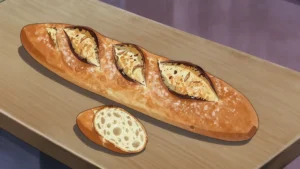
- Brush the tops with the cooled glaze, then draw the ridges: with wetted fingers, press right down to the tray to mark a border a thumb’s width inside the edge, then two or three long grooves down the length. The name means drawn by hand, and the marks must be deep or they will close up in the oven.
- Bake at 230°C (450°F) with a tray of water in the oven for the first 10 minutes, then 200°C (400°F) for a further 20–25 minutes, until the loaf is a deep even brown, sounds hollow when tapped underneath and reads 96°C (205°F) inside. Cool on a rack.
Technique
- The flour glaze, not egg or milk, is what produces the characteristic matt-glossy mahogany crust. Egg wash gives a shinier, more brittle finish that is not right for this loaf.
- Press the finger grooves firmly to the base of the loaf. A timid touch vanishes during the oven spring and you end up with an ordinary oval loaf.
- Matnakash is traditionally baked on the wall of a tonir, which is why it is flat and oval rather than tall; a domestic oven with steam gets close.
- It is the everyday table bread of Armenia, torn rather than sliced, and it stales quickly, which is why it is bought daily.
Substitutions
- No time for a poolish? Use 15 g fresh yeast in the main dough and add 100 g of the flour as a 1-hour sponge, accepting a plainer flavour.
- Cornflour can replace the plain flour in the glaze for a slightly glassier shine.
Variations
- A wholemeal matnakash, made with a quarter wholemeal flour, denser and nuttier.
- Sesame matnakash, sprinkled after glazing, common in Yerevan bakeries.
History
The name means finger-drawn; the grooves are pressed by hand before the loaf goes into the oven.
Frequently asked questions
What is Matnakash?
Matnakash is a bread & pastry from Armenia: soft oval loaf marked with deep finger-drawn ridges across the top. The name means finger-drawn; the grooves are pressed by hand before the loaf goes into the oven.
How long does Matnakash take to make?
Matnakash takes 30 min of preparation and 3 hr 30 min of cooking. The recipe makes 2 loaves. It is rated medium to make.
What can I substitute in Matnakash?
Yes, within limits. No time for a poolish? Use 15 g fresh yeast in the main dough and add 100 g of the flour as a 1-hour sponge, accepting a plainer flavour. Cornflour can replace the plain flour in the glaze for a slightly glassier shine.
What is the most important thing to get right in Matnakash?
Brush the tops with the cooled glaze, then draw the ridges: with wetted fingers, press right down to the tray to mark a border a thumb’s width inside the edge, then two or three long grooves down the length. The name means drawn by hand, and the marks must be deep or they will close up in the oven.