
Ingredients
Herb butter
- 150 gunsalted butter, softened
- 3 tbspfinely chopped dill
- 2 tbspfinely chopped parsley
- 2garlic cloves, crushed (optional – the oldest versions use none)
- ½ tspsalt
- Squeeze of lemon juice
Chicken
- 4chicken breasts, skinless, ideally with the wing drumette bone left attached
- 1 tspsalt
- ½ tspwhite pepper
Coating and frying
- 100 gplain flour
- 3eggs, beaten with 1 tbsp milk
- 200 gfine dry white breadcrumbs
- 1 litreneutral oil, for deep-frying
- 50 gclarified butter (optional, for basting)
Directions
- Beat the softened butter with the herbs, garlic, salt and lemon, roll it into a tight cylinder in cling film and freeze until rock hard, at least 1 hour. Cut into 4 batons.
- Butterfly each chicken breast horizontally without cutting through, open it out, cover with cling film and beat it with a mallet or rolling pin to an even 5 mm – working from the centre outwards, firmly but without tearing holes.
- Season the flattened meat, lay a frozen butter baton at one end, fold in the sides and roll it up tightly into a fat cigar, keeping the wing bone protruding if you have it.
- Wrap each roll very tightly in cling film, twisting the ends like a cracker, and chill 30 minutes so it holds its shape.
- Unwrap and coat in flour, then egg, then breadcrumbs. Then repeat the egg and breadcrumbs a second time. A double coating is what keeps the butter in – a single one splits under pressure.
- Chill the crumbed rolls uncovered for at least 1 hour, or overnight, so the crust dries and sets firm.
- Heat the oil to 165°C (325°F) and fry two at a time for 7–8 minutes, turning, until deep golden. A lower temperature than usual is deliberate: the crumb must not colour before the centre reaches 74°C (165°F).
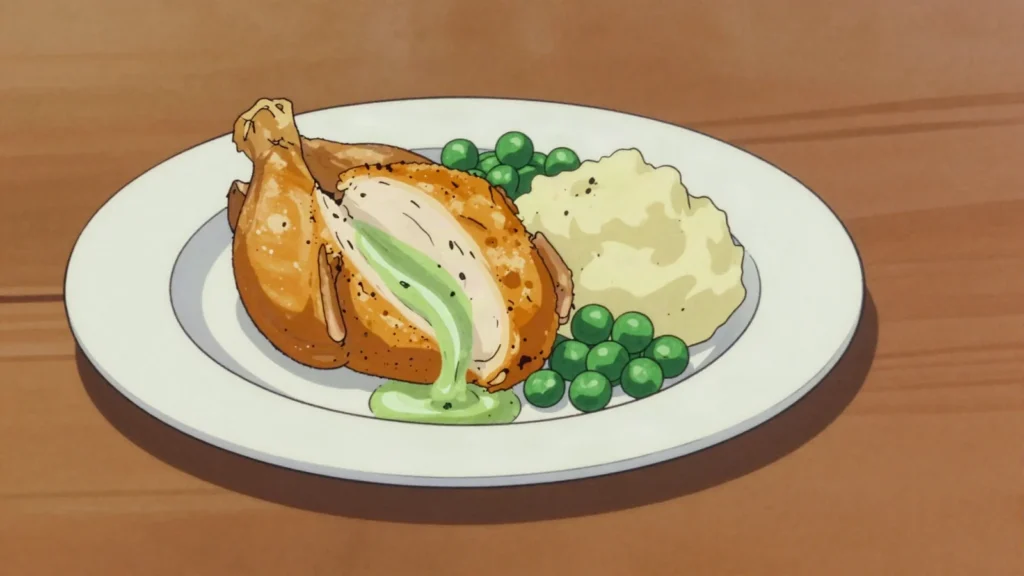
- Drain and rest 3 minutes, then serve at once – the whole point is the jet of green herb butter that shoots out when the crust is pierced, so warn whoever is sitting opposite. Traditional accompaniments are mashed or straw potatoes and green peas.
Technique
- Any tear or gap in the meat is a leak waiting to happen. Patch holes with a scrap of beaten-out chicken before rolling, and seal the seam by pressing firmly.
- Freezing the butter and chilling the crumbed roll are both non-negotiable. Warm butter melts before the crust sets and floods the pan.
- The dish’s origins are disputed: it is usually traced to a Kyiv restaurant kitchen in the early twentieth century, drawing on the French côtelette de volaille, though several cities claim it. The English spelling shifted from Kiev to Kyiv after 2019.
Substitutions
- No wing bone? Use plain skinless breasts – the bone is decorative and a serving handle, not structural.
- The rolls can be baked at 200°C (400°F) for 22–25 minutes on a rack after a brief shallow fry to set the crumb, though the crust is less even.
Variations
- A mushroom and butter filling, or one with grated hard cheese folded through the herb butter.
- Kotleta po-kyivsky made with minced chicken shaped around the butter, the everyday canteen version.
History
A boneless chicken breast, pounded thin, wrapped tightly around a piece of cold herb butter, then breaded and fried so the butter melts into liquid inside the crisp shell once cut open, generally credited to Kyiv, the capital of Ukraine, though the dish’s precise origin is genuinely disputed, with some food historians tracing its roots to earlier French culinary technique adapted within Russian and Ukrainian aristocratic and later Soviet-era restaurant cooking during the 1900s. Its name became internationally established during the Soviet period, when the dish was served and popularized across Soviet restaurants and later exported internationally as a specifically Soviet-Ukrainian specialty. The dramatic butter release when the chicken is cut open is considered the dish’s signature, most memorable feature.
Frequently asked questions
What is Chicken Kyiv?
Chicken Kyiv is a main from Ukraine: breaded chicken cutlet gushing herb butter when cut. A boneless chicken breast, pounded thin, wrapped tightly around a piece of cold herb butter, then breaded and fried so the butter melts into liquid inside the crisp shell once cut open, generally credited to Kyiv, the capital of Ukraine, though the dish’s precise origin is genuinely disputed, with some food historians tracing its roots to earlier French culinary technique adapted within Russian and Ukrainian aristocratic and later Soviet-era restaurant cooking during the 1900s. Its name became internationally established during the Soviet period, when the dish was served and popularized across Soviet restaurants and later exported internationally as a specifically Soviet-Ukrainian specialty. The dramatic butter release when the chicken is cut open is considered the dish’s signature, most memorable feature.
How long does Chicken Kyiv take to make?
Chicken Kyiv takes 40 min of preparation and 1 hr 30 min chilling plus 20 min cooking of cooking. The recipe makes 4 servings. It is rated hard to make.
What can I substitute in Chicken Kyiv?
Yes, within limits. No wing bone? Use plain skinless breasts – the bone is decorative and a serving handle, not structural. The rolls can be baked at 200°C (400°F) for 22–25 minutes on a rack after a brief shallow fry to set the crumb, though the crust is less even.
What is the most important thing to get right in Chicken Kyiv?
Heat the oil to 165°C (325°F) and fry two at a time for 7–8 minutes, turning, until deep golden. A lower temperature than usual is deliberate: the crumb must not colour before the centre reaches 74°C (165°F).