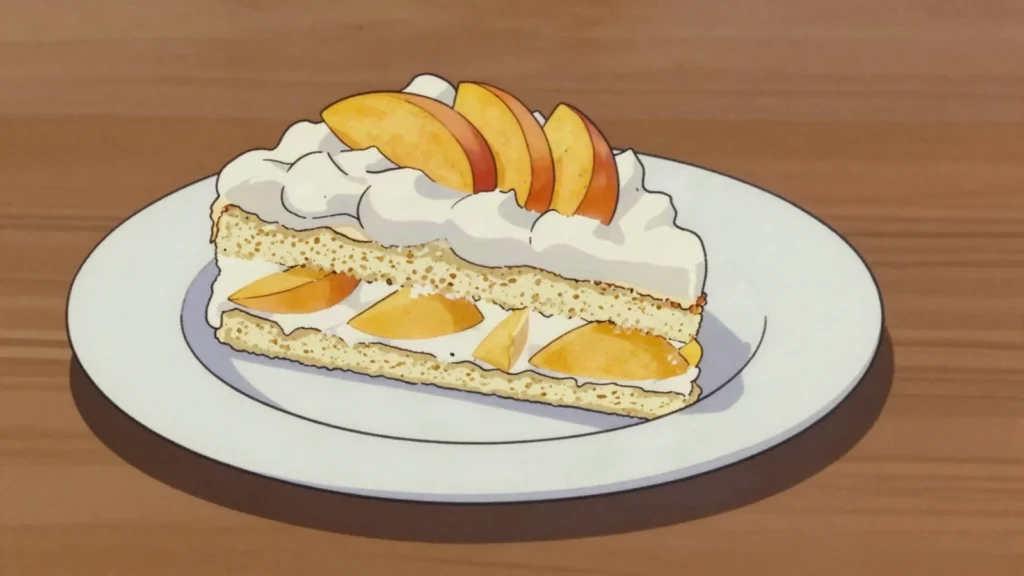

Ingredients
Sponge
- 6eggs, separated
- 180 gcaster sugar
- 180 gplain flour
- 1 tspvanilla extract
Meringue
- 4egg whites
- 200 gcaster sugar
Syrup
- 100 mlpeach syrup from the tin
- 50 mlwater
- 2 tbspsugar
Filling
- 800 mldouble cream
- 60 gicing sugar
- 1large tin peaches in syrup, drained and sliced
- 200 gdulce de leche, optional
Directions
- Make the meringue first, because it needs the longest. Whisk the whites to soft peaks, add the sugar a spoonful at a time and whisk to a stiff, glossy meringue.
- Spread it thinly on lined trays and dry it at 100°C (210°F) for 2 hours, until it is completely crisp the whole way through with no chewy centre.
- Cool it and then crush it into pieces roughly the size of a fingernail.
- Do not reduce it to powder. Those crisp shards through the cream are the entire texture of a chajá, and dust simply dissolves into it and disappears.
- For the sponge, whisk the yolks with half the sugar until pale and thick, whisk the whites with the remaining sugar to soft peaks, and fold the two together with the sifted flour and vanilla.
- Bake in a lined 22 cm tin at 180°C (355°F) for 25 minutes, then cool it and slice it horizontally into three discs.
- Warm the peach syrup with the water and sugar and brush it generously over every disc. Unsoaked sponge in a chajá is dry sponge, and there is a lot of it.
- Whip the cream with the icing sugar to soft peaks and stop there, because it firms further as the cake chills.
- Assemble in layers: sponge, cream, peaches, sponge, cream, peaches, sponge.
- Cover the whole cake, top and sides, in the remaining cream.
- Press the crushed meringue all over it until no cream shows anywhere.
- Chill for at least 4 hours before serving.
- Eat it the day it is made. The meringue softens against the cream overnight, and once that happens the cake has lost the one thing that makes it a chajá.
Technique
- Crush the meringue, do not powder it, and put it on at the last stage.
- It was created in 1927 by the confectioner Orlando Castellano in Paysandú, and named after the chajá bird, whose loose mass of feathers it was thought to resemble.
- Tinned peaches are traditional here rather than a compromise. The syrup is needed for soaking anyway.
Substitutions
- Shop-bought meringues, roughly crushed, which saves two hours and works well.
- Fresh peaches poached in syrup, if they are in season.
Variations
- With dulce de leche spread between the layers.
- With strawberries in place of peaches.
- Postre chajá, built in individual glasses rather than as a cake.
History
Meringue, cream and peach cake created in 1927 by the confectioner Orlando Castellano in Paysandu, named after a local bird.
Frequently asked questions
What is Chajá?
Chajá is a dessert from Uruguay: sponge, peaches, cream and crushed meringue; Paysandú creation. Meringue, cream and peach cake created in 1927 by the confectioner Orlando Castellano in Paysandu, named after a local bird.
How long does Chajá take to make?
Chajá takes 1 hr plus 4 hr chilling of preparation and 2 hr 30 min of cooking. The recipe makes 12 servings. It is rated hard to make.
What can I substitute in Chajá?
Yes, within limits. Shop-bought meringues, roughly crushed, which saves two hours and works well. Fresh peaches poached in syrup, if they are in season.
What is the most important thing to get right in Chajá?
Spread it thinly on lined trays and dry it at 100°C (210°F) for 2 hours, until it is completely crisp the whole way through with no chewy centre.