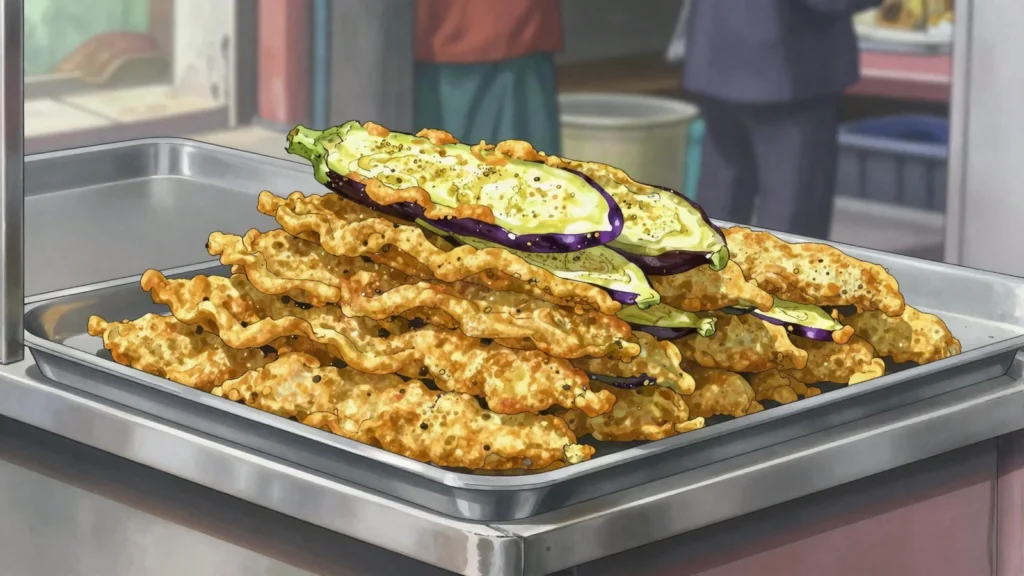

Ingredients
Aubergine
- 2large aubergines
- 1 tspsalt
- ½ tspground turmeric
Batter
- 150 ggram flour (besan)
- 2 tbsprice flour
- ½ tspground turmeric
- 1 tspchilli powder
- ½ tspground cumin
- ¼ tspbicarbonate of soda
- 1 tspsalt
- 1 tspsugar
- 180–200 mlcold water
To fry
- 700 mlmustard oil or sunflower oil
To serve
- puffed rice (muri)
- sliced onion and green chilli
- mustard oil, for drizzling
Directions
- Slice the aubergines lengthways into thin slices about 5 mm thick — thin enough to cook through in the time the batter takes to crisp, which is the trick with beguni.
- Rub the slices with the salt and turmeric and leave 20 minutes. Pat them dry with a cloth afterwards; the salt draws out water that would otherwise make the batter slide off.
- Whisk the gram flour, rice flour, spices, salt and sugar with the cold water to a smooth batter the thickness of double cream. Rest it 30 minutes, then whisk in the bicarbonate just before frying.
- The rice flour and the bicarbonate are both there for crispness — gram flour alone gives a soft, slightly heavy coating.
- Heat the oil to 180°C (350°F). If using mustard oil, bring it to smoking point first and let it cool back down, which takes the raw pungency off.
- Dip each slice in the batter, letting the excess run off, and lower it into the oil. Fry three or four at a time for 3–4 minutes, turning once, until golden and crisp.
- Drain on a rack, never on paper. Serve immediately with muri, sliced onion, green chilli and a drizzle of raw mustard oil — the standard Bengali evening snack, and popular at iftar.
Technique
- Thin slices and a thin batter. A thick slice steams inside a coating that has already browned.
- Add the bicarbonate at the last moment; its lift is gone within minutes of hitting liquid.
- Eat them within a few minutes. Beguni does not keep and does not reheat.
Substitutions
- Potato, plantain or pumpkin slices in the same batter make the wider family of bhaji.
- Sunflower oil if mustard oil is too strong, though the flavour is characteristically Bengali.
Variations
- Peyaji, the onion fritter sold from the same stall.
- A version with a slit cut in the slice and a spoonful of spiced potato tucked inside.
History
A fixture of Bangladeshi iftar stalls through Ramadan, fried in vast pans on Dhaka pavements from mid-afternoon.
Frequently asked questions
What is Beguni?
Beguni is a street food from Bangladesh: aubergine slices in gram-flour batter, deep-fried and eaten hot with muri. A fixture of Bangladeshi iftar stalls through Ramadan, fried in vast pans on Dhaka pavements from mid-afternoon.
How long does Beguni take to make?
Beguni takes 20 min plus 30 min resting of preparation and 20 min of cooking. The recipe makes 4 servings. It is rated easy to make.
What can I substitute in Beguni?
Yes, within limits. Potato, plantain or pumpkin slices in the same batter make the wider family of bhaji. Sunflower oil if mustard oil is too strong, though the flavour is characteristically Bengali.
What is the most important thing to get right in Beguni?
Rub the slices with the salt and turmeric and leave 20 minutes. Pat them dry with a cloth afterwards; the salt draws out water that would otherwise make the batter slide off.