Ingredients
The rice
- 800 gcooked rice
- cold, from the day before
- red rice if you have it
- see the safety notes carefully
- broken up with a fork
The vegetables
- whatever remains from dinner
- cooked or raw
- 1onion, sliced
- 4green chillies, sliced
- or more, to taste
- 2 handfulsspinach or greens
- 1carrot, diced small
- a handful of beans or peas
- a few mushrooms, sliced
The seasoning
- 3 tablespoonsoil
- or butter
- 2 clovesgarlic, chopped
- a thumb of ginger, grated
- optional
- salt, to taste
- 1 teaspoonchilli powder
- or to taste
Sometimes added
- 50 gdatshi
- or a soft crumbly cheese
- or feta, crumbled
- a fried egg, on top
- leftover meat, chopped
To serve
- hot from the pan
- ezay, the chilli relish
- suja, Bhutanese butter tea
Directions
- Cool cooked rice as fast as you can. Within one hour of cooking is the target. Spread it out on a tray to cool faster. The centre stays warm for hours. Use it within one day. Reheat it thoroughly, until piping hot. Discard rice left out overnight. Discard rice that smells at all off. In Bhutan the climate helps considerably.
- Take the cold rice from the fridge. Break it up thoroughly with a fork. Cold rice sets into a solid block. Work it through with your fingers if needed. Leftover cooked vegetables need no preparation.
- Chop them into bite-sized pieces. Raw vegetables need cutting small. Cut everything roughly the same size. They only need warming through. Heat a wide pan over a high heat. A wok is ideal if you have one. Add the oil and let it shimmer. Fry it hard for two minutes. It should soften and colour at the edges.
- Add the garlic and ginger. Cook them for thirty seconds only. Fry them for three or four minutes. Keep them moving in the pan. Fry them for a minute. Now add the cold rice. Add it all at once. Press the rice into the hot pan. Let it sit for thirty seconds without stirring.
- Repeat that a few times. Constant stirring gives soft steamed rice. Add any cooked vegetables or meat. Add the greens or spinach. Toss it all through thoroughly. Add salt and chilli powder.
- Taste it as you go. Now add the cheese if using it. Add it in the last minute. Toss it through so it softens. Do not cook it until it melts entirely.
- Stir it so every part is heated. Cold spots in the middle are the risk. Serve it straight from the pan. Top it with a fried egg if you like. Serve ezay on the side. It suits a cold morning genuinely well. Cook only what you will eat now. Discard any that is left over.
Technique
- Cooked rice carries a specific and genuine risk. Bacillus cereus spores are present on raw rice and survive cooking entirely; if cooked rice is left warm they germinate, multiply and produce a toxin that is heat stable. Reheating does not destroy that toxin, so frying the rice does not make it safe. The storage is what protects you.
- Cool cooked rice within an hour, spread thin on a tray rather than left in a deep pot where the centre stays warm for hours. Refrigerate it immediately, use it within a day, reheat it until piping hot throughout, and reheat it only once. Discard rice left out overnight or that smells at all off.
- Do not keep this dish. It is already reheated rice and reheating a second time is not safe. Cook only what you will eat and discard the rest.
- In Bhutan the climate helps: much of the country is high and cold, and a kitchen overnight can be genuinely cold, which is part of why the practice is safe there. In a warm kitchen, refrigerate the rice rather than leaving it out.
- Day-old rice is not only thrift — it genuinely fries better. Fresh rice is soft and wet, clumps and steams; refrigerated rice dries slightly, the grains firm up and separate, and they fry instead. That is true of fried rice everywhere.
- Break up every clump before the rice hits the pan. Cold rice sets into a solid block and those clumps never separate once frying.
- Press the rice into the hot pan and let it sit thirty seconds before tossing, repeating a few times. Constant stirring gives soft steamed rice; letting it catch gives some crisp grains, and that contrast is what makes good fried rice.
- In Bhutan chillies are a vegetable rather than a seasoning, eaten in whole large quantities — ema datshi, the national dish, is chillies cooked with cheese. Four here is moderate and a Bhutanese cook might use three times as many. Adjust to your own tolerance.
- This is a method rather than a recipe. Whatever is left from the previous dinner goes in, so it comes out differently every time. The atlas gives a version, not the version.
Substitutions
- Any leftover cold rice replaces Bhutanese red rice; the red rice is nutty and chewy and holds its shape particularly well.
- Feta, rinsed to reduce the salt, replaces datshi; any mild crumbly cheese works.
- Butter replaces oil and is common in Bhutanese cooking.
- Whatever vegetables you actually have replace the list entirely — that is the point of the dish.
- Leftover meat chopped small is added in many households.
- A fried egg on top turns it into a fuller meal.
Variations
- Ema datshi, chillies cooked with cheese, is Bhutan’s national dish and often supplies the leftovers this uses.
- Kewa datshi and shamu datshi are the potato and mushroom versions of the same cheese dish.
- A version with dried yak meat is made in the highlands.
- Ezay, the pounded chilli relish, is served alongside at most meals.
- Related leftover fried rice dishes exist across Asia, from nasi goreng to chahan, on the same principle.
- Some households add a handful of puffed rice or corn for texture.
History
A thrift dish of Bhutanese households, standard at breakfast the morning after a large meal.
Frequently asked questions
What is Zow Shungo?
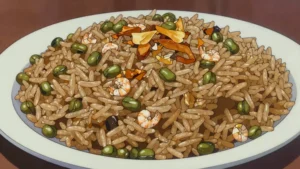
Zow Shungo is a main from Bhutan: leftover rice fried up with whatever vegetables and chillies remain from dinner. A thrift dish of Bhutanese households, standard at breakfast the morning after a large meal.
How long does Zow Shungo take to make?
Zow Shungo takes 15 minutes of preparation and 15 minutes of cooking. The recipe makes serves 4. It is rated easy to make.
What can I substitute in Zow Shungo?
Yes, within limits. Any leftover cold rice replaces Bhutanese red rice; the red rice is nutty and chewy and holds its shape particularly well. Feta, rinsed to reduce the salt, replaces datshi; any mild crumbly cheese works. Butter replaces oil and is common in Bhutanese cooking. Whatever vegetables you actually have replace the list entirely — that is the point of the dish. Leftover meat chopped small is added in many households. A fried egg on top turns it into a fuller meal.
What is the most important thing to get right in Zow Shungo?
Taste it as you go. Now add the cheese if using it. Add it in the last minute. Toss it through so it softens. Do not cook it until it melts entirely.