
Ingredients
The leaves
- 600 gcassava leaves
- pounded, fresh or frozen
- see the notes
- or 400 g frozen pounded leaf
The beans
- 400 gdried white beans
- soaked overnight
- or 2 tins, drained
The rest
- 2onions, chopped
- 4garlic cloves, crushed
- 150 mlred palm oil
- 1hot chilli, optional
- 1stock cube
- or salt
- about 1 litre water
Sometimes added
- smoked fish, flaked
- or dried shrimp
- 1aubergine, diced
- chopped leek
Directions
- Cook it the full time regardless. It is dense, sour and quite firm. Strip the leaves from their stems. Pull the leaf away from the stem. Discard all of the stems entirely. Wash all the leaves thoroughly. Wash them in several changes of water.
- Pick out any of the damaged leaves. Drain them all well afterward. Pound the leaves in a large mortar. Work them until they break down entirely. That takes real time and effort. Keep working until it is a paste. Process it until entirely broken down. Add a splash of water to help it. Cooking the beans is done alongside.
- Drain and rinse the soaked beans. Discard all of the soaking water. Rinse them under fresh cold water. Boil the beans until fully tender. Soaked white beans take about an hour. Salt slows their softening considerably. Season only once they are soft. Put the pounded leaves in a large pot.
- Cover them well with plenty of water. Use plenty of water at the start. Add more water as it cooks down. Never let the pot boil right dry. Bring the pot up to a steady boil. A gentle simmer is not enough here. Keep it boiling steadily throughout. Boil it for at least ninety minutes. Two hours is genuinely better still. Leave the pot uncovered as it boils. Cook it uncovered right throughout.
- Cook it in a well ventilated kitchen. Start with more than seems needed. Add the red palm oil to the pot. Add it partway through the cooking. About one hour in is about right. Add the chopped onion and garlic. Stir the cooked beans into the leaves.
- Add them for the last thirty minutes. They take up the flavour in that time. Stir in smoked fish or dried shrimp. Flake the fish and remove the bones. Taste it and season the pot now.
- Taste before adding much more. Judging it takes a careful look. Cook it down further if it is thin. Add more water if it is too thick. The leaves should be entirely soft. Cook it on until it is fully soft. Serving it is always done hot. Serve it with chikwangue alongside. It keeps three days refrigerated.
Technique
- Cassava leaves contain cyanogenic glycosides — more than the root does — and must be both pounded and boiled long. Pounding breaks the plant cells open so the enzymes can reach the compounds, and long boiling drives off the released cyanide, which is volatile and escapes as gas. Neither step alone is sufficient; both together are the established practice. Raw or lightly cooked cassava leaves must never be eaten.
- Boil it at a genuine steady boil for at least ninety minutes and preferably two hours, uncovered so the volatile gas can escape rather than being trapped by a tight lid, in a well ventilated kitchen with a window open or an extractor running. That length is the whole safety point and should not be shortened.
- Frozen pounded cassava leaf sold in African shops saves the pounding but does not shorten the cooking at all — cook it the full time regardless. Followed properly this is entirely safe and is eaten daily by millions; the atlas states the reasons plainly. It also carries placali, which records the same chemistry in the cassava root.
Substitutions
- Smoked fish or dried shrimp add real savoury depth and are common rather than universal; both hide entirely in the dark stew and neither is visible, so say clearly if you have used them since fish and shellfish allergies can be severe. The plain version is entirely vegetarian, and fish, shrimp or a fish-based stock cube all end that.
- Some cooks fry the onion and garlic first for a deeper flavour where the traditional route adds them raw to soften in the long cooking; both are genuinely done.
Variations
- Red palm oil is unrefined, deep orange-red and earthy, and colours the whole dish — refined palm oil is pale and flavourless and is genuinely not a substitute. It is used generously, which is characteristic of the region, and reducing it changes the dish entirely.
- Strip and discard every stem, using only the leaf blade, since the stems are tough and fibrous; the leaves reduce enormously over the long boil, so start with far more than seems needed and top the water up rather than letting it boil dry.
- The dish pairs the two cheapest inland proteins — dried beans and the leaves of the plant already grown for its root — and is eaten with chikwangue made from that same root, a genuinely complete use of one plant.
History
A Congo basin one-pot pairing the two cheapest proteins available inland, dried beans and the leaves of the cassava plant already grown for its root.
Frequently asked questions
What is Saka madesu?
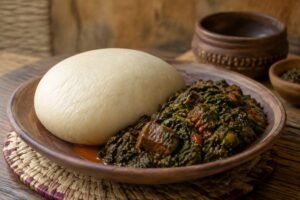
Saka madesu is a soup & stew from Republic of the Congo: cassava leaves stewed with beans and palm oil, eaten with chikwangue. A Congo basin one-pot pairing the two cheapest proteins available inland, dried beans and the leaves of the cassava plant already grown for its root.
How long does Saka madesu take to make?
Saka madesu takes 40 minutes plus soaking of preparation and 2 hours of cooking. The recipe makes serves 6. It is rated medium to make.
What can I substitute in Saka madesu?
Yes, within limits. Smoked fish or dried shrimp add real savoury depth and are common rather than universal; both hide entirely in the dark stew and neither is visible, so say clearly if you have used them since fish and shellfish allergies can be severe. The plain version is entirely vegetarian, and fish, shrimp or a fish-based stock cube all end that. Some cooks fry the onion and garlic first for a deeper flavour where the traditional route adds them raw to soften in the long cooking; both are genuinely done.
What is the most important thing to get right in Saka madesu?
Cover them well with plenty of water. Use plenty of water at the start. Add more water as it cooks down. Never let the pot boil right dry. Bring the pot up to a steady boil. A gentle simmer is not enough here. Keep it boiling steadily throughout. Boil it for at least ninety minutes. Two hours is genuinely better still. Leave the pot uncovered as it boils. Cook it uncovered right throughout.