
Ingredients
The beans
- 400 gblack-eyed peas
- soaked for a few hours
- water, to cover
- 1 teaspoonsalt
The cassava
- 1 kgcassava
- peeled and cut in lengths
- water, to cover
- salt
The stew on top
- 3onions, sliced
- 4tomatoes, chopped
- 2 tablespoonstomato paste
- 4 tablespoonspalm oil or groundnut oil
- 2stock cubes
- 1hot chilli, chopped
- salt and black pepper
To serve
- hot on one plate
- at a market stand
Directions
- Peel it thoroughly and discard the peel. Boil it in plenty of fresh water. Discard all of that cooking water. Do not eat cassava that tastes bitter. Cut the cassava into shorter lengths. Cut it into pieces about ten centimetres. Score the skin down each length. Cassava has a thick two-layer peel.
- Cut down through both layers with a knife. Pull out the woody central fibre. Pull it out before you boil them. Put the cassava in a pot of water. Cover it well with plenty of water. Add a little salt in to the water.
- Use plenty rather than the minimum. Cooking it takes about thirty minutes. Bring it right up to a full boil. Let it boil for about thirty minutes. Judging it takes a proper fork test. Drain all of the cooking water away. Do not use it for anything at all. Drain the soaked black-eyed peas. Put them into a separate large pot.
- Cover them well with fresh water. Boiling them takes about forty minutes. Bring the whole pot up to a boil. Skim off any foam that rises up. Add the salt partway through cooking. Salt at the start can toughen the skins.
- Add it once they start to soften. Judging them takes a firm squeeze. Squeeze a bean between your fingers. It should crush easily and completely. Take them off the heat once soft. Draining them is straightforward enough. Drain the beans and keep them warm. Heat the oil in a wide heavy pot. Add all the sliced onions to it.
- Cook them for a good ten minutes. The onions should soften right down. Add the chopped tomatoes to the pot. Cook them down for about eight minutes. Add the tomato paste in to them. Cook it out for a few minutes. Give it a good two or three minutes. Add the stock cubes to the pot. Add the chopped chilli in to it. Season it with salt and black pepper. Add a little water if it is very thick.
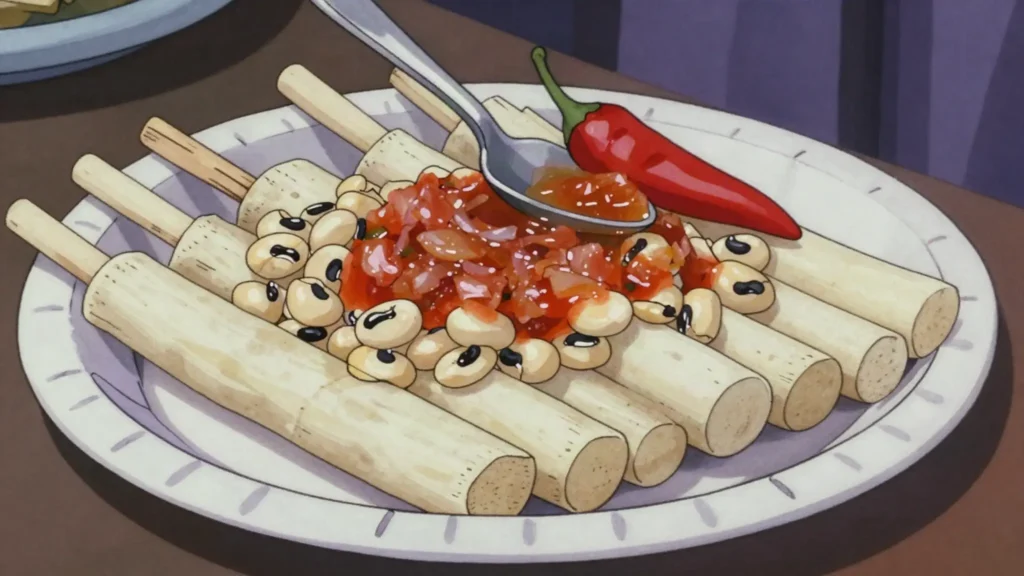
- Let it simmer for about ten minutes. Judging it takes a careful look. Oil rising to the surface is wanted. Lay the cassava pieces on the plate. Spoon all the beans over the top. Spoon the stew over both of them. Serving it is always done hot. Serve it hot on the one plate. It keeps two days refrigerated.
Technique
- Cassava contains cyanogenic glycosides that release cyanide when the plant is damaged, and it is never eaten raw in any variety. Peel it thoroughly and discard the peel, which holds most of the compounds — a thick brown outer bark and a pink inner layer, both of which must come away. Boil it in plenty of water and discard that water rather than using it, since the compounds are water soluble and leach into it. Cassava that tastes bitter should not be eaten; that bitterness signals the compounds and the signal should be trusted.
- The cassava and beans are cooked in separate pots because they take very different times, and are combined only on the plate — which is why the name keeps them apart. Cassava goes down as the base and soaks up the stew from above, with the beans between the two.
- Split each peeled length and pull out the tough woody cord running down the centre, which stays hard however long it cooks and comes away easily once split.
Substitutions
- Red palm oil gives colour and a distinct flavour, groundnut oil a plainer one; both are genuinely used in the Gambia.
- Black-eyed peas need less soaking than most beans and can even be cooked unsoaked, which simply takes longer.
Variations
- Nyambeh is cassava in Mandinka and nyebeh the black-eyed pea, so the name simply lists the two parts.
- Fry the tomato paste for two or three minutes before adding liquid, since raw paste tastes metallic.
- Oil separating slightly on the surface of the stew shows it has cooked down properly and is wanted rather than a fault.
History
A cheap filling plate sold at Gambian markets and roadside stands, the cassava and beans cooked separately then combined.
Frequently asked questions
What is Nyambeh nyebeh?
Nyambeh nyebeh is a street food from Gambia: boiled cassava with black-eyed peas, topped with onion and tomato stew. A cheap filling plate sold at Gambian markets and roadside stands, the cassava and beans cooked separately then combined.
How long does Nyambeh nyebeh take to make?
Nyambeh nyebeh takes 20 minutes plus soaking of preparation and 1 hour 30 minutes of cooking. The recipe makes serves 6. It is rated easy to make.
What can I substitute in Nyambeh nyebeh?
Yes, within limits. Red palm oil gives colour and a distinct flavour, groundnut oil a plainer one; both are genuinely used in the Gambia. Black-eyed peas need less soaking than most beans and can even be cooked unsoaked, which simply takes longer.
What is the most important thing to get right in Nyambeh nyebeh?
Peel it thoroughly and discard the peel. Boil it in plenty of fresh water. Discard all of that cooking water. Do not eat cassava that tastes bitter. Cut the cassava into shorter lengths. Cut it into pieces about ten centimetres. Score the skin down each length. Cassava has a thick two-layer peel.