
Ingredients
Dough
- 600 gstrong white flour
- 300 mlice-cold water
- 12 gfine salt
Filling
- 400 gbeef chuck, hand-chopped or coarsely minced
- 200 gpork belly, hand-chopped or coarsely minced
- 2onions (about 250 g), minced to a pulp
- 3garlic cloves, crushed
- 30 gcoriander leaf and stalk, finely chopped
- 1 tspground caraway or cumin
- 1 tspdried red chilli flakes
- 2 tspfine salt
- 1 tspcoarsely ground black pepper
- 200 mlice-cold water or cold beef stock
To serve
- Coarsely ground black pepper
Directions
- Work the salt into the flour, add the ice water in stages and knead 10–12 minutes to a very firm, smooth dough. Wrap and rest 40 minutes at room temperature; it should be stiff, not soft.
- Mix the meats, onion, garlic, coriander, caraway, chilli, salt and pepper. Beat in the cold water 50 ml at a time until the filling is loose and sloppy, almost pourable. This water becomes the soup.
- Chill the filling 30 minutes so the fat firms up and it is easier to handle.
- Roll the dough 2–3 mm thin and cut 12 cm rounds. Roll each round again from the edges so the rim is thin and the centre stays thick enough to hold the weight.
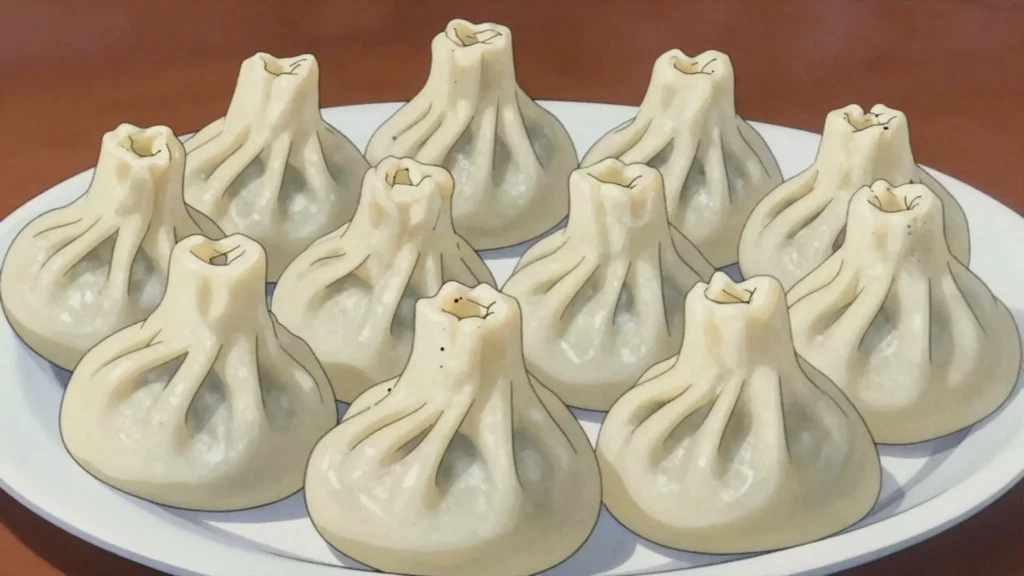
- Put a heaped tablespoon of filling in the middle. Hold the disc in your cupped palm and pleat the edge round in small folds, turning as you go: 19 pleats is the traditional minimum and a proud cook makes more.
- Twist the gathered pleats into a firm topknot and pinch off any excess dough, leaving a stubby handle. There must be no gap, or the soup runs out.
- Bring a wide, deep pan of well-salted water to a rolling boil. Stir the water into a whirlpool and drop in 6–8 khinkali at a time, tail-up.
- Nudge them off the base with a wooden spoon and simmer 7–8 minutes, until they float, the dough turns glassy and the belly swells taut with liquid.
- Lift out with a slotted spoon, drain briefly, pile on a wooden board and shower with black pepper. No sauce, no vinegar.
- Eat with your hands: hold the topknot, bite a small hole in the shoulder, slurp the broth, then eat the rest and leave the tough knot on the plate to be counted.
Technique
- Hand-chopping the meat with two knives gives the loose, juicy texture Georgians expect; a fine machine mince turns pasty and holds no soup.
- Cold everything: cold water, cold filling, cold hands. Warm fat smears and the broth breaks instead of setting into juice.
- The knot is not eaten. In a kitchen the discarded knots are counted to see who ate the most.
- Never pierce or cut a khinkali on the plate; losing the soup is the one real mistake.
Substitutions
- Kalakuri (town-style) khinkali as above; for the mountain original from Pshavi and Khevsureti drop the coriander and caraway and use only lamb, onion, salt and pepper.
- No pork: use all beef with 200 g of beef fat or a fatty short rib, or the filling dries out.
Variations
- Kalakuri, with herbs and a soupier filling, the version found in Tbilisi.
- Khevsuruli, plain minced lamb, no greens, from the high Caucasus.
- Kartofilis khinkali, filled with mashed potato, butter and fried onion.
History
Twisted, hand-pleated dumplings filled with spiced meat and its own juicy broth, most strongly associated with the mountainous regions of Georgia, particularly Pshavi and Khevsureti, where the dumpling’s dense, doughy top knot, traditionally left thick and not eaten, is generally explained as a functional handle for holding a hot, juice-filled dumpling without utensils. Counting the number of pleats folded into each khinkali is treated in Georgian food culture as a mark of a cook’s skill, with a properly made khinkali expected to have a specific, fairly high number of neat folds rather than a rough or approximate pinch. It is traditionally eaten by hand, lifted by the knot, with the broth sipped from a small bite taken at the side before the rest is eaten, and the tough top knot is customarily left on the plate rather than eaten.
Frequently asked questions
What is Khinkali?
Khinkali is a main from Georgia: twisted soup dumplings of spiced meat, slurped by hand. Twisted, hand-pleated dumplings filled with spiced meat and its own juicy broth, most strongly associated with the mountainous regions of Georgia, particularly Pshavi and Khevsureti, where the dumpling’s dense, doughy top knot, traditionally left thick and not eaten, is generally explained as a functional handle for holding a hot, juice-filled dumpling without utensils. Counting the number of pleats folded into each khinkali is treated in Georgian food culture as a mark of a cook’s skill, with a properly made khinkali expected to have a specific, fairly high number of neat folds rather than a rough or approximate pinch. It is traditionally eaten by hand, lifted by the knot, with the broth sipped from a small bite taken at the side before the rest is eaten, and the tough top knot is customarily left on the plate rather than eaten.
How long does Khinkali take to make?
Khinkali takes 1 hr of preparation and 15 min of cooking. The recipe makes 4 servings (about 24 khinkali). It is rated hard to make.
What can I substitute in Khinkali?
Yes, within limits. Kalakuri (town-style) khinkali as above; for the mountain original from Pshavi and Khevsureti drop the coriander and caraway and use only lamb, onion, salt and pepper. No pork: use all beef with 200 g of beef fat or a fatty short rib, or the filling dries out.
What is the most important thing to get right in Khinkali?
Twist the gathered pleats into a firm topknot and pinch off any excess dough, leaving a stubby handle. There must be no gap, or the soup runs out.