
Ingredients
Aubergine
- 4large aubergines
- salt
- oil, for frying
Base
- 2onions, thinly sliced
- 4 clovesgarlic, sliced
- 1 tspturmeric
- 150 mlkashk
- salt
- black pepper
To finish
- 2 tbspdried mint
- 3 tbspoil
- 50 gwalnuts, chopped
- extra kashk, to drizzle
To serve
- sangak or lavash bread
Directions
- Peel the aubergines, slice them thickly, salt them, and leave them 30 minutes, then rinse and dry them.
- Fry the slices in oil until deep golden on both sides and completely soft.
- Fry them rather than roasting them if you want the real thing. The oil is a large part of the flavour and roasted aubergine gives something noticeably thinner.
- Fry the sliced onions slowly until deep brown and crisp, then lift out and reserve half for the top.
- Fry the garlic separately, briefly, and reserve some of that too.
- Now the fried mint, which is the signature of the dish. Heat the oil, take it off the heat, and stir the dried mint into it.
- Off the heat, without exception. Mint burns in hot oil in about three seconds and turns black and bitter, and the residual heat is enough to bloom it.
- It should turn dark green and smell strongly, and the oil should stain green.
- Mash the fried aubergine coarsely with a fork or a wooden spoon, leaving some texture.
- Do not blend it smooth. It should look mashed rather than puréed, and a food processor turns it into baby food.
- Stir in half the fried onion and garlic, the turmeric and most of the kashk, and warm it through gently over a low heat.
- Taste for salt carefully. Kashk is very salty on its own and the dish rarely needs more.
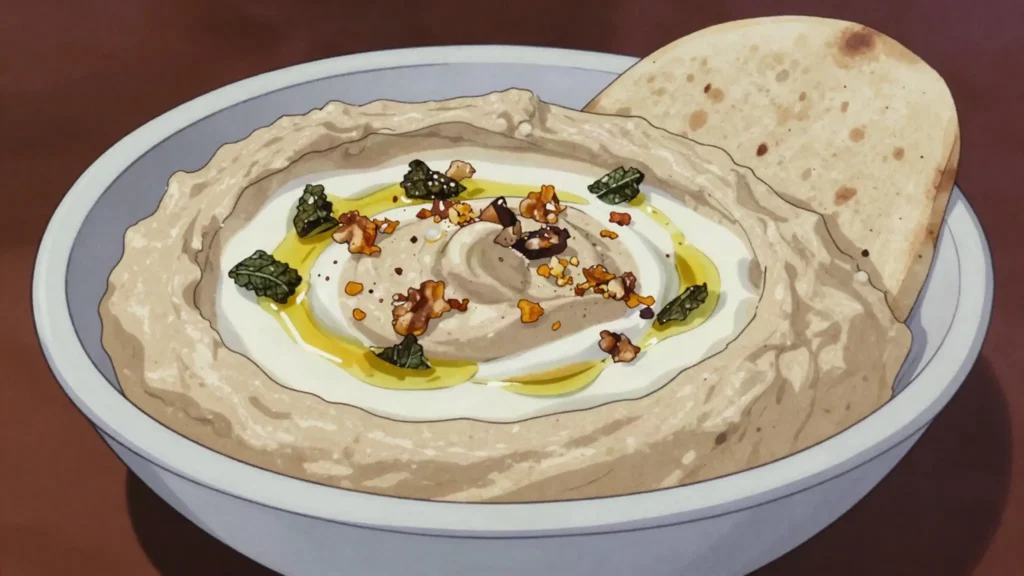
- Spread it in a shallow dish and make swirls in the surface with the back of a spoon.
- Drizzle the remaining kashk over in a spiral, then the mint oil, then scatter the reserved onion, garlic and walnuts.
- The layered topping is how it is presented in Iran, and the contrast of white kashk, green mint oil and dark onion is half the dish.
- Serve warm or at room temperature with flatbread for scooping.
- Kashk is drained fermented whey, dried and reconstituted, and it is bought as a thick liquid or as hard balls.
Technique
- It is served as a starter or as part of a spread rather than as a main course.
- Liquid kashk in jars is the convenient form; dried kashk balls must be soaked and blended.
- It is good cold and is often made in advance.
Substitutions
- Thick sour yoghurt with extra salt and a little lemon, which is an approximation rather than a substitute.
- Roasted aubergine if you want to use less oil, accepting a lighter result.
Variations
- With minced lamb stirred through.
- Smoother, closer to a dip.
- With more walnut, which is common in Tabriz.
History
Fried aubergine with whey kashk, mint oil and walnuts, drawn from the same fermented dairy tradition.
Frequently asked questions
What is Kashk-e bademjan?
Kashk-e bademjan is a salad & side from Iran: fried aubergine dip with fermented whey, fried mint and walnuts. Fried aubergine with whey kashk, mint oil and walnuts, drawn from the same fermented dairy tradition.
How long does Kashk-e bademjan take to make?
Kashk-e bademjan takes 25 min of preparation and 40 min of cooking. The recipe makes 6 servings. It is rated easy to make.
What can I substitute in Kashk-e bademjan?
Yes, within limits. Thick sour yoghurt with extra salt and a little lemon, which is an approximation rather than a substitute. Roasted aubergine if you want to use less oil, accepting a lighter result.
What is the most important thing to get right in Kashk-e bademjan?
Fry them rather than roasting them if you want the real thing. The oil is a large part of the flavour and roasted aubergine gives something noticeably thinner.