
Ingredients
Custard
- 1.5 litreswhole milk
- 200 gfine semolina
- 250 gsugar
- 5eggs
- 100 gbutter
- zest of 1 lemon
- 1 tspvanilla extract
Pastry
- 400 gphyllo
- 200 gbutter, melted
Syrup
- 500 gsugar
- 350 mlwater
- 1strip lemon peel
- 1cinnamon stick
- 1 tbsplemon juice
Directions
- Make the syrup first and let it go completely cold. Boil the sugar, water, lemon peel and cinnamon for 8 minutes, then cool it and stir in the lemon juice.
- Hot pastry into cold syrup. That is the rule for every syrup pastry in Greece, and doing it the other way round gives a soggy tray.
- Heat the milk with the lemon zest to just below boiling.
- Whisk the eggs with the sugar until pale and thick.
- Rain the semolina into the hot milk in a thin stream, whisking hard, and cook for 5 minutes until it thickens.
- Rain it in slowly. Semolina tipped in as a mass sets into lumps within seconds and there is no recovering it.
- Off the heat, temper the egg mixture in, then return the pan to a low heat for 2 minutes without letting it boil.
- Beat in the butter and vanilla, then press film onto the surface and cool it completely.
- Butter a baking tray and lay in 6 or 7 sheets of phyllo, brushing each with butter and letting them hang generously over the sides.
- Pour in the cold custard and level it.
- Fold the overhanging pastry in over it, then cover with 6 or 7 more buttered sheets, tucking the edges down inside the tray.
- Score the top layers into diamonds or squares before it goes into the oven.
- Score it beforehand. Cutting a baked galaktoboureko shatters the pastry and pushes the custard out through every cut.
- Bake at 180°C (355°F) for 50 minutes, until deep golden and audibly crisp.
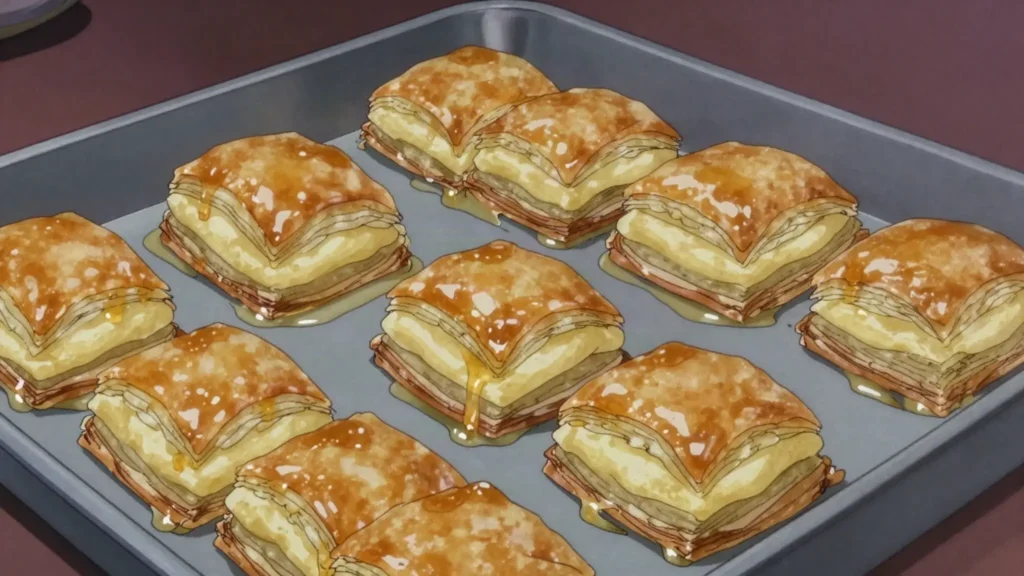
- Pour the cold syrup evenly over the hot tray the moment it comes out of the oven, and listen for the hiss.
- Let it stand for at least 4 hours before cutting down through the scored lines.
Technique
- The name joins galakto, milk, with the Turkish börek, which is a fair description of what it is.
- Fine semolina rather than coarse. The custard should be silken with no grain in it at all.
- It is best on the day it is made and still good on the second, after which the pastry softens.
Substitutions
- Cornflour in place of some of the semolina for an even smoother custard, which is less traditional.
- Orange zest instead of lemon, which is common in the north.
Variations
- Rolled into individual cigars rather than baked as a tray.
- With orange syrup and a little cinnamon in the custard.
- Bougatsa, the closely related Thessaloniki version, which carries no syrup at all.
History
A custard pie, made from a semolina-thickened milk custard baked between layers of crisp phyllo pastry and soaked in a sweet syrup once baked, documented across Greece for many generations as one of the country’s most beloved traditional desserts. Its name, directly combining the Greek words for milk and pie, describes the dish’s defining milk-custard filling, and the contrast between the crisp, syrup-soaked phyllo exterior and the soft, creamy custard within reflects a broader Greek pastry tradition of combining contrasting textures within a single dessert. Galaktoboureko remains one of the most iconic and widely prepared traditional Greek desserts, commonly found in bakeries and restaurants throughout the country.
Frequently asked questions
What is Galaktoboureko?
Galaktoboureko is a dessert from Greece: semolina custard baked in syrupy phyllo. A custard pie, made from a semolina-thickened milk custard baked between layers of crisp phyllo pastry and soaked in a sweet syrup once baked, documented across Greece for many generations as one of the country’s most beloved traditional desserts. Its name, directly combining the Greek words for milk and pie, describes the dish’s defining milk-custard filling, and the contrast between the crisp, syrup-soaked phyllo exterior and the soft, creamy custard within reflects a broader Greek pastry tradition of combining contrasting textures within a single dessert. Galaktoboureko remains one of the most iconic and widely prepared traditional Greek desserts, commonly found in bakeries and restaurants throughout the country.
How long does Galaktoboureko take to make?
Galaktoboureko takes 40 min plus 4 hr standing of preparation and 1 hr of cooking. The recipe makes 1 tray, 16 pieces. It is rated medium to make.
What can I substitute in Galaktoboureko?
Yes, within limits. Cornflour in place of some of the semolina for an even smoother custard, which is less traditional. Orange zest instead of lemon, which is common in the north.
What is the most important thing to get right in Galaktoboureko?
Fine semolina rather than coarse. The custard should be silken with no grain in it at all.