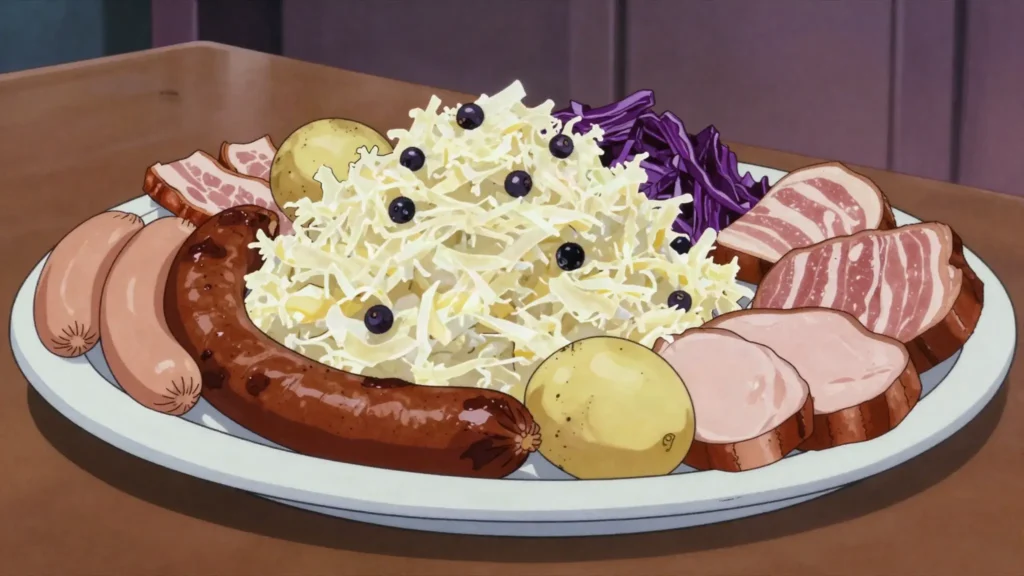

Ingredients
Sauerkraut
- 2 kgsauerkraut, bought
- 200 ggoose or duck fat
- 2onions, sliced
- 750 mldry Riesling
Meats
- 300 gsmoked bacon, in one piece
- 500 gsalted pork shoulder
- 4Strasbourg sausages
- 4Montbéliard sausages
- 1Morteau sausage
Aromatics
- 10juniper berries
- 6black peppercorns
- 4cloves
- 2bay leaves
Also
- 8potatoes, peeled
- salt
To serve
- strong mustard
- horseradish
Directions
- Buy the sauerkraut rather than making it. This is a dish built around a fermented product from a specialist, and Strasbourg has recorded cabbage salters as a trade since the sixteenth century.
- Rinse the sauerkraut once only and squeeze it out. Rinsing repeatedly washes away the sourness the whole dish is built on, and not rinsing at all leaves it too salty to eat in the quantity served.
- Melt the goose fat in a large heavy pot and soften the onions for 10 minutes.
- Add half the sauerkraut, then the bacon and the salted pork, then the remaining sauerkraut over the top.
- Tie the juniper, peppercorns, cloves and bay leaves into a square of muslin and bury the bundle in the middle.
- Pour in the Riesling, cover, and cook in a low oven at 150°C (300°F) for 2 hours 30 minutes.
- Use a dry Alsatian Riesling, and use the same bottle you intend to drink with it, which is the local rule and a sound one.
- Add the potatoes for the last 45 minutes.
- Add the sausages for the final 20 minutes only. Boiled for two hours they split, shed their fat into the cabbage and turn grainy.
- Pile the sauerkraut onto a large warmed platter, arrange the meats and potatoes over it, and serve with strong mustard and horseradish.
Technique
- Rinse once, sausages late, same wine in the pot and the glass. Everything else is patience.
- Alsace still supplies most of the sauerkraut eaten in France, and the quality of what you buy sets the ceiling for the dish.
- It reheats well and is arguably better the next day, once the meats have given more to the cabbage.
Substitutions
- Lard in place of goose fat, which is milder.
- Any dry unoaked white wine, though the Riesling is the traditional one.
- Smoked pork knuckle in place of the salted shoulder.
Variations
- Choucroute royale, made with champagne instead of Riesling.
- Choucroute de la mer, with fish and shellfish in place of the pork.
- With a ham knuckle added at the start for more body.
History
Alsace’s signature platter; Strasbourg records cabbage salters as a trade from the sixteenth century, and the region still supplies most French sauerkraut.
Frequently asked questions
What is Choucroute garnie?
Choucroute garnie is a main from France: fermented cabbage braised in wine with sausages, bacon and salted pork. Alsace’s signature platter; Strasbourg records cabbage salters as a trade from the sixteenth century, and the region still supplies most French sauerkraut.
How long does Choucroute garnie take to make?
Choucroute garnie takes 20 min of preparation and 3 hr of cooking. The recipe makes 8 servings. It is rated easy to make.
What can I substitute in Choucroute garnie?
Yes, within limits. Lard in place of goose fat, which is milder. Any dry unoaked white wine, though the Riesling is the traditional one. Smoked pork knuckle in place of the salted shoulder.
What is the most important thing to get right in Choucroute garnie?
Buy the sauerkraut rather than making it. This is a dish built around a fermented product from a specialist, and Strasbourg has recorded cabbage salters as a trade since the sixteenth century.