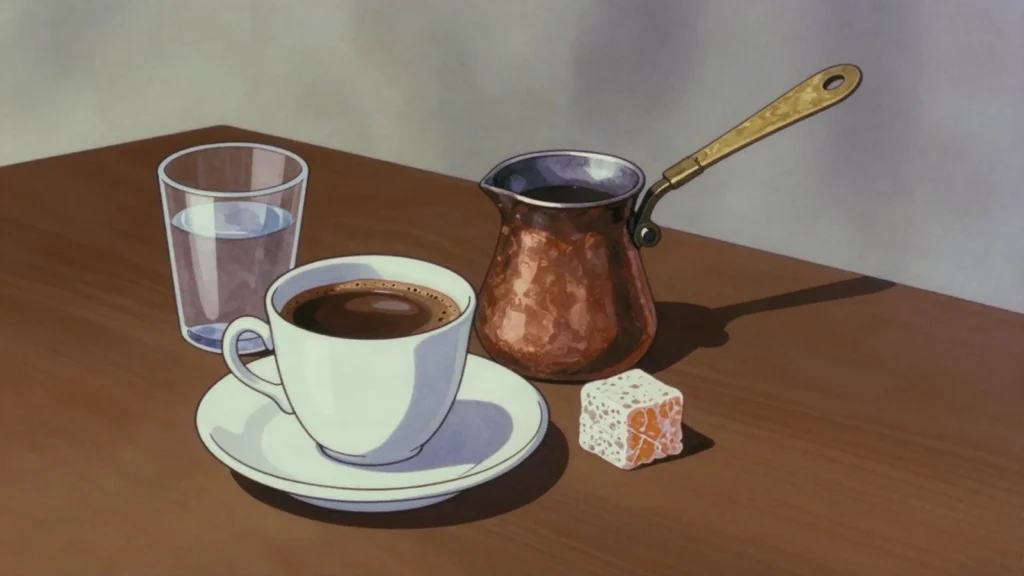

Ingredients
Coffee
- 2heaped tsp (about 14 g) coffee ground to a flour-fine powder, finer than espresso
- 140 mlcold water (measured in the serving cups)
- Sugar to taste: none (sade), 1 tsp (az şekerli), 2 tsp (orta), 3 tsp (çok şekerli)
- 1cardamom pod, cracked (optional, more common in the Arab world)
To serve
- 2small fincan cups with saucers
- 2glasses of cold water
- Turkish delight or a single date, per cup
Directions
- Measure the water using the cups you will serve in, so the volume is exactly right – about 70 ml per cup, and the cezve should be no more than two-thirds full.
- Put the cold water, coffee and sugar into the cezve (a small long-handled copper pot) and stir until the grounds are wetted and the sugar dissolved. Stir now and essentially not again.
- Set the cezve over the lowest possible heat, or in hot sand if you have it. Slow heat is the whole technique – fast heat gives thin coffee and no foam.
- Over 3–4 minutes a dark ring of foam will creep in from the edges and build into a thick pale-brown head. Do not stir it.
- The instant the foam rises up the neck of the pot and threatens to break, lift the cezve off the heat. It must never actually boil – boiling destroys the foam and makes the coffee bitter.
- Spoon a little of the foam into each cup first, so every drinker gets some. Foam (köpük) is the mark of a well-made cup and its absence is a visible failure.
- Return the pot to the heat for 15–20 seconds until it rises a second time, then pour slowly and steadily down the side of each cup, letting the grounds settle in the pot.
- Serve immediately with a glass of cold water to clear the palate and a piece of lokum. Let it stand a minute so the grounds settle, drink without stirring, and stop before the sludge at the bottom.
Technique
- The grind is non-negotiable. It must be powder-fine – most domestic burr grinders cannot go there, so buy it ground for Turkish coffee or use a hand mill set to its finest.
- Turkish coffee culture was inscribed on the UNESCO Intangible Cultural Heritage list in 2013. The tradition covers not only the brewing but the hospitality, the fortune-telling from the grounds and the coffee served when a suitor’s family visits.
- Sugar is added at the start, never afterwards, because stirring the finished cup ruins the foam and lifts the grounds. Ask guests how they take it before you brew.
Substitutions
- No cezve? A very small stainless saucepan works, though the narrow neck of a proper cezve is what builds the foam.
- A dark roast is traditional in Turkey, but a medium roast Arabica ground fine makes a sweeter, more fragrant cup.
Variations
- Menengiç kahvesi, made from roasted wild terebinth berries and milk, from southeastern Turkey.
- Dibek kahvesi, ground in a stone mortar with mastic or cardamom, and sandy-brewed coffee cooked in hot sand for extra foam.
History
Reached Istanbul in the sixteenth century; its cezve brewing, fortune-telling and hospitality rituals were inscribed by UNESCO in 2013.
Frequently asked questions
What is Turkish coffee?
Turkish coffee is a drink from Turkey: finely ground coffee simmered in cezve, served with grounds; UNESCO-listed. Reached Istanbul in the sixteenth century; its cezve brewing, fortune-telling and hospitality rituals were inscribed by UNESCO in 2013.
How long does Turkish coffee take to make?
Turkish coffee takes 5 min of preparation and 5 min of cooking. The recipe makes 2 servings. It is rated easy to make.
What can I substitute in Turkish coffee?
Yes, within limits. No cezve? A very small stainless saucepan works, though the narrow neck of a proper cezve is what builds the foam. A dark roast is traditional in Turkey, but a medium roast Arabica ground fine makes a sweeter, more fragrant cup.
What is the most important thing to get right in Turkish coffee?
Set the cezve over the lowest possible heat, or in hot sand if you have it. Slow heat is the whole technique – fast heat gives thin coffee and no foam.