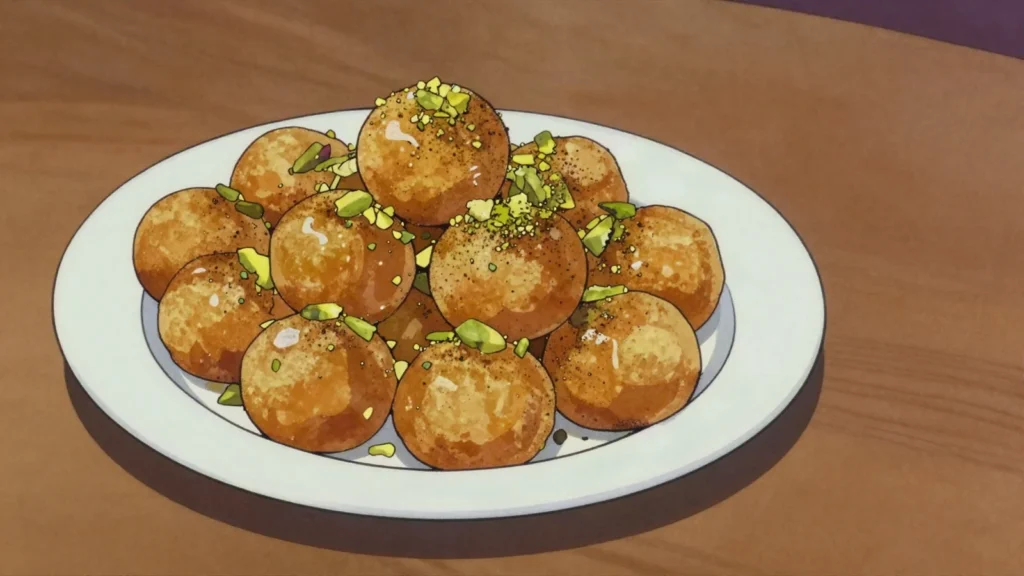

Ingredients
Batter
- 300 gplain flour
- 50 gcornflour
- 7 ginstant yeast
- 1 tbspsugar
- ½ tspsalt
- 300 mlwarm water
Syrup
- 400 gsugar
- 300 mlwater
- 1 tsplemon juice
- 1strip lemon peel
To fry
- oil, for deep frying
To finish
- ground cinnamon
- ground walnut or pistachio, optional
Directions
- Make the syrup first and let it go completely cold. Boil the sugar, water, lemon juice and peel for 10 minutes, then cool it.
- Hot lokma into cold syrup. The temperature difference is what gives the thin crackling shell, and warm syrup soaks straight in and makes them soggy.
- Whisk the flour, cornflour, yeast, sugar and salt with the warm water into a thick, smooth batter.
- The cornflour is what makes lokma shatter rather than merely crisp, and it is the difference from a plain doughnut batter.
- Beat it hard for 5 minutes, then cover and leave it 1 hour 30 minutes until risen and bubbly.
- Stir it down very gently, keeping as much of the gas in as you can.
- Heat the oil to 170°C (340°F).
- Take up batter in your fist and squeeze small balls out between thumb and forefinger, cutting them off with a wet spoon.
- The fist-and-spoon method is why lokma are never perfectly round, and the irregular surface is what catches the syrup.
- Fry in batches for 4 to 5 minutes, turning constantly, until deep golden all over.
- Keep them moving. They float, and the upper half stays pale unless you turn them the whole time.
- Lift them out and drop them straight into the cold syrup while still hot.
- Turn them in the syrup for about a minute, then lift them out.
- A minute only. Longer and they turn to sponge, and the point is a crisp shell over a soft, hollow middle.
- Dust with cinnamon and ground nuts and serve at once.
- Now the thing that distinguishes lokma from every other version of this sweet: it is closely tied to death.
- In Turkey lokma is cooked in enormous quantities and handed out free in the street on the seventh and fortieth day after a death, as hayır, an act of charity in the name of the person who has died.
- You will see a stall set up outside a mosque or on a pavement with no price, and taking one is understood as saying a prayer for the dead.
- It is also sold commercially and eaten as an ordinary sweet, so both readings are correct depending on where you meet it.
- The Greek loukoumades is the same fried dough with honey rather than sugar syrup and none of the funerary association.
Technique
- The batter is deliberately wet and sticky and is never rolled or handled as a dough.
- They must be eaten within an hour and are always made to order.
- The name comes from lokma, meaning a mouthful or a morsel.
Substitutions
- Honey syrup in place of sugar syrup.
- Two wet teaspoons in place of the fist-and-spoon method.
Variations
- Loukoumades, the Greek version, with honey.
- Kaimati and luqaimat, the Swahili coast and Gulf versions, with cardamom.
- Filled with chocolate or cream, which is a modern shop variation.
History
Descended from medieval Arab luqmat al-qadi recorded in thirteenth-century cookbooks; Aegean towns fry it in the street as charity.
Frequently asked questions
What is Lokma?
Lokma is a dessert from Turkey: syrup-soaked fried dough balls, often handed out free in memory of the dead. Descended from medieval Arab luqmat al-qadi recorded in thirteenth-century cookbooks; Aegean towns fry it in the street as charity.
How long does Lokma take to make?
Lokma takes 20 min plus 1 hr 30 min rising of preparation and 25 min of cooking. The recipe makes about 50. It is rated medium to make.
What can I substitute in Lokma?
Yes, within limits. Honey syrup in place of sugar syrup. Two wet teaspoons in place of the fist-and-spoon method.
What is the most important thing to get right in Lokma?
The cornflour is what makes lokma shatter rather than merely crisp, and it is the difference from a plain doughnut batter.