
Ingredients
Soup
- 500 gthick Bulgarian yoghurt
- 300 gcucumbers, peeled and cut in 5 mm dice
- 2garlic cloves, crushed to a paste with salt
- 1 tspfine salt
- 300 mlvery cold water
- 2 tbspsunflower oil
- 1 tbspred wine vinegar (optional)
Aromatics
- 40 gwalnut halves, roughly crushed
- ½ bunchdill, finely chopped
To serve
- Ice cubes
- A few walnut halves and dill fronds
Directions
- Dice the cucumber small and even by hand. Bulgarians dice rather than grate for tarator, because grating bleeds the cucumber and turns the soup watery.
- Salt the cucumber lightly and set it aside for 5 minutes, then tip off any liquid that gathers.
- Crush the garlic with a pinch of salt in a mortar into a smooth paste — chopped garlic leaves harsh bites in a cold soup.
- Whisk the yoghurt in a bowl until completely smooth and lump-free before any water goes in; adding water first makes it impossible to smooth out.
- Beat in the garlic paste and the salt, then thin with the cold water a little at a time until it pours like single cream. Some households use less water and eat it thick with a fork, as a salad rather than a soup.
- Stir in the cucumber, the crushed walnuts and most of the dill, then trickle in the sunflower oil and stir once so it streaks through rather than emulsifying.
- Chill 30 minutes. The garlic and dill need this time to bloom into the yoghurt; served straight away it tastes flat and raw.
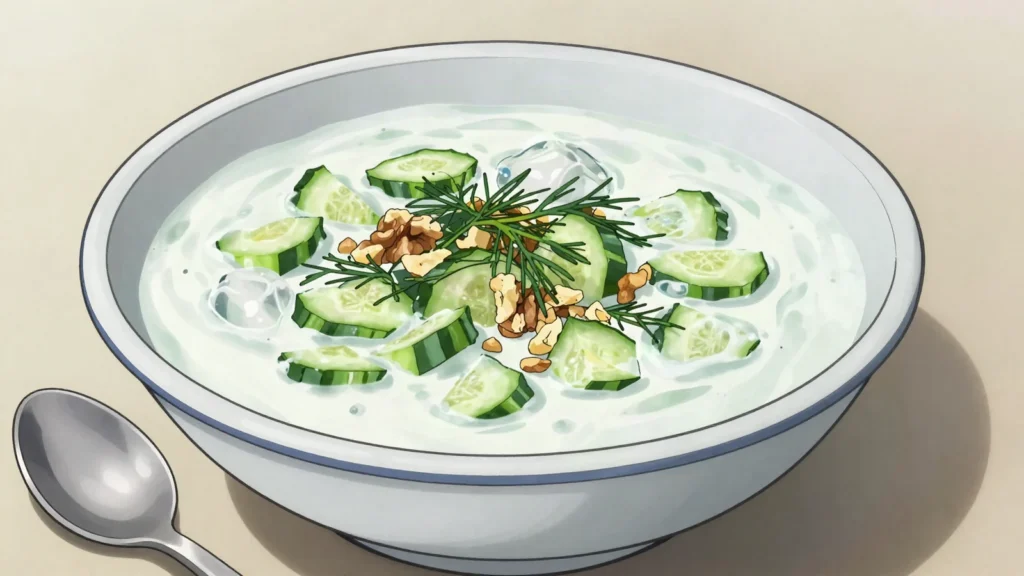
- Serve in bowls with an ice cube in each, the remaining dill and a few walnut halves on top.
Technique
- Bulgarian yoghurt is fermented with Lactobacillus bulgaricus and is sharper and thicker than most. If yours is mild, add the vinegar; if it is very thick like Greek strained yoghurt, use more water.
- The walnuts are traditional and not a garnish — they were originally pounded into the soup to thicken and enrich it, and older recipes call for a spoonful of walnut paste.
- It is eaten as a starter in summer heat, and also drunk from a glass; a thicker version served as a side dish is called snezhanka or ‘Snow White’.
Substitutions
- No dill: use mint, which is what the neighbouring Turkish cacık uses, though it makes the soup taste noticeably Turkish rather than Bulgarian.
- Walnuts can be swapped for blanched almonds, giving a milder, sweeter soup.
Variations
- Snezhanka drains the yoghurt overnight and skips the water entirely, producing a thick spoonable salad.
- In Dobrudzha some cooks blend the soup completely smooth and serve it in glasses.
History
A cold soup of yoghurt, cucumber, garlic, dill and walnuts, thinned with water and served chilled, particularly popular in Bulgaria during summer as a refreshing, low-effort dish requiring no cooking at all. Its combination of yoghurt and cucumber closely echoes similar cold yoghurt-based dishes found across the former Ottoman Empire and the wider Balkans and Middle East under different regional names, reflecting shared culinary influence spread through Ottoman-era trade and rule across the region from roughly the 1500s onward rather than a single point of invention in any one country. Bulgaria’s particular yoghurt tradition, built on specific native bacterial cultures long used in Bulgarian dairy fermentation, is considered by some Bulgarian cooks to give their version of tarator a distinctive tang not fully replicated elsewhere.
Frequently asked questions
What is Tarator?
Tarator is a soup & stew from Bulgaria: cold yoghurt soup with cucumber, dill, walnuts. A cold soup of yoghurt, cucumber, garlic, dill and walnuts, thinned with water and served chilled, particularly popular in Bulgaria during summer as a refreshing, low-effort dish requiring no cooking at all. Its combination of yoghurt and cucumber closely echoes similar cold yoghurt-based dishes found across the former Ottoman Empire and the wider Balkans and Middle East under different regional names, reflecting shared culinary influence spread through Ottoman-era trade and rule across the region from roughly the 1500s onward rather than a single point of invention in any one country. Bulgaria’s particular yoghurt tradition, built on specific native bacterial cultures long used in Bulgarian dairy fermentation, is considered by some Bulgarian cooks to give their version of tarator a distinctive tang not fully replicated elsewhere.
How long does Tarator take to make?
Tarator takes 15 min of preparation and 30 min chilling of cooking. The recipe makes 4 servings. It is rated easy to make.
What can I substitute in Tarator?
Yes, within limits. No dill: use mint, which is what the neighbouring Turkish cacık uses, though it makes the soup taste noticeably Turkish rather than Bulgarian. Walnuts can be swapped for blanched almonds, giving a milder, sweeter soup.
What is the most important thing to get right in Tarator?
Dice the cucumber small and even by hand. Bulgarians dice rather than grate for tarator, because grating bleeds the cucumber and turns the soup watery.