
Ingredients
Pastry (masa quebrada)
- 400 gplain flour
- 200 gcold unsalted butter, cubed
- 150 gcaster sugar
- 2egg yolks plus 1 whole egg
- 2 tspbaking powder
- zest of 1 lemon
- 1 tspvanilla extract
- 1 pinchsalt
- 1to 2 tbsp cold milk, only if needed
Filling
- 500 gdulce de membrillo (quince paste)
- 80 mlhot water or sweet white wine
- 1 tsplemon juice
To finish
- 1egg yolk beaten with 1 tsp milk
- icing sugar, optional
Directions
- Rub or pulse the butter into the flour, sugar, baking powder, salt and zest until it looks like coarse sand with a few pea-sized pieces left.
- Add the yolks, whole egg and vanilla and bring the dough together in as few movements as possible; add milk only if it refuses to cohere. Flatten into two discs, one holding about two thirds of the dough, wrap and chill for 1 hour.
- Break the quince paste into a saucepan with the hot water and lemon juice and warm over low heat, mashing with a fork, until it is a thick, spreadable puree with no lumps. Cool it to room temperature.
- Roll the larger disc to 4 mm and line a 26 cm loose-bottomed tart tin, pressing it well into the corners and trimming the rim. Chill 15 minutes.
- Spread the quince evenly over the base, no more than 1 cm deep, leaving a clean 1 cm border.
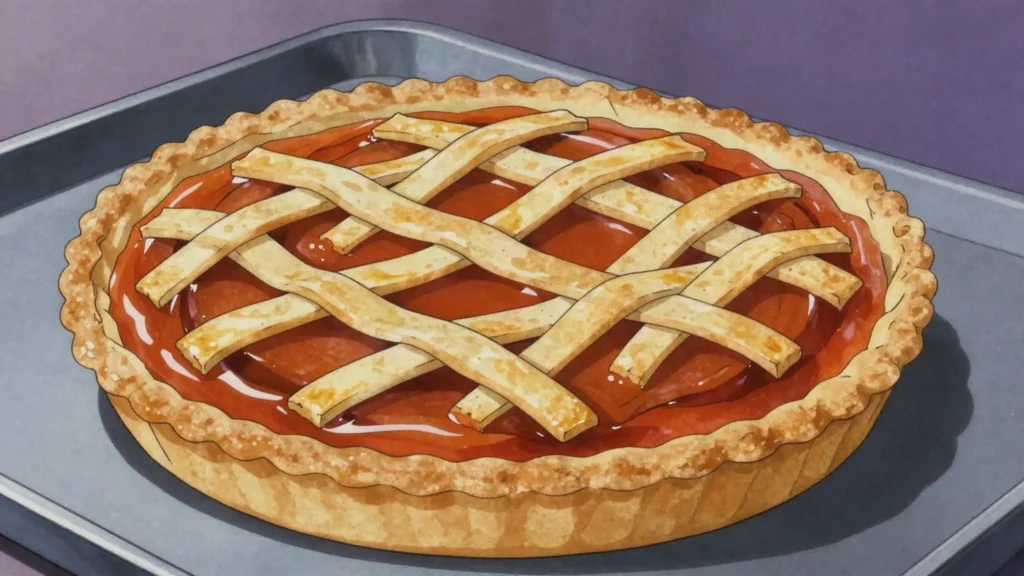
- Roll the second disc and cut it into 1.5 cm strips. Lay them over the filling in a lattice, traditionally an odd number of strips in each direction with the strips laid diagonally, and press the ends firmly onto the border.
- Brush the lattice and rim with egg yolk wash and bake at 180°C (350°F) for 35 to 40 minutes, until the pastry is an even golden brown and the quince is bubbling gently in the gaps.
- Cool completely in the tin before cutting, so the filling sets; the pastry is fragile while warm.
Technique
- The dough is a masa quebrada rather than a French pate sucree: the baking powder gives the slightly cakey, crumbly bite Argentines expect, and it is what separates pastafrola from an Italian crostata.
- Loosening the quince with water is essential. Straight from the block it bakes into a rubbery layer that pulls the lattice apart.
- Superstition and habit both say an odd number of lattice strips. Practically, laying them diagonally rather than square makes the tart easier to cut into even wedges.
Substitutions
- Dulce de batata, the sweet potato paste, is the second classic filling and is treated exactly the same way. Guava paste works in the north of the country.
Variations
- Pastafrola de dulce de leche uses 450 g of thick dulce de leche repostero, sometimes with grated coconut over the lattice.
- A Santa Fe version adds 100 g of ground walnuts to the pastry.
History
From the Italian pasta frolla; a fixture of Argentine bakeries and afternoon mate.
Frequently asked questions
What is Pastafrola?
Pastafrola is a bread & pastry from Argentina: short pastry tart filled with quince or sweet potato paste, latticed. From the Italian pasta frolla; a fixture of Argentine bakeries and afternoon mate.
How long does Pastafrola take to make?
Pastafrola takes 30 min plus 1 hr chilling of preparation and 40 min of cooking. The recipe makes one 26 cm tart, 10 slices. It is rated easy to make.
What can I substitute in Pastafrola?
Yes, within limits. Dulce de batata, the sweet potato paste, is the second classic filling and is treated exactly the same way. Guava paste works in the north of the country.
What is the most important thing to get right in Pastafrola?
The dough is a masa quebrada rather than a French pate sucree: the baking powder gives the slightly cakey, crumbly bite Argentines expect, and it is what separates pastafrola from an Italian crostata.