
Ingredients
Skyr
- 2 litresskimmed milk
- 3 tbsplive skyr, as the starter culture
- 2 dropsvegetarian (microbial) rennet, diluted in 2 tbsp cool boiled water
To serve
- 200 mlsingle cream or whole milk, to loosen
- 4 tbspsugar or a little honey (optional)
- 250 gbilberries, blueberries or crowberries
Directions
- Heat the skimmed milk slowly to 85–90°C (185–195°F), stirring so it does not catch, and hold it there for 10 minutes. This denatures the whey proteins and is what makes skyr thick rather than merely strained.
- Cool the milk quickly in a sink of cold water to 38–40°C (100–105°F), checked with a thermometer.
- Whisk the live skyr into a cupful of the warm milk until smooth, then stir it through the whole pot.
- Stir in the diluted rennet with about 20 gentle strokes and then stop moving the milk entirely.
- Cover and hold at 38–40°C (100–105°F) for 4–5 hours, in a switched-off oven with the light on or a wide vacuum flask, until the milk has set to a soft curd that pulls cleanly from the side of the pan.
- Ladle the curd gently into a colander lined with damp muslin set over a bowl, without stirring or breaking it up more than necessary.
- Drain in the refrigerator for 8–12 hours, until the mass has lost roughly two thirds of its volume in whey and is thick enough to stand a spoon in.
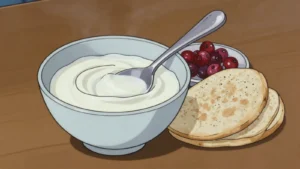
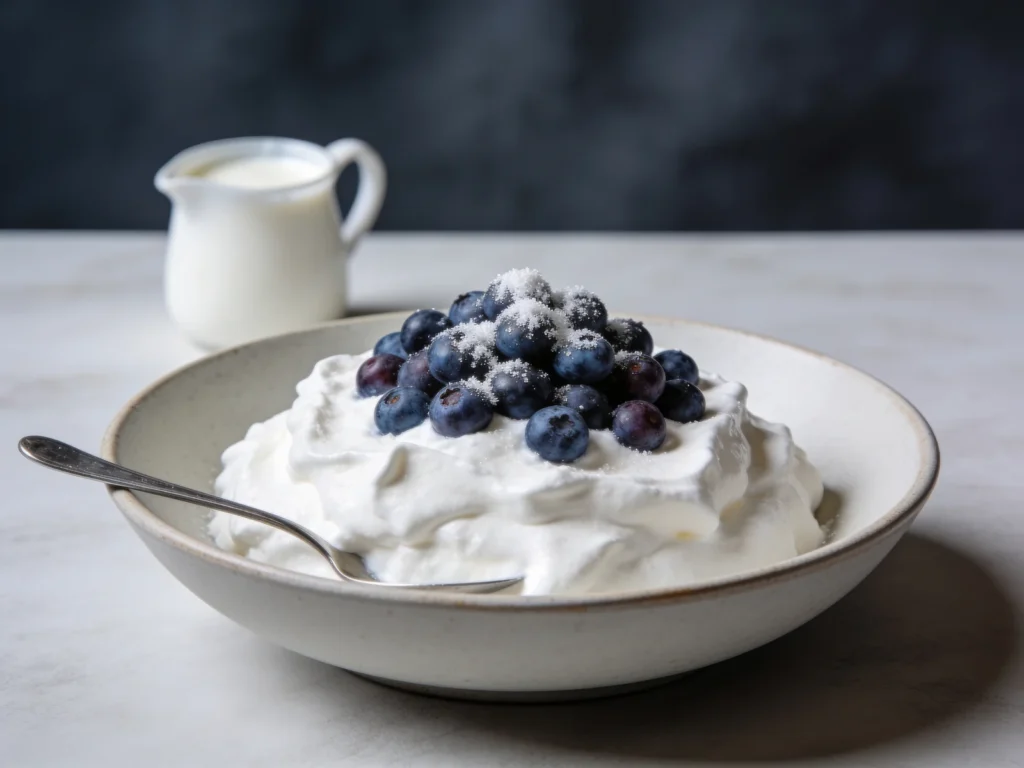
- Beat the drained curd smooth, loosening with a little cream or milk to a spoonable consistency, and serve cold with berries and a dusting of sugar.
Technique
- Skyr is technically a fresh acid-set cheese, not a yoghurt, though it is eaten and sold as a dairy dessert; it has been made in Iceland since settlement.
- The 85–90°C (185–195°F) hold and the low fat of skimmed milk are both essential. Whole milk gives a softer, greasier curd that never reaches the classic dense texture.
- Traditional skyr is set with rennet from a calf stomach; use microbial rennet to keep it vegetarian, and expect a very slightly softer set.
- Keep the drained whey (mysa). Icelanders drink it, and it was historically used to preserve food through winter.
Substitutions
- No live skyr for the starter: a plain live yoghurt with Streptococcus thermophilus works and gives a slightly tangier result.
- Rennet can be omitted altogether; culture alone gives a looser curd that needs an extra 4 hours of draining.
Variations
- Hraeringur is skyr beaten with warm oatmeal porridge, a traditional Icelandic breakfast.
- Skyrkaka is a baked cheesecake made on a skyr base, now standard on Reykjavik dessert menus.
History
A thick, strained dairy product similar to yoghurt though technically classified as a fresh cheese due to its production method, documented in Icelandic cooking since the country’s earliest Norse settlement beginning in the late 800s, with the specific culture and technique for making skyr believed to have been carried to Iceland by the original Norse settlers themselves. Its thick, protein-dense texture, achieved by straining out much of the liquid whey from cultured milk, made skyr a practical, long-keeping dairy staple well suited to Iceland’s historically isolated, resource-limited farming economy. Skyr remains one of Iceland’s most essential traditional foods, and it has more recently gained significant international commercial popularity as a high-protein dairy product marketed well beyond Iceland’s borders.
Frequently asked questions
What is Skyr?
Skyr is a cheese & dairy from Iceland: thick tangy cultured dairy with berries or cream. A thick, strained dairy product similar to yoghurt though technically classified as a fresh cheese due to its production method, documented in Icelandic cooking since the country’s earliest Norse settlement beginning in the late 800s, with the specific culture and technique for making skyr believed to have been carried to Iceland by the original Norse settlers themselves. Its thick, protein-dense texture, achieved by straining out much of the liquid whey from cultured milk, made skyr a practical, long-keeping dairy staple well suited to Iceland’s historically isolated, resource-limited farming economy. Skyr remains one of Iceland’s most essential traditional foods, and it has more recently gained significant international commercial popularity as a high-protein dairy product marketed well beyond Iceland’s borders.
How long does Skyr take to make?
Skyr takes 20 min of preparation and 5 hr culturing + 12 hr draining of cooking. The recipe makes about 700 g skyr from 2 litres milk. It is rated medium to make.
What can I substitute in Skyr?
Yes, within limits. No live skyr for the starter: a plain live yoghurt with Streptococcus thermophilus works and gives a slightly tangier result. Rennet can be omitted altogether; culture alone gives a looser curd that needs an extra 4 hours of draining.
What is the most important thing to get right in Skyr?
Heat the skimmed milk slowly to 85–90°C (185–195°F), stirring so it does not catch, and hold it there for 10 minutes. This denatures the whey proteins and is what makes skyr thick rather than merely strained.