
Ingredients
Beans
- 1 kgfermented and dried cocoa beans from Sao Tome and Principe, Amelonado or Forastero-Trinitario, ideally from Claudio Corallo, Diogo Vaz or a Principe cooperative
The bar
- About 600 g cocoa nibs, from the roasted and winnowed beans
- 350 gunrefined cane sugar
- 50 gextra cocoa butter, optional, for flow
- 1 pinchfine sea salt
Optional inclusions used on the island
- 1Sao Tomean vanilla pod, split
- 50 gcandied ginger, finely chopped
Directions
- Understand the origin: the pods are cut ripe, split, and the wet beans heaped in wooden boxes under banana leaves to ferment for 5 to 7 days, turned daily as the pulp drains and the temperature climbs to about 50°C (120°F). This is where the chocolate flavour is actually created; a bean that has not fermented properly can never be rescued in the roaster.
- The beans are then sun-dried on sliding wooden decks for 7 to 14 days down to about 7 percent moisture. On Sao Tome the roques, the old plantation estates, still dry on rolling trays that are pushed under cover when the rain comes.
- Roast the dried beans at 130°C (275°F) for 20–25 minutes, or at 120°C (250°F) for 35 minutes for a more delicate lot. They will crackle, the kitchen will smell of chocolate and toast, and the shells will loosen.
- Cool completely, then crack the beans with a rolling pin and winnow: pour the cracked mass between two bowls in front of a fan or outside in a breeze so the light shell blows away and the heavy nibs fall. Expect to lose about 20 percent of the weight as shell.
- Grind the nibs. In a melanger, wet grinder or stone mill, run the nibs alone for 30–45 minutes until they liquefy into a thick brown paste, the cocoa liquor, at around 45°C (115°F).
- Add the sugar in three additions over the next hour, then the salt and the extra cocoa butter, and let the machine run. Total conching time is 18 to 24 hours; the particle size drops below 20 microns and the chocolate stops feeling gritty on the roof of the mouth.
- Taste every few hours. Sao Tomean cocoa runs to red fruit, coffee and a distinct woody, earthy depth; long conching softens the acidity, and going too far flattens the fruit.
- Rest the finished chocolate in a warm room for 24 hours, then temper: bring it to 45°C (115°F), cool to 27°C (80°F) while stirring, then warm gently back to 31°C (90°F). Test on a knife tip; it should set in 3 minutes with a matt-to-glossy snap.
- Pour into moulds, tap out air bubbles, cool at 18°C (65°F) for 30 minutes, then unmould. Wrap and rest a week before eating; the flavour keeps developing.
Technique
- Sao Tome and Principe was the world’s largest cocoa producer in the early 1900s and the islands still grow small volumes of very high quality bean. The modern reputation rests on estate bars made on the island itself rather than beans exported for processing elsewhere.
- Tempering is not optional if you want a bar that snaps and does not melt on the fingers. Untempered chocolate sets soft and blooms grey within days as unstable cocoa butter crystals migrate.
- Do not let a drop of water into the chocolate at any stage. Even a splash seizes the whole mass into a grainy paste that can only be used for ganache.
- A blender or food processor will not make chocolate. Without a stone melanger you cannot get particles below the roughly 30 microns the tongue detects, and the bar will be gritty. Grinding at home is a matter of hours, not minutes.
Substitutions
- No melanger? Buy ready-made Sao Tomean cocoa liquor or a 100 percent bar, melt it, and blend in icing sugar (which is already fine enough) plus cocoa butter for a rustic bar you can temper the same way.
- Unrefined cane sugar can be replaced with plain caster sugar for a cleaner, less molasses-tinged bar.
- If you cannot source Sao Tomean beans, other Gulf of Guinea Amelonado beans, such as those from Principe’s neighbours, share the earthy Forastero backbone.
Variations
- Claudio Corallo’s signature style, where the bar carries visible crystals of raw sugar and sometimes candied ginger or dried orange.
- A 100 percent bar of pure liquor, made with no sugar at all, which the island’s producers are known for.
- Bars flavoured with local vanilla, arabica coffee beans or a splash of the island’s own aguardente.
History
São Tomé was briefly the world’s largest cocoa producer around 1900; a British boycott over forced labour on its roças collapsed the trade in 1909.
Frequently asked questions
What is São Tomé chocolate?
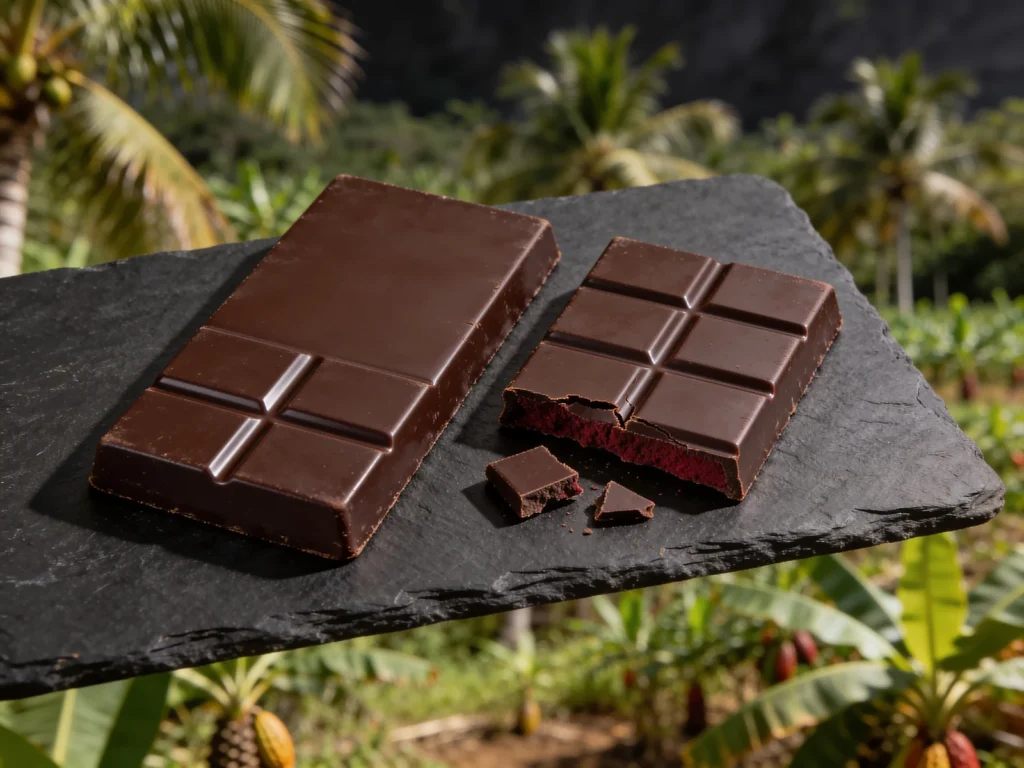
São Tomé chocolate is a dessert from São Tomé and Príncipe: intense dark chocolate made on the island from its own plantation cocoa. São Tomé was briefly the world’s largest cocoa producer around 1900; a British boycott over forced labour on its roças collapsed the trade in 1909.
How long does São Tomé chocolate take to make?
São Tomé chocolate takes 1 hr 30 min active of preparation and 24 hr grinding and setting, plus 7 days if you ferment beans yourself of cooking. The recipe makes about 700 g, roughly 7 bars. It is rated hard to make.
What can I substitute in São Tomé chocolate?
Yes, within limits. No melanger? Buy ready-made Sao Tomean cocoa liquor or a 100 percent bar, melt it, and blend in icing sugar (which is already fine enough) plus cocoa butter for a rustic bar you can temper the same way. Unrefined cane sugar can be replaced with plain caster sugar for a cleaner, less molasses-tinged bar. If you cannot source Sao Tomean beans, other Gulf of Guinea Amelonado beans, such as those from Principe’s neighbours, share the earthy Forastero backbone.
What is the most important thing to get right in São Tomé chocolate?
Understand the origin: the pods are cut ripe, split, and the wet beans heaped in wooden boxes under banana leaves to ferment for 5 to 7 days, turned daily as the pulp drains and the temperature climbs to about 50°C (120°F). This is where the chocolate flavour is actually created; a bean that has not fermented properly can never be rescued in the roaster.