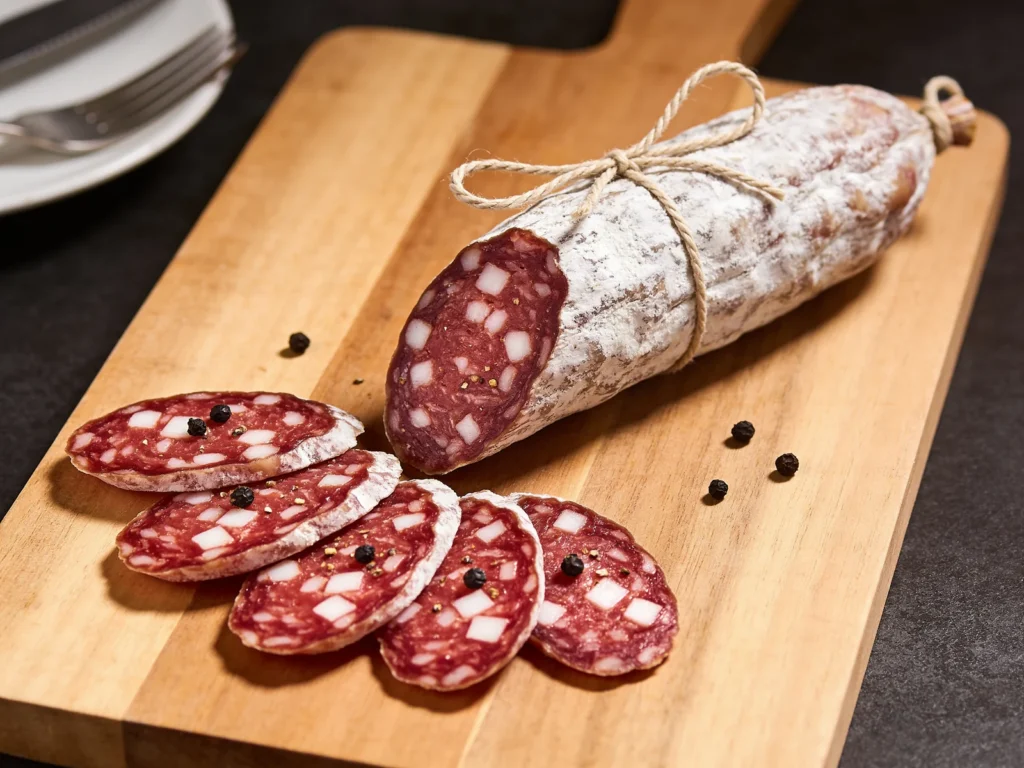

Ingredients
Meat and fat
- 2 kglean pork shoulder, well trimmed, chilled to 0°C (30°F)
- 600 gpork belly or jowl
- 400 ghard pork back fat, part-frozen
Cure per kilo of total mix
- 26 gfine sea salt (2.6 per cent)
- 3 gcuring salt number 2 with nitrite and nitrate
- 3 gcaster sugar or dextrose
- 3 gcoarse black pepper
- 2 gwhole white peppercorns
- 3 ggarlic, crushed to a paste in 40 ml dry red wine
- 1 gground nutmeg
- 0.5 gcrushed aniseed, optional and typical of some Tandil houses
Culture and casing
- 0.5 gstarter culture for fast-fermented dry sausage (Pediococcus and Staphylococcus), rehydrated in 20 ml unchlorinated water
- natural pork casings 40 to 45 mm, soaked and rinsed
- butcher’s twine
Directions
- Chill every piece of meat, the fat, the grinder plates and the mixing bowl until the fat is almost frozen; keeping the mix below 4°C (40°F) throughout is what stops the fat smearing and gives the clean mosaic Tandil salami is known for.
- Mince the lean meat through a 6 mm plate and the belly and back fat through an 8 mm plate, or hand-dice the back fat into 4 mm cubes for a coarser cut.
- Mix the salt, curing salt, sugar and spices through the meat with the wine and garlic for 3 to 4 minutes, until the mass turns tacky and clings to your hand when turned upside down. Fold in the rehydrated culture last.
- Stuff the mix tightly into the casings with no air pockets, prick any bubbles with a sterile needle, tie into 25 cm links and weigh each one, writing the green weight on the tag.
- Ferment at 22 to 24°C (75°F) and 90 per cent humidity for 48 to 72 hours, until the pH has dropped to 5.0 or below and the surface has firmed and taken on a slight lactic smell.
- Move them to a drying room at 12 to 14°C (55°F) and 75 to 80 per cent humidity with slow air movement. Tandil’s dry, breezy pampas air at the foot of the sierras is the historic reason the town’s salami is what it is.
- Let a white Penicillium bloom develop over the first two weeks, brushing off any green, black or fuzzy grey growth with a vinegar-dampened cloth.
- They are ready when each salami has lost 35 to 38 per cent of its green weight, usually 30 to 60 days, and feels firm end to end with no soft core. Slice thin, at an angle, for a picada.
Technique
- Salame de Tandil holds an Indicacion Geografica, granted in 2011 and the first Argentine food to receive one. It is defined by the region, the Basque and Italian curing tradition brought there in the 19th century, and by the climate rather than by a single spice formula.
- Curing salt is a food-safety requirement, not a flavour choice. Nitrite protects against Clostridium botulinum during the slow, low-oxygen dry, and the pH drop below 5.0 in the first three days is the second barrier.
- Case hardening is the common failure: if the outside dries far faster than the inside you get a hard shell and a wet core. Cure it by lowering the temperature, raising humidity, and vacuum-bagging the salami for a week to equalise.
- Weigh, do not guess. Weight loss is the only reliable measure of when a dry sausage is safe and ready.
Substitutions
- No curing chamber: a wine fridge set to 13°C (55°F) with a tray of salt water and a small fan gives usable conditions, or a cool cellar in winter with the salamis hung away from draughts.
Variations
- Salamin, the thinner version stuffed into 30 mm casing, dries in three weeks and is what most Argentines actually slice at home.
- Some Tandil producers add a share of another red meat and a heavier hand with the aniseed, giving a sweeter, more perfumed sausage.
History
Cured in Tandil since Basque and Italian settlers arrived; it was the first Argentine food granted a protected geographical indication.
Frequently asked questions
What is Salame de Tandil?
Salame de Tandil is a charcuterie & cured from Argentina: dry-cured salami from the Buenos Aires hills, sliced for picadas. Cured in Tandil since Basque and Italian settlers arrived; it was the first Argentine food granted a protected geographical indication.
How long does Salame de Tandil take to make?
Salame de Tandil takes 2 hr over two days of preparation and 3 days fermenting plus 30 to 60 days drying of cooking. The recipe makes about 8 salamis of 300 g. It is rated hard to make.
What can I substitute in Salame de Tandil?
Yes, within limits. No curing chamber: a wine fridge set to 13°C (55°F) with a tray of salt water and a small fan gives usable conditions, or a cool cellar in winter with the salamis hung away from draughts.
What is the most important thing to get right in Salame de Tandil?
Salame de Tandil holds an Indicacion Geografica, granted in 2011 and the first Argentine food to receive one. It is defined by the region, the Basque and Italian curing tradition brought there in the 19th century, and by the climate rather than by a single spice formula.