
Ingredients
Vegetable, choose one
- 800 gspinach
- or 800 g beetroot leaves and beets
- or 600 g green beans
- or 800 g cabbage
- or 600 g nettles
Walnut base
- 250 gwalnuts
- 4 clovesgarlic
- 1 bunchcoriander
- 1 tspground blue fenugreek, utskho suneli
- 1 tspground coriander seed
- ½ tspground marigold, imeretian saffron
- 1 tspred wine vinegar
- ½ tspcayenne or ground red pepper
- salt
To finish
- pomegranate seeds
- coriander leaves
To serve
- mchadi, cornbread
- or shotis puri
Directions
- Use fresh walnuts and taste one first. Blanch the chosen vegetable briefly: spinach for 90 seconds, beans for 5 minutes, cabbage for 6, nettles for 3. Keep the blanching short and refresh everything in iced water, which fixes the colour. Now squeeze the vegetable genuinely dry, hard, in your hands or in a cloth.
- Squeeze it far harder than feels right. For beetroot pkhali, roast the beets whole rather than boiling them, which keeps them dense and sweet. Chop the drained vegetable very finely with a knife, or pulse it briefly.
- Pound the walnuts, garlic, fresh coriander, spices and salt into a paste in a mortar, or grind them. Pounding gives a better texture than a blender, because it crushes the walnuts and releases their oil rather than cutting them.
- Add the vinegar and taste, which should be clearly sharp. Mix it by hand so you can feel when it comes together and holds. It should be stiff enough to shape into a ball that holds without slumping.
- Taste and adjust for salt, vinegar and heat, and expect it to need more salt than you think. Now let it rest at least an hour, and it is better after several. Shape it into small balls or quenelles, or press it into a mound and score the top.
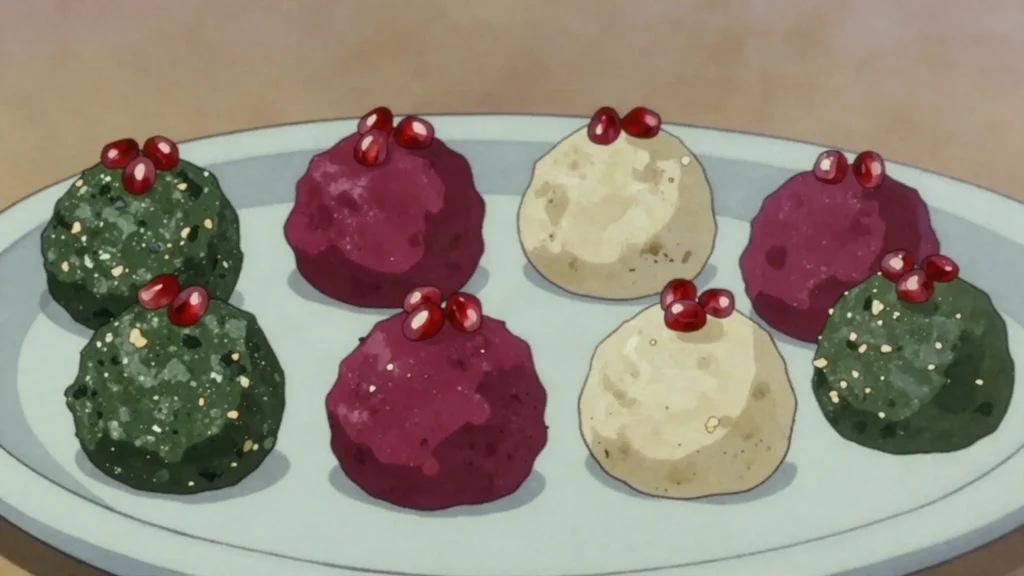
- Press a hollow into the top of each and fill it with pomegranate seeds. The pomegranate is traditional and it is not only decoration, because its sharpness cuts the richness of the walnuts.
- Serve at room temperature with mchadi or bread, as part of a spread of several pkhali. It keeps three days in the fridge and improves for the first two. Bring it back to room temperature before serving, because cold flattens the walnut flavour entirely.
Technique
- Nettle pkhali is made in spring and is considered particularly good.
- Badrijani nigvzit, aubergine rolls with the same walnut paste, is the close relative.
- The walnut paste is the base of a great deal of Georgian cooking, including satsivi.
Substitutions
- Any dark leafy green, or roasted beetroot, or green beans.
- Ground fenugreek and a pinch of turmeric at a pinch, though neither matches the Georgian spices.
Variations
- Beetroot pkhali, deep red and sweet.
- Nettle pkhali in spring.
- Bean or cabbage pkhali, both pale.
History
A dish of finely chopped vegetables, most commonly spinach, beet greens or cabbage, mixed with a paste of ground walnut, garlic and vinegar, formed into small balls or patties and often garnished with pomegranate seed, documented across Georgia for many generations as a significant vegetable dish. Its walnut-paste base reflects the deep, centuries-old importance of walnuts across Georgian cooking, and pkhali is traditionally prepared in several different vegetable varieties served together as part of the same meal, reflecting a broader Georgian supra feast tradition of presenting many small, distinct dishes rather than one central plate. Pkhali remains one of the most iconic and widely recognized traditional Georgian dishes, especially valued during periods of Orthodox Christian fasting.
Frequently asked questions
What is Pkhali?
Pkhali is a salad & side from Georgia: minced spinach or beet greens with walnut-garlic paste, pomegranate seeds. A dish of finely chopped vegetables, most commonly spinach, beet greens or cabbage, mixed with a paste of ground walnut, garlic and vinegar, formed into small balls or patties and often garnished with pomegranate seed, documented across Georgia for many generations as a significant vegetable dish. Its walnut-paste base reflects the deep, centuries-old importance of walnuts across Georgian cooking, and pkhali is traditionally prepared in several different vegetable varieties served together as part of the same meal, reflecting a broader Georgian supra feast tradition of presenting many small, distinct dishes rather than one central plate. Pkhali remains one of the most iconic and widely recognized traditional Georgian dishes, especially valued during periods of Orthodox Christian fasting.
How long does Pkhali take to make?
Pkhali takes 30 min of preparation and 20 min of cooking. The recipe makes 6 servings. It is rated easy to make.
What can I substitute in Pkhali?
Yes, within limits. Any dark leafy green, or roasted beetroot, or green beans. Ground fenugreek and a pinch of turmeric at a pinch, though neither matches the Georgian spices.
What is the most important thing to get right in Pkhali?
Squeeze it far harder than feels right. For beetroot pkhali, roast the beets whole rather than boiling them, which keeps them dense and sweet. Chop the drained vegetable very finely with a knife, or pulse it briefly.