
Ingredients
Nuts
- 400 gwalnut halves, kept whole and unbroken
- 8lengths of strong cotton thread, 60 cm each
- 1long darning needle
Tatara (thickened must)
- 2 litresfresh grape must, pressed from Rkatsiteli or Saperavi grapes
- 200 gplain wheat flour, sifted
- 1 tbsppowdered chalk or kirsi (white clay), optional, to cut the acid
- 100 gsugar, only if the grapes were low in sugar
Directions
- Thread the walnut halves onto doubled cotton, leaving 10 cm bare at the bottom and a loop at the top. Stop about 25 cm short of the loop so there is a bare handle to hang from.
- Bring the must to a simmer in a wide pan. If using chalk, stir in a slurry of it now, simmer 10 minutes, then let it stand off the heat 2 hours and ladle off the clear must, leaving the sediment behind.
- Whisk 400 ml of the cold clear must into the flour until absolutely smooth, with no lumps at all.
- Heat the remaining must to a bare simmer, then pour in the flour slurry in a thin stream, whisking hard. Cook at a lazy blip for 30–40 minutes, stirring constantly with a wooden spoon so it does not catch.
- It is ready when the tatara coats the spoon like thick custard and a spoonful dropped on a cold plate holds its shape, roughly 105°C (225°F).
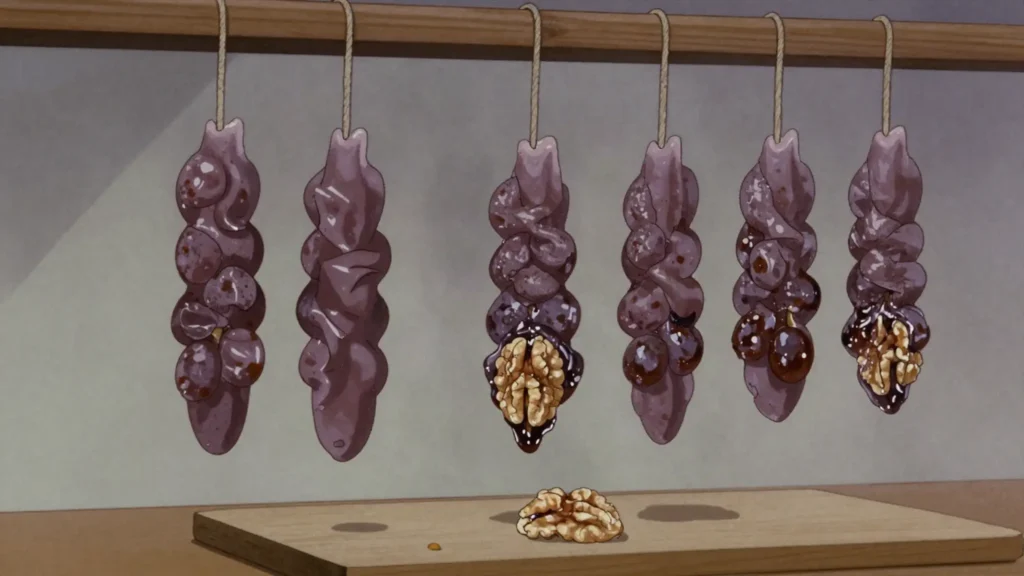
- Take the pan off the heat and let the tatara cool to about 70°C (160°F), thick but still flowing. Hold each string by the loop and lower the nuts in, twirling so every walnut is coated; lift, let the excess run back, and hang on a rod with a tray beneath.
- Let them set for 2–3 hours until touch-dry, then dip a second and a third time, drying between each coat, until the churchkhela is as thick as a thumb.
- Hang in a dry, airy, shaded place at 15–22°C (60–70°F) for 5–7 days until the surface is leathery and no longer tacky.
- Wrap in a clean cotton cloth and mature in a cool dry room for a further 1–2 weeks, until a fine white sugar bloom dusts the outside and the inside is chewy, not runny.
Technique
- The flour must be hydrated in cold must first. Tipping dry flour into hot must gives permanent lumps, and lumpy tatara slides off the nuts.
- Airflow decides everything. In damp still air the coating stays wet and moulds; if you see fuzz rather than white sugar bloom, discard the string.
- The white bloom on a mature churchkhela is crystallised grape sugar and is the mark of a good one, not spoilage.
- It is not a sweet-shop candy: made properly with must alone, it is only as sweet as the grapes were.
Substitutions
- No fresh must: reduce 3 litres of unsweetened dark grape juice to 2 litres, then proceed. It is sweeter and less tannic than true must.
- Kakhetians use wheat flour; in Imereti and Guria the same job is done with 180 g fine maize flour, giving a softer, more pudding-like coat.
Variations
- Kakhuri churchkhela, walnut and wheat flour, the classic dark version sold on every roadside.
- Gurian and Abkhaz versions strung with hazelnuts, sometimes with a tail of dried tklapi fruit leather.
- Phelamushi: the same maize tatara eaten warm in a bowl with sliced sulguni, no nuts at all.
History
A candle-shaped candy, made by dipping a string of threaded walnuts or hazelnuts repeatedly into thickened, spiced grape juice until it builds up into a firm, chewy coating, documented across Georgia and the wider Caucasus region for many centuries, sometimes informally described as a Georgian energy bar given its dense, portable, long-lasting nature. Its production, historically timed to the annual grape harvest and winemaking season when fresh grape juice, called tatara, becomes available in large quantities, reflects churchkhela’s deep connection to Georgia’s ancient and highly significant winemaking tradition, since the candy essentially preserves the season’s grape harvest in a durable, storable form. Churchkhela remains one of Georgia’s most iconic traditional sweets, closely tied to the country’s winemaking culture and harvest season.
Frequently asked questions
What is Churchkhela?
Churchkhela is a snack from Georgia: strung walnuts dipped in thickened grape must, dried into chewy candles. A candle-shaped candy, made by dipping a string of threaded walnuts or hazelnuts repeatedly into thickened, spiced grape juice until it builds up into a firm, chewy coating, documented across Georgia and the wider Caucasus region for many centuries, sometimes informally described as a Georgian energy bar given its dense, portable, long-lasting nature. Its production, historically timed to the annual grape harvest and winemaking season when fresh grape juice, called tatara, becomes available in large quantities, reflects churchkhela’s deep connection to Georgia’s ancient and highly significant winemaking tradition, since the candy essentially preserves the season’s grape harvest in a durable, storable form. Churchkhela remains one of Georgia’s most iconic traditional sweets, closely tied to the country’s winemaking culture and harvest season.
How long does Churchkhela take to make?
Churchkhela takes 45 min of preparation and 2 weeks drying of cooking. The recipe makes 8 churchkhela. It is rated medium to make.
What can I substitute in Churchkhela?
Yes, within limits. No fresh must: reduce 3 litres of unsweetened dark grape juice to 2 litres, then proceed. It is sweeter and less tannic than true must. Kakhetians use wheat flour; in Imereti and Guria the same job is done with 180 g fine maize flour, giving a softer, more pudding-like coat.
What is the most important thing to get right in Churchkhela?
Bring the must to a simmer in a wide pan. If using chalk, stir in a slurry of it now, simmer 10 minutes, then let it stand off the heat 2 hours and ladle off the clear must, leaving the sediment behind.