
Ingredients
The fish
- 4whole river fish
- about 400 g each
- scaled and gutted
- or 4 thick fillets
- salt
The seasoning
- a large bunch of sacha culantro
- or coriander with a little culantro
- 3tomatoes, sliced
- 2onions, sliced
- 4garlic cloves, crushed
- 1or 2 hot chillies, sliced
- juice of 2 limes
- salt and black pepper
To wrap
- bijao leaves
- or banana leaves
- wilted over a flame
- string or leaf strips, to tie
To serve
- boiled cassava
- or rice
- opened at the table
Directions
- Use a larger quantity if substituting. Add a little culantro if you can find it. Let the fire burn right down first. Use two or three layers of leaf. Steam and aroma come out as it opens. The gills should be red rather than brown. Cut the leaves into large squares. A few seconds each side is enough. Scale and gut the fish if needed.
- Rinse the whole cavity thoroughly. It is bitter and should come out. Rinse all of it out completely. Cut two or three slashes in each side. They also help it cook evenly. Cut down in towards the backbone. Rub salt over the fish and into the slashes. Squeeze fresh lime juice over it.
- Add it shortly before wrapping. Do not leave it sitting for hours. Chop the sacha culantro roughly. Use a large bunch rather than a few sprigs. Combining it is straightforward enough.
- Mix the herb with the garlic and chilli. Season it with salt and black pepper. The seasoning must be inside the fish. Work it right into all the cuts. Lay two or three leaves overlapping. Lay some sliced onion and tomato down.
- Set the whole fish on top of them. Lay more onion and tomato over it. Scatter more culantro over the top. Fold the leaves over the fish. Fold both of the sides in first. Wrap it tightly rather than loosely. Fold it firmly all the way round. Tie the whole parcel with string. Tie it firmly in both directions. It must hold together on the fire. Let the fire burn down to embers.
- Wait until it is glowing rather than flaming. That is what the method needs. Lay the parcel directly on the embers. Give it about twelve full minutes. Let it cook for about twelve minutes. Turn the parcel over carefully. Give it another twelve minutes.
- Use tongs rather than your hands. The hot parcel is extremely hot. Turn it once rather than repeatedly. A four hundred gram fish takes about twenty-five minutes.
- Use tongs and stand well back. Checking the fish is straightforward enough. Check there rather than at the belly. Any translucence means it needs longer. Bring the parcels to the table closed. Serve boiled cassava alongside. It does not keep at all well after.
Technique
- The parcel goes on embers rather than flames: flames burn straight through the leaf and the fish burns instead of steaming, where embers give the steady moderate heat the method needs. Use two or three overlapping leaf layers, since the outer one chars black — expected rather than a fault — while the inner ones protect the fish.
- Lay sliced onion and tomato under and over the fish rather than just around it: they cushion it from the heat and release the moisture that steams it. Then wrap the parcel tightly and tie it firmly in both directions, since a loose parcel lets steam escape and the fish dries out.
- Open the parcel away from your face and use tongs — hot steam escapes as it opens and can scald badly. That opening at the table is part of the dish, but it is genuinely hot.
Substitutions
- Banana leaf stands in for bijao, which has its own distinct aroma; the technique is identical either way. Pass any leaf briefly over a flame until it darkens and softens, since fresh leaf cracks when folded.
- Coriander stands in for sacha culantro but is much milder, so use a larger quantity; culantro has long serrated leaves and a far more concentrated flavour.
Variations
- Fresh fish has clear bright eyes, red rather than brown gills and firm flesh, and smells clean; cloudy sunken eyes, brown gills or a sour smell mean discarding it.
- Push the herb, garlic and chilli mixture into the cavity and right into the slashes, since seasoning sitting on the outside washes off.
- Check for doneness at the backbone rather than the belly, since that flesh cooks last.
History
An Amazonian technique of San Martin and Loreto; the leaf parcel is laid straight on embers and opened at the table.
Frequently asked questions
What is Patarashca?
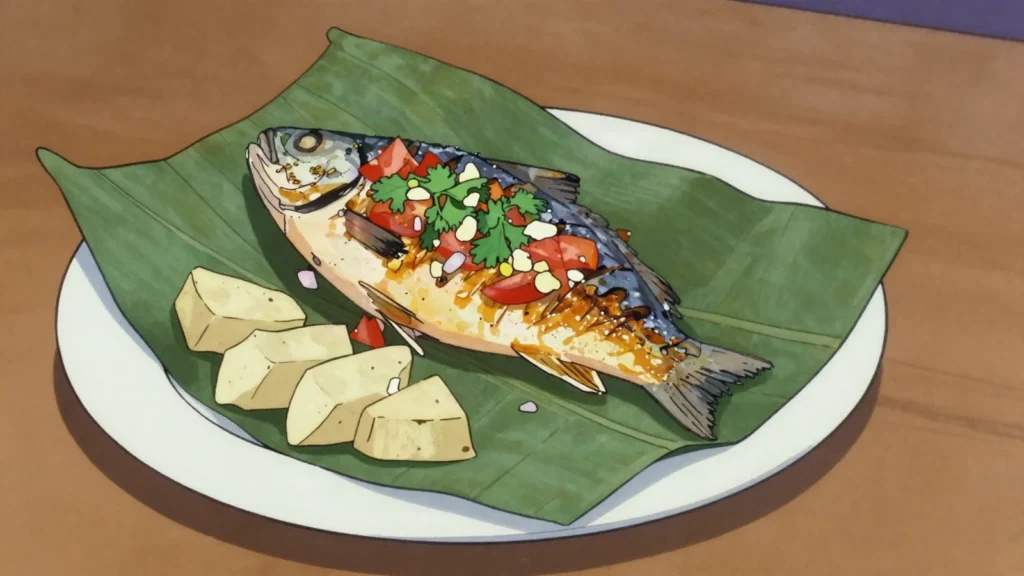
Patarashca is a main from Peru: river fish seasoned with sacha culantro and grilled in bijao leaves. An Amazonian technique of San Martin and Loreto; the leaf parcel is laid straight on embers and opened at the table.
How long does Patarashca take to make?
Patarashca takes 30 minutes of preparation and 25 minutes of cooking. The recipe makes serves 4. It is rated medium to make.
What can I substitute in Patarashca?
Yes, within limits. Banana leaf stands in for bijao, which has its own distinct aroma; the technique is identical either way. Pass any leaf briefly over a flame until it darkens and softens, since fresh leaf cracks when folded. Coriander stands in for sacha culantro but is much milder, so use a larger quantity; culantro has long serrated leaves and a far more concentrated flavour.
What is the most important thing to get right in Patarashca?
Use a larger quantity if substituting. Add a little culantro if you can find it. Let the fire burn right down first. Use two or three layers of leaf. Steam and aroma come out as it opens. The gills should be red rather than brown. Cut the leaves into large squares. A few seconds each side is enough. Scale and gut the fish if needed.