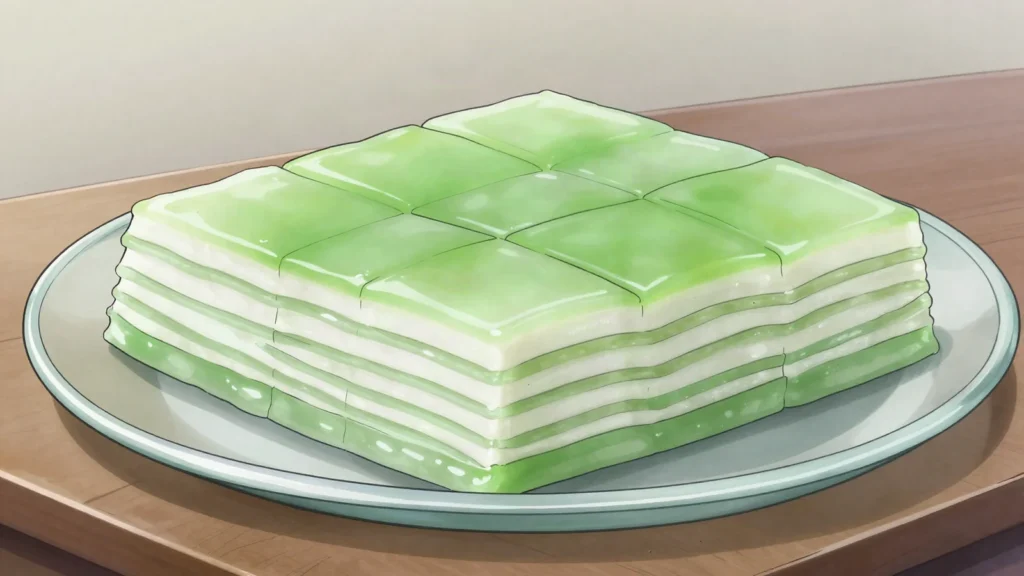

Ingredients
The base batter
- 200 grice flour
- not glutinous rice flour
- 100 gtapioca starch
- 50 gmung bean starch
- or more tapioca starch
- 200 gsugar
- half a teaspoon salt
- 800 mlcoconut milk
- 200 mlwater
The green layer
- half the batter
- a large bunch of pandan leaves
- about 60 g, blended and strained
- or 1 teaspoon pandan extract
- see the note on colour
The white layer
- the other half of the batter
- plain, or with extra coconut cream
Equipment
- a steamer with a lid
- a shallow tin or tray
- about 20 by 20 cm
- lightly oiled
- a cloth for the lid
- a ladle
To serve
- cut into diamonds or squares
- at room temperature
- with tea
Directions
- Use plain rice flour, not glutinous. Cut the leaves into short lengths. Blend them with a little water. Blend for a minute until well broken down. Strain through muslin, squeezing hard. Natural pandan gives a soft muted green. Check the label if that matters to you. Whisk the flours, starches, sugar and salt together.
- Whisk the dry ingredients before any liquid. Mixing them dry prevents most of that. Add the coconut milk gradually while whisking. Add the water. Whisk until completely smooth. Pour the batter through a fine sieve.
- Divide the batter into two equal parts. Add the pandan liquid to one half. Leave the other half plain. Both should be thin and pourable. Whisk each batter before every single ladle. Bring the water to a rolling boil. Oil the tin lightly. Set it in the steamer to heat. Tie a cloth under the steamer lid.
- Ladle a thin layer of green batter in. About half a centimetre deep. Cover and steam for about five minutes. The layer should be set and no longer liquid. Whisk the white batter. Ladle it over the set green layer. Pour it gently over the back of a spoon. Cover and steam another five minutes.
- Continue alternating green and white. Whisk before each ladle. Steam each until set. Thin layers look better than thick ones. Check the steamer water level throughout.
- Top it up with boiling water. Adding cold water drops the temperature. Steam scalds badly. Lift the lid away from your face. Lift the far edge first. Lift the tin out and let it cool completely. Give it at least three hours. Warm cake is soft and will not cut. Cold cake cuts into clean diamonds.
- Oil a knife before cutting. The cake is sticky and it drags on a dry blade. Cut it into diamonds or squares. Cut parallel lines, then diagonal ones. Serve it at room temperature. Serve it with tea. Check the flours have not been milled with wheat. It keeps two days at room temperature. Keep it covered so it does not dry. It hardens if refrigerated.
Technique
- Whisk the batter before every single ladle. The starch settles constantly, and unstirred batter gives layers of uneven thickness that separate badly — this is the step people forget.
- Tie a cloth under the steamer lid. Condensation drips pit the surface of each layer and make them watery, and with ten or more layers the damage compounds. This is essential here rather than optional.
- Pour each new layer gently over the back of a spoon. Poured hard, it dents or breaks the set layer beneath and gives muddy mixed bands.
- Steam each layer about five minutes, until it is set, firm and slightly tacky rather than wet. Give the final layer ten minutes, since the top has not had the cumulative steaming the bottom layers have.
- Cool it completely, at least three hours and preferably overnight. The starch sets only as it cools — warm cake will not cut, sticks to the knife and tears.
- Do not refrigerate it. Cold hardens the starch too far and it goes tough and loses its chew; if you must, bring it back to room temperature, which restores most of it.
- Oil the knife or dip it in water between cuts. The cake is sticky and drags badly on a dry blade.
- Strain the batter through a fine sieve after mixing. Lumps are visible and unpleasant in a layer cake, and whisking the dry flours together before adding liquid prevents most of them.
- Use plain rice flour, not glutinous, which gives a sticky opaque cake — a different thing entirely, sold in near-identical bags.
- Tapioca starch gives the chew and cornflour is not a good substitute, being softer and less elastic. Asian grocers sell it cheaply.
- Natural pandan gives a soft muted green, not the vivid green of shop cakes, which comes from food colouring. Most commercial versions use it, and the atlas records that without judgement — add a drop if you want the bright colour, or accept the gentler one.
- Check the steamer water throughout and top it up with boiling water, never cold. Lift the lid away from your face every time, far edge first — you will be doing it ten or more times.
- This is naturally free of gluten, egg and dairy, which makes it useful for many people; check the flours have not been milled alongside wheat.
Substitutions
- Bottled pandan extract replaces fresh leaves; many contain colouring already.
- Frozen pandan leaves replace fresh and work well; dried have almost no flavour.
- More tapioca starch replaces mung bean starch, giving a slightly softer set.
- A drop of green food colouring gives the vivid shop colour.
- Butterfly pea flower gives a blue layer instead of green.
- Palm sugar replaces white sugar for a darker, more caramel flavour.
Variations
- Kuih lapis in Malaysia and Singapore is the same cake, often in pink and white.
- Kue lapis in Indonesia is the closest relative.
- Bánh da lợn in Vietnam adds mung bean to alternate layers.
- Khanom chan in Thailand is built the same way in nine layers.
- Num ansom and other Cambodian sweets are made for the same festivals.
- A version with a mung bean paste layer is made in some households.
Frequently asked questions
What is Nom Chak Kachan?
Nom Chak Kachan is a dessert from Cambodia: steamed layer cake of rice flour, coconut milk and pandan in green and white bands.
How long does Nom Chak Kachan take to make?
Nom Chak Kachan takes 40 minutes of preparation and 1 hour, plus setting of cooking. The recipe makes makes about 20 pieces. It is rated medium to make.
What can I substitute in Nom Chak Kachan?
Yes, within limits. Bottled pandan extract replaces fresh leaves; many contain colouring already. Frozen pandan leaves replace fresh and work well; dried have almost no flavour. More tapioca starch replaces mung bean starch, giving a slightly softer set. A drop of green food colouring gives the vivid shop colour. Butterfly pea flower gives a blue layer instead of green. Palm sugar replaces white sugar for a darker, more caramel flavour.
What is the most important thing to get right in Nom Chak Kachan?
Tie a cloth under the steamer lid. Condensation drips pit the surface of each layer and make them watery, and with ten or more layers the damage compounds. This is essential here rather than optional.