
Ingredients
Beans
- 3 kgdried soybeans
- water, for soaking and boiling
Equipment
- rice straw, or a straw mat
- string, for hanging
- a warm room, around 25 to 30°C (77 to 86°F)
Directions
- Soak the soybeans overnight in plenty of cold water, then drain.
- Boil them for three to four hours until a bean crushes easily between finger and thumb. They must be genuinely soft — undercooked beans will not bind into a block.
- Drain and crush them while hot, traditionally in a wooden mortar, to a coarse paste with some texture left.
- Shape into firm rectangular blocks about 15 by 20 cm, pressing hard so there are no air pockets inside. A loose block cracks and moulds through the middle.
- Dry the blocks in a warm airy place for three to five days, turning daily, until the outsides are hard and dry to the touch.
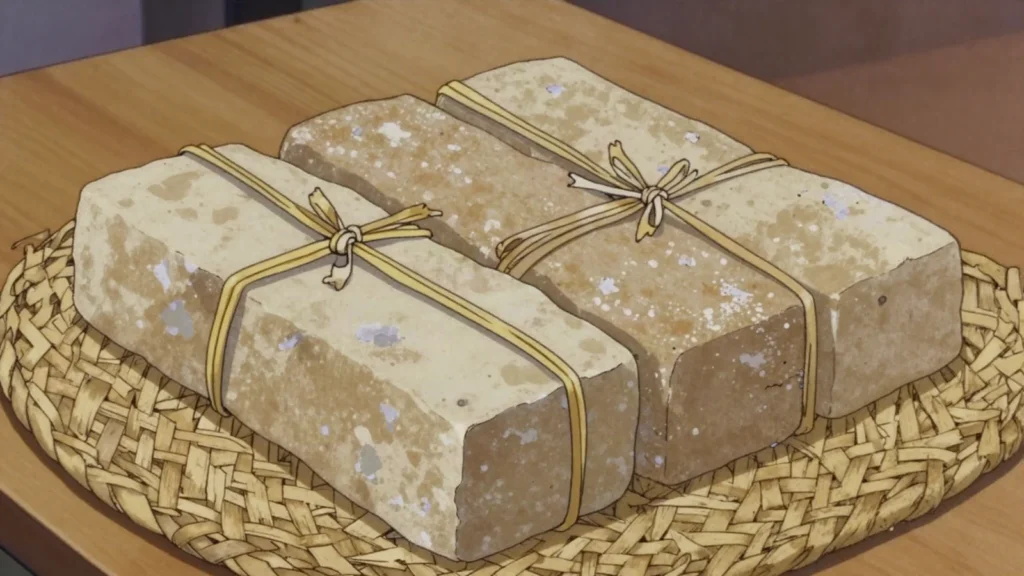
- Wrap each block in rice straw and hang them under the eaves or from a beam in a warm room for four to six weeks.
- The straw is the whole point. It carries Bacillus subtilis and the wild moulds that ripen the block — this is a deliberate open inoculation from the environment, and it is why meju is made in late autumn when the air carries the right organisms.
- The blocks will grow a white, then yellowish, then patchy dark mould coat, and will smell strongly ammoniacal. That is correct.
- When they are hard through and lighter in the hand, brush the surface clean and dry them in the sun for a day. They are now ready to brine into ganjang and doenjang at the first lunar month.
Technique
- Press the blocks hard. Air pockets are where a block goes bad rather than ripening.
- The straw and the season are the recipe. This is an open ferment relying on wild organisms, and Korean households make it at a fixed time of year for that reason.
- The ammonia smell is normal. Fuzzy black or green mould through the middle of a block is not — that block goes out.
Substitutions
- Bought meju, which is sold ready-ripened in Korean groceries and is what most households now use.
- A straw mat in place of loose straw for wrapping.
Variations
- Brined whole it makes ganjang and doenjang together.
- Ground and mixed with chilli powder and rice syrup it becomes gochujang.
History
Formed in late autumn, hung in straw under the eaves to catch wild bacteria, then brined at the first lunar month.
Frequently asked questions
What is Meju?
Meju is a fermented & pickled from South Korea: blocks of boiled crushed soybeans, mould-ripened; the starter for all Korean jang. Formed in late autumn, hung in straw under the eaves to catch wild bacteria, then brined at the first lunar month.
How long does Meju take to make?
Meju takes 2 hours plus 6 to 8 weeks drying and ripening of preparation and 4 hours of cooking. The recipe makes makes 6 blocks. It is rated hard to make.
What can I substitute in Meju?
Yes, within limits. Bought meju, which is sold ready-ripened in Korean groceries and is what most households now use. A straw mat in place of loose straw for wrapping.
What is the most important thing to get right in Meju?
Boil them for three to four hours until a bean crushes easily between finger and thumb. They must be genuinely soft — undercooked beans will not bind into a block.