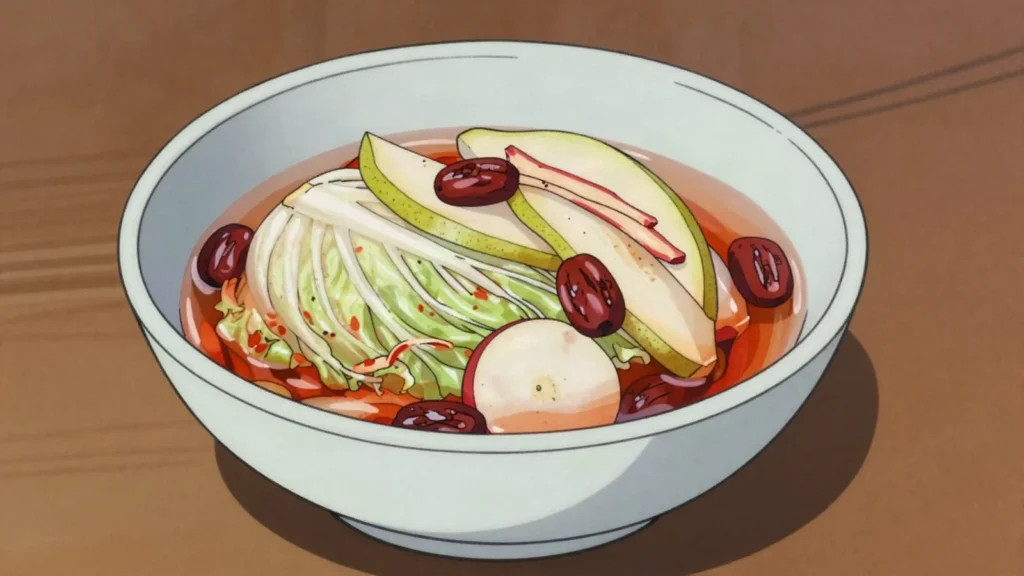

Ingredients
Cabbage
- 2Chinese cabbages, halved lengthwise
- 150 gcoarse non-iodised salt
- 2 litreswater
Filling
- 1Korean pear, in matchsticks
- 1white radish, in matchsticks
- 50 gchestnuts, sliced
- 30 gdried jujube, sliced
- 4spring onions, in lengths
- 6 clovesgarlic, in fine slivers
- 3cm ginger, in fine slivers
- 2 tbsppine nuts
- 1red chilli, seeded and cut in fine strips, for colour only
Brine
- 1.5 litreswater
- 2 tbspsalt
- 2 tbspsugar
- 3 tbspsalted shrimp or fish sauce, optional
Directions
- Soak the halved cabbages in the salt water for about four hours, turning occasionally, until the thick white stems bend without snapping.
- Rinse well in three changes of cold water and drain upside down for an hour. Under-rinsed cabbage gives kimchi that is simply salty; over-salted cabbage never ferments properly.
- Mix all the filling ingredients together. There is no chilli powder here at all — the strips of fresh red chilli are for colour, and this is how kimchi tasted before chillies reached Korea around 1600.
- Tuck the filling between every leaf of each cabbage half, working from the outside in, then fold each half over on itself and pack into a crock.
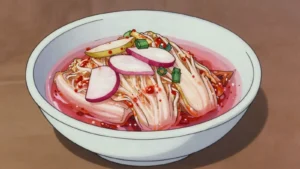
- Mix the brine ingredients and pour over until the cabbage is just covered. Baek kimchi sits in a clear brine rather than a paste, and that brine is drunk as well as eaten.
- Weight the cabbage down so nothing floats, cover, and leave at cool room temperature for one to two days until it starts to smell faintly sour and the brine turns cloudy.
- Move to the fridge and leave at least three more days before eating. It goes on souring slowly for weeks.
- Serve cold, cut into pieces, with some of the brine spooned over — and use the brine as the broth for cold noodles.
Technique
- Rinse the salted cabbage properly and taste a piece. This decides whether the kimchi is seasoned or just salty.
- No chilli powder. Adding it makes an ordinary kimchi and loses the point of this one.
- The brine is part of the dish, not packing liquid.
Substitutions
- Leave out the salted shrimp for a vegan version, adding a little more salt.
- Apple or nashi in place of Korean pear.
- Walnuts or almonds in place of pine nuts.
Variations
- The brine is used as the broth for dongchimi-guksu and naengmyeon.
- A Kaesong version wraps the filling in whole leaves as bossam kimchi.
History
This is how kimchi tasted before chilies reached Korea around 1600; the white style survives for children and cold-noodle broths.
Frequently asked questions
What is Baek Kimchi?
Baek Kimchi is a fermented & pickled from South Korea: chili-free white kimchi in clear brine with pear, jujube and chestnut. This is how kimchi tasted before chilies reached Korea around 1600; the white style survives for children and cold-noodle broths.
How long does Baek Kimchi take to make?
Baek Kimchi takes 1 hour 30 minutes plus 4 hours salting and 3 days fermenting of preparation and no cooking at all. The recipe makes makes about 2 kg. It is rated medium to make.
What can I substitute in Baek Kimchi?
Yes, within limits. Leave out the salted shrimp for a vegan version, adding a little more salt. Apple or nashi in place of Korean pear. Walnuts or almonds in place of pine nuts.
What is the most important thing to get right in Baek Kimchi?
Rinse well in three changes of cold water and drain upside down for an hour. Under-rinsed cabbage gives kimchi that is simply salty; over-salted cabbage never ferments properly.