
Ingredients
The fish
- 400 gsalted fish
- maleh, bought cured
- safi, rabbitfish, or chanad, kingfish
- not home-cured, see the note
- from a Gulf or Middle Eastern grocer
For soaking
- cold water, several changes
- milk, for the last soak
- optional, see the note
The rice
- 400 gbasmati rice
- rinsed and soaked 30 minutes
- 2onions, sliced
- 4 clovesgarlic, crushed
- a thumb of ginger, grated
- 3tomatoes, chopped
- 2green chillies, slit
- 1 teaspoonturmeric
- 1 tablespoonbaharat
- or mixed Gulf spice
- 3dried limes, loomi, pierced
- 4 tablespoonsoil or ghee
- no salt until you taste it
- see the note
To serve
- fresh coriander
- lime wedges
- sliced raw onion
- daqoos, the tomato sauce
- salad
Directions
- Salt was the answer. Cook it when nobody minds. It makes no recommendation about anyone’s diet. Rinse the fish under cold running water. Put it in a bowl of cold water. Give it eight to twelve hours.
- Soak it in the refrigerator. Warm soaking is exactly the wrong condition. Cover the bowl. Give it an hour or two. Break off a small piece and taste it. It should be pleasantly salty rather than harsh. Season the rest of the dish from there. Rinse the tasting piece and cook it briefly first. Do not taste salted fish raw.
- Drain the fish and pat it dry. Pull it into large flakes. Pick out the bones. Fry the flakes briefly in a little oil. Two or three minutes. Lift the fish out and keep it. Rinse the rice until the water runs clear. Soak it thirty minutes and drain it.
- Fry the onions in the oil until deep brown. Give them fifteen to twenty minutes. Brown, not burnt. Keep the heat medium and stir. Add the garlic, ginger and chillies. Cook them a minute. Add the turmeric and baharat. Stir them for thirty seconds. Spices bloom in hot fat. Add the tomatoes and cook them down. Give them five minutes until they collapse.
- Pierce each loomi with a knife. Add them whole. Loomi are limes boiled in salt water and dried until black. Add water, about one and a half times the rice by volume. Bring it to the boil. Taste before adding any salt. Add the drained rice. Stir once.
- Stir once and then leave it. Bring it back to the boil. Turn it to the lowest heat and cover it. Give it fifteen minutes.
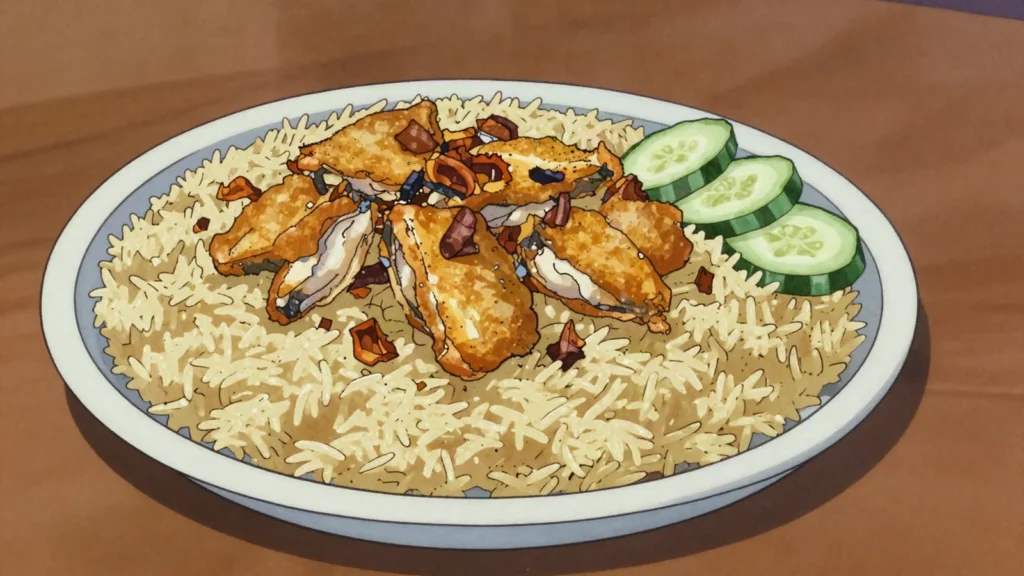
- Scatter the fried fish over the rice. Cover it again. Give it five more minutes. Take it off the heat and leave it covered. Give it ten minutes. Serve it on a wide platter. Daqoos, the thin garlicky tomato sauce. Keep it sealed, or everything nearby smells of it.
Technique
- Buy the fish already salted. The atlas gives no curing method because Clostridium botulinum type E is associated with fish, grows without air, tolerates cold, and produces a toxin with no smell, taste or visible sign — controlled by measured salt concentration, gutting, temperature and time rather than judgement. Improperly salted fish, especially uneviscerated, has caused documented botulism outbreaks.
- The soaking is the whole technique. Eight to twelve hours in cold water with three or four changes — the water saturates with salt and stops working, so one long soak in one bowl does far less. Soak it in the refrigerator: as the salt comes out, the fish loses its preservation.
- Taste a small piece, rinsed and briefly cooked, before seasoning anything else. Salted fish varies enormously and tasting is the only way to know. Do not taste it raw.
- Taste the rice before adding any salt at all. The fish brings salt with it however well you soaked it, and salting to habit gives an inedible dish.
- A final soak in milk for an hour or two softens the salt-fish flavour and sweetens the flesh.
- Fry the fish separately and add it at the end. Cooked through the whole dish it disintegrates; added late it stays in flakes.
- Pierce the dried limes. Whole and unpierced they float and give nothing.
- Brown the onions properly — fifteen to twenty minutes — because browned onion is the base flavour of Gulf rice and there is no shortcut. Brown, not burnt; burnt onion is bitter throughout.
- Rinse and soak the rice, stir it once and then leave it alone. Stirring rice as it cooks breaks the grains, and opening it early gives wet rice.
- The smell is extremely strong and gets into a kitchen and stays. Open windows first. It divides people completely — some Bahrainis love it and some cannot be in the house with it, and the atlas says so rather than pretending otherwise.
- Cover the soaking bowl. The smell transfers to everything in the refrigerator.
- The IARC classifies Chinese-style salted fish as carcinogenic to humans — a classification naming a specific traditional product and process, which the atlas records accurately without extending it to all salted fish. Salted and preserved fish generally is associated in research with nasopharyngeal cancer risk, most strongly for heavy lifelong consumption from childhood. The atlas records that as fact and makes no dietary recommendation.
- Judge a piece by firm, dry, pale-to-amber flesh smelling strongly fishy but not rancid. Slimy, mouldy or damp fish, a rancid or ammoniac smell, or red or pink discolouration all mean leave it.
- Salted fish is often bony. Go through the flakes carefully by hand.
- Keep the uncooked salted fish sealed, or everything nearby smells of it.
Substitutions
- Any salted fish works — bacalao, salt cod, is the most widely available.
- Salted mackerel or salted herring substitute, both stronger.
- Fresh kingfish, well salted at the pan, gives the dish without the cure.
- Lime juice and zest replace dried limes at some cost in smokiness.
- Any Gulf or Levantine baharat blend works; garam masala is close.
- Ghee replaces oil and is more traditional.
Variations
- Maleh cooked with tomato and eaten with bread instead of rice.
- Machboos with fresh fish is the everyday version of the same rice.
- Muhammar, the sweet date rice, is served with fried fish instead.
- Bacalao dishes across the Atlantic use the same soak-then-cook logic.
- Shutki in Bengal is the dried rather than brined counterpart.
- A version with more chilli is made in the South Asian households of Bahrain.
History
Bahrain’s fishing villages salted surplus catch in barrels; the smell is strong and the taste divisive.
Frequently asked questions
What is Maleh?
Maleh is a charcuterie & cured from Bahrain: salted fish packed in brine, cooked with rice or eaten with bread. Bahrain’s fishing villages salted surplus catch in barrels; the smell is strong and the taste divisive.
How long does Maleh take to make?
Maleh takes 20 minutes plus 12 hours soaking of preparation and 45 minutes of cooking. The recipe makes serves 4. It is rated medium to make.
What can I substitute in Maleh?
Yes, within limits. Any salted fish works — bacalao, salt cod, is the most widely available. Salted mackerel or salted herring substitute, both stronger. Fresh kingfish, well salted at the pan, gives the dish without the cure. Lime juice and zest replace dried limes at some cost in smokiness. Any Gulf or Levantine baharat blend works; garam masala is close. Ghee replaces oil and is more traditional.
What is the most important thing to get right in Maleh?
Soak it in the refrigerator. Warm soaking is exactly the wrong condition. Cover the bowl. Give it an hour or two. Break off a small piece and taste it. It should be pleasantly salty rather than harsh. Season the rest of the dish from there. Rinse the tasting piece and cook it briefly first. Do not taste salted fish raw.