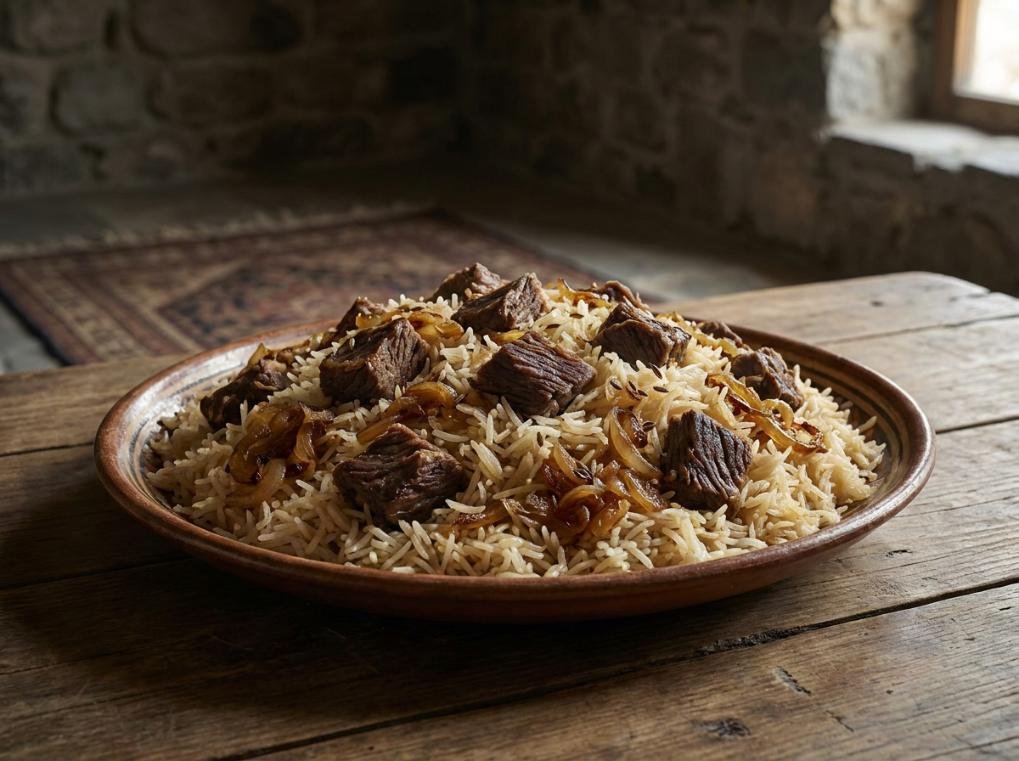

Ingredients
The animal
- 1whole fat-tailed sheep, about 25 to 35 kg, ideally a well-fattened wether slaughtered in late autumn
- the fat tail (dumba) left attached
Cure
- 2to 3 kg coarse rock salt, roughly 8 to 10 per cent of the carcass weight
- 2 tbspground black pepper (optional, Ghazni style)
- 1 tbspground cumin (optional)
Equipment
- a clean, cold, well-ventilated flat roof or open shed
- muslin or a fine mesh cage against flies
- strong cord
To cook later
- the dried meat, cut into pieces, plus rice, onion and water
Directions
- Warm weather is the single most common cause of a spoiled landi. Skin the animal, remove the head, feet and all the internal organs, and wipe the cavity dry with cloth; do not wash it with water, which drives moisture into the meat.
- Slash the thick muscles of the leg and shoulder to the bone so the salt can reach the middle; unsalted deep muscle is where spoilage starts.
- Rub the salt hard into every surface, working it into the slashes, the cavity and around the bones, using roughly 8 to 10 per cent of the carcass weight in total, and adding the pepper and cumin if you use them.
- Stack the salted pieces in a cool place on a slatted surface for 24 to 48 hours so the brine draws out and runs off, then rub in a second, lighter coat of salt.
- Hang the pieces from the roof beams or on a line on a flat roof in cold, dry, moving air, well spaced so nothing touches, and cage or wrap them in muslin against flies and birds. Dry for 3 to 6 weeks depending on the cold.
- Bring the pieces in at night if there is any chance of rain or damp; moisture is the enemy from here on. It is ready when the outside is hard, dark and leathery, the meat has lost roughly a third of its weight, and a skewer pushed into the thickest part comes out clean-smelling with no sour or sweet taint.
Technique
- This is a genuine preservation method from the high-altitude, low-humidity Hazarajat and northern provinces, where winter is long and cold and there is no refrigeration. It is not safely reproducible in a warm or humid climate.
- The key food-safety numbers are the salt rate, 8 to 10 per cent of carcass weight, and the ambient temperature, which needs to stay in the region of 2 to 10°C (50°F) throughout the dry, with humidity below about 70 per cent. Above that, use a curing chamber or do not attempt it.
- Fat-tailed sheep are chosen deliberately: the dumba fat renders slowly and does not turn rancid as fast as the fat of leaner breeds.
- Landi is a marker of a household’s winter security, prepared communally in autumn, and the first cut is traditionally shared with neighbours.
Substitutions
- A whole sheep is impractical for most kitchens. The same cure works on a single bone-in leg, salted at 8 per cent of its weight, drained 2 days and dried 3 weeks at 4 to 8°C (45°F) in a fridge or curing chamber with a fan, and it is what the Afghan diaspora does.
Variations
- Landi in Ghazni is often rubbed with pepper and cumin before drying; further north it is left plain.
- Some households cold-smoke the meat lightly over dung or brushwood for the first days, which speeds surface drying and deters flies.
History
Winter meat store of the Hazarajat and Ghor highlands, butchered in late autumn and dried in cold dry air before snow closes the passes.
Frequently asked questions
What is Landi?
Landi is a charcuterie & cured from Afghanistan: whole sheep salted and air-dried on the roof, kept for eating through winter. Winter meat store of the Hazarajat and Ghor highlands, butchered in late autumn and dried in cold dry air before snow closes the passes.
How long does Landi take to make?
Landi takes 1 day of butchery and salting of preparation and 3 to 6 weeks of air-drying of cooking. The recipe makes 1 whole sheep, feeding a household through the winter. It is rated hard to make.
What can I substitute in Landi?
Yes, within limits. A whole sheep is impractical for most kitchens. The same cure works on a single bone-in leg, salted at 8 per cent of its weight, drained 2 days and dried 3 weeks at 4 to 8°C (45°F) in a fridge or curing chamber with a fan, and it is what the Afghan diaspora does.
What is the most important thing to get right in Landi?
Warm weather is the single most common cause of a spoiled landi. Skin the animal, remove the head, feet and all the internal organs, and wipe the cavity dry with cloth; do not wash it with water, which drives moisture into the meat.