
Ingredients
Dough
- 500 gplain flour
- 10 gfresh yeast
- 200 mlwarm milk
- 80 gsugar
- 100 gbutter, melted
- 3egg yolks
- 1 tspsalt
- zest of 1 lemon
Fillings
- 250 gquark or tvaroh, with 1 egg yolk and 50 g sugar
- 250 gpovidla plum butter
- 200 gground poppy seed cooked with milk and sugar
Streusel
- 50 gflour
- 40 gbutter
- 40 gsugar
To finish
- melted butter
- icing sugar
Directions
- Make a soft enriched dough with the flour, yeast, warm milk, sugar, melted butter, yolks, salt and zest, and knead it 10 minutes.
- Prove for 1 hour 30 minutes until doubled.
- Divide into pieces of about 60 g and roll each into a smooth ball.
- Set them well apart on a lined tray and prove for a further 30 minutes.
- Now press a wide, deep well into the centre of each ball with the base of a glass or your knuckles.
- Press it right down almost to the tray and make the well wide. A shallow dip closes up in the oven and the filling slides off the top.
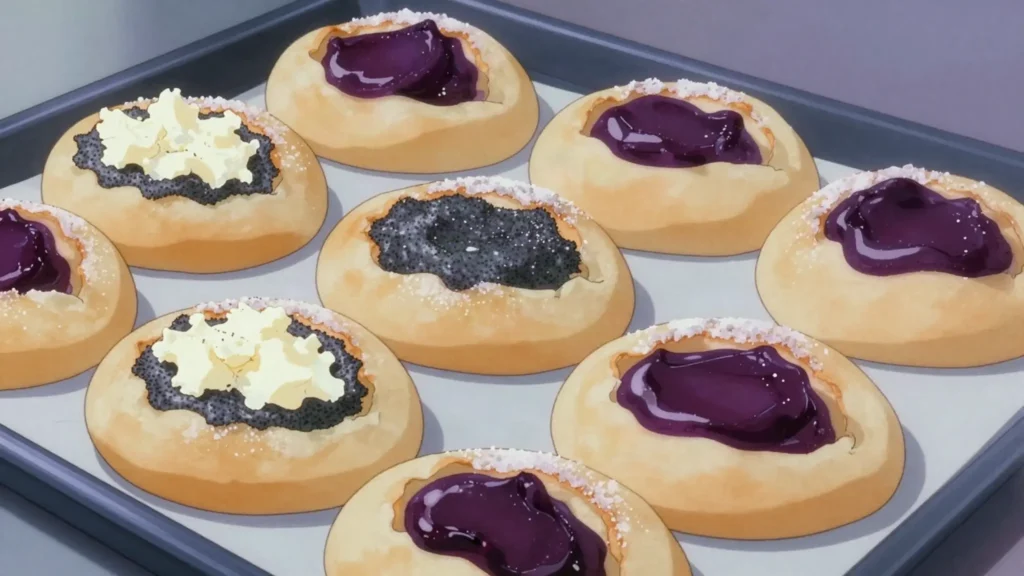
- Fill each well generously, either with one filling or with two side by side.
- The three classic fillings are tvaroh, povidla and poppy seed, and a tray with all three is how a Czech bakery sells them.
- Rub the streusel ingredients together into crumbs and scatter them over.
- Prove for 15 minutes more, just until the dough round puffs slightly around the filled well.
- Bake at 190°C (375°F) for 15 to 18 minutes, until golden.
- Brush with melted butter as they come out and dust with icing sugar once cool.
- They are open-faced and round, which is the Czech original. The filled, enclosed Texas kolache is a descendant of Moravian emigrants and is a different pastry.
- The plural is koláče and a single one is a koláč, which Czechs are particular about.
- The very large ones, made for weddings and cut into pieces, are the older form and are where the word comes from.
- Eat them the day they are made, with coffee.
Technique
- Povidla is thick slow-cooked plum butter, barely sweetened, and ordinary plum jam is too loose.
- Tvaroh is the Czech fresh curd cheese; quark is the closest thing sold elsewhere.
- Wedding kolache, svatební koláčky, are made tiny and given to guests in bags.
Substitutions
- Quark, or ricotta drained overnight and sweetened.
- Damson or prune jam cooked down further, in place of povidla.
Variations
- Svatební koláčky, made small for weddings.
- Frgál, the very large Wallachian version.
- The Texas kolache, enclosed and often savoury with sausage.
History
Round yeast pastry with poppy, curd or plum filling; Czech emigrants took it to Texas, where a town holds an annual kolache festival.
Frequently asked questions
What is Kolache?
Kolache is a bread & pastry from Czechia: round sweet yeast buns topped with quark, poppy, plum jam. Round yeast pastry with poppy, curd or plum filling; Czech emigrants took it to Texas, where a town holds an annual kolache festival.
How long does Kolache take to make?
Kolache takes 40 min plus 2 hr rising of preparation and 20 min of cooking. The recipe makes about 16. It is rated medium to make.
What can I substitute in Kolache?
Yes, within limits. Quark, or ricotta drained overnight and sweetened. Damson or prune jam cooked down further, in place of povidla.