
Ingredients
The fish
- 1carp, about 2 kg
- cleaned and cut into steaks
- or 6 thick carp fillets
- salt and lemon juice
- for the initial seasoning
The coating
- 100 gplain flour
- 2eggs, beaten
- 150 gfine breadcrumbs
- salt and white pepper
- three shallow dishes
To fry
- butter and oil mixed
- or clarified butter
- a wide heavy pan
- over a moderate heat
To serve
- Czech potato salad
- bramborový salát
- lemon wedges
- on Christmas Eve
Directions
- Score the flesh at about three millimetre intervals. Cut down to but not through the skin. It does not remove them, but it helps considerably. Rinse the carp pieces and pat them thoroughly dry. Wet fish does not take a breadcrumb coating well. Take real care with that rather than rushing it. Season the fish with salt and lemon juice. Rub the salt into both sides of each piece.
- Squeeze lemon juice over them as well. Let them sit for about twenty minutes. Soak the fish in cold milk if it tastes muddy. Give it an hour or two in the refrigerator. Score the flesh closely with a sharp knife. Make cuts about three millimetres apart. Cut down to but not through the skin.
- Work along the whole length of each piece. Use a genuinely sharp thin bladed knife. Take your time and cut evenly along the piece. Put flour, beaten egg and breadcrumbs in three dishes. Use three wide shallow dishes side by side. Season the flour with salt and white pepper. Work left to right in a single direction. That keeps the mess and the confusion down.
- Flour gives the egg something to cling to. Breadcrumbs give the crisp golden crust. Press each piece into the flour on both sides. Press it down firmly so the flour adheres. Loose flour makes the coating patchy and thick.
- Dip the floured fish into the beaten egg. Turn it so both sides are entirely coated. Let the excess egg drip off before moving on. Too much egg gives a thick soggy layer. Hold it over the dish for a few seconds. Press the fish firmly into the breadcrumbs. Press down firmly on both sides of the piece. The crumbs must adhere properly to the egg.
- Cover every surface including the edges. Let the crumbed pieces rest for fifteen minutes. Set them on a rack rather than on a plate. A rack keeps the underside from going damp. Heat butter and oil together in a wide pan. Butter gives the flavour this dish wants. Oil raises the temperature butter can reach. Use enough fat to come partway up the fish. About one centimetre deep is a reasonable amount.
- Adjust the heat if it is faster or slower. Lay the coated fish carefully into the hot fat. Lay it away from you to avoid any splashing. Do not crowd the pan with too many pieces.
- Work in batches rather than fitting them all in. Give thick steaks about five minutes a side. Turn each piece once only rather than repeatedly. Use a fish slice and slide it right under. Turn it gently rather than flipping it. The flesh should be opaque and flake easily.
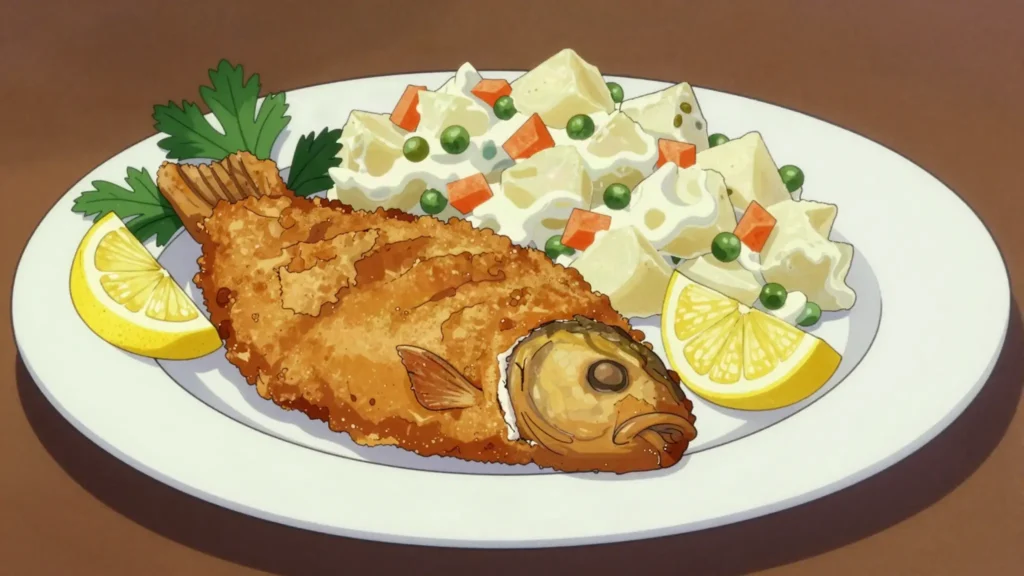
- Lift the fried fish onto kitchen paper briefly. Do not leave it sitting there for long. Boil potatoes and carrots and let them cool. Serve the hot fried carp with the cold potato salad. The fish is hot and the salad is cold. Put lemon wedges on the table with the plates. Cold fried carp is genuinely eaten the next day too.
Technique
- Carp has a great many fine, sharp Y-shaped bones scattered through the flesh rather than in a row, and they are easy to swallow — a genuine choking risk, especially for children. Warn everyone at the table, supervise young children closely, and eat it slowly. Scoring the flesh at about three-millimetre intervals down to but not through the skin cuts each bone into short segments, which frying then softens; that is a genuine traditional technique but it reduces the problem rather than solving it, and bones will still be present.
- Carp can taste muddy depending on the pond it was raised in, from compounds in the water itself, and it varies considerably from source to source. Soaking it an hour or two in cold milk reduces that, as do salt and lemon juice; both are genuinely used in Czech kitchens. Drain and dry it thoroughly afterward.
- Live carp are sold from street tubs across Czechia in December and some families keep one at home briefly — a genuinely widespread traditional custom that is also increasingly questioned on welfare grounds. The atlas records the custom rather than recommending it; buy the fish already killed and cleaned if you prefer.
Substitutions
- Thick carp fillets replace the bone-in steaks and are used in some modern kitchens; both are genuinely served in Czech homes. Clarified butter replaces the butter and oil mixture and does both jobs on its own.
- Some households dip and crumb the fish twice for a considerably thicker crust, which is genuinely done, though a single coating is more usual.
Variations
- Pat the fish thoroughly dry before coating, since a damp surface makes the breading slide off, and shake off all loose flour before the egg — loose flour makes the coating patchy. Let the excess egg drip off too, since too much gives a thick soggy layer.
- Rest the crumbed pieces fifteen minutes on a rack before frying so the coating settles and adheres; it is far less likely to fall off in the pan. Turn each piece once only with a fish slide slid right under, since repeated turning knocks the coating loose.
- Serve the hot fish with cold Czech potato salad, which is a substantial dish of potato, carrot, celeriac, pickle and egg bound with mayonnaise and mustard, made on the twenty-third of December so it improves overnight. Fish soup from the carp head and bones usually comes first, so the whole fish is used across the meal.
History
Carp were raised in South Bohemian ponds dug by sixteenth-century fishpond builders such as Jakub Krčín; live carp are still sold from street tubs in December.
Frequently asked questions
What is Smažený kapr?
Smažený kapr is a main from Czechia: breaded fried carp served with potato salad on Christmas Eve. Carp were raised in South Bohemian ponds dug by sixteenth-century fishpond builders such as Jakub Krčín; live carp are still sold from street tubs in December.
How long does Smažený kapr take to make?
Smažený kapr takes 30 minutes of preparation and 20 minutes of cooking. The recipe makes serves 6. It is rated medium to make.
What can I substitute in Smažený kapr?
Yes, within limits. Thick carp fillets replace the bone-in steaks and are used in some modern kitchens; both are genuinely served in Czech homes. Clarified butter replaces the butter and oil mixture and does both jobs on its own. Some households dip and crumb the fish twice for a considerably thicker crust, which is genuinely done, though a single coating is more usual.
What is the most important thing to get right in Smažený kapr?
Score the flesh at about three millimetre intervals. Cut down to but not through the skin. It does not remove them, but it helps considerably. Rinse the carp pieces and pat them thoroughly dry. Wet fish does not take a breadcrumb coating well. Take real care with that rather than rushing it. Season the fish with salt and lemon juice. Rub the salt into both sides of each piece.