Ingredients
The paste
- 600 gwhite maize flour
- or 600 g millet flour
- or a mixture of both
- 2 litreswater
- 1 teaspoonsalt, optional
Sometimes added
- 2 tablespoonscassava flour
- a squeeze of lemon
- a pinch of potash, traditionally
To serve
- sauce gombo, okra sauce
- or peanut sauce
- or a leaf sauce
- meat or fish, from the sauce
Directions
- Take about a quarter of the flour. Mix it with cold water in a bowl. Whisk it until completely smooth. It should be thin and pourable.
- Put the rest of the water in a heavy pot. Add the salt if you are using it. Bring it up to a rolling boil. Adding the slurry in takes care.
- Stir the slurry again before you pour it. Flour settles to the bottom quickly. Pour it into the boiling water slowly. Whisk hard the whole time you pour. Let it boil for about five minutes. Adding the dry flour is the main step. Add the remaining flour a handful at a time.
- Beat it in with a strong wooden spoon. Work each handful in before adding more. Use a long strong spoon or a paddle. Judging the paste takes practice. Keep beating over the heat for ten minutes.
- Add a splash of hot water if it seizes. It is caustic and must be used sparingly. Scoop a portion of the hot paste into it. Swirl it round to shape it into a ball.
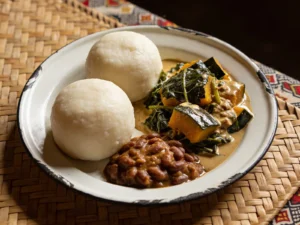
- Turn it out onto a serving plate. Water stops it sticking to everything. Set one ball on each serving plate. Ladle sauce around it rather than over it.
- Tear off a piece with your fingers. Make a small hollow in it with your thumb. Dip it into the sauce and swallow. It does not keep well at all cold.
Technique
- Southern Cote d’Ivoire is forest country where cassava, plantain and yam grow, giving foutou and attieke, while the north is drier savannah growing maize, millet and sorghum; kabato belongs to that northern grain cooking and the two halves of the country eat differently.
- To is the general Sahelian name for this food, made across Burkina Faso, Mali and Niger by stirring grain flour into boiling water and beating it stiff; kabato is the Ivorian name for the same thing.
- A cold slurry is added to boiling water first and dry flour beaten in afterwards, and that two-stage method is what prevents lumps that would never break down.
Substitutions
- Maize flour, millet flour or a mixture of both all work.
- Fine flour is essential, since coarse flour gives a gritty paste.
Variations
- A pinch of potash is added traditionally in some places and left out in others.
- Sauce gombo, peanut sauce and leaf sauces are all served with it.
- To across Burkina Faso, Mali and Niger is the same preparation.
History
The northern Ivorian version of Sahelian tô, adopted from Malinke and Senufo grain cooking where maize and millet outrank cassava.
Frequently asked questions
What is Kabato?
Kabato is a main from Côte d’Ivoire: stiff maize or millet paste eaten by hand with okra sauce. The northern Ivorian version of Sahelian tô, adopted from Malinke and Senufo grain cooking where maize and millet outrank cassava.
How long does Kabato take to make?
Kabato takes 10 minutes of preparation and 35 minutes of cooking. The recipe makes serves 6. It is rated medium to make.
What can I substitute in Kabato?
Yes, within limits. Maize flour, millet flour or a mixture of both all work. Fine flour is essential, since coarse flour gives a gritty paste.
What is the most important thing to get right in Kabato?
Stir the slurry again before you pour it. Flour settles to the bottom quickly. Pour it into the boiling water slowly. Whisk hard the whole time you pour. Let it boil for about five minutes. Adding the dry flour is the main step. Add the remaining flour a handful at a time.