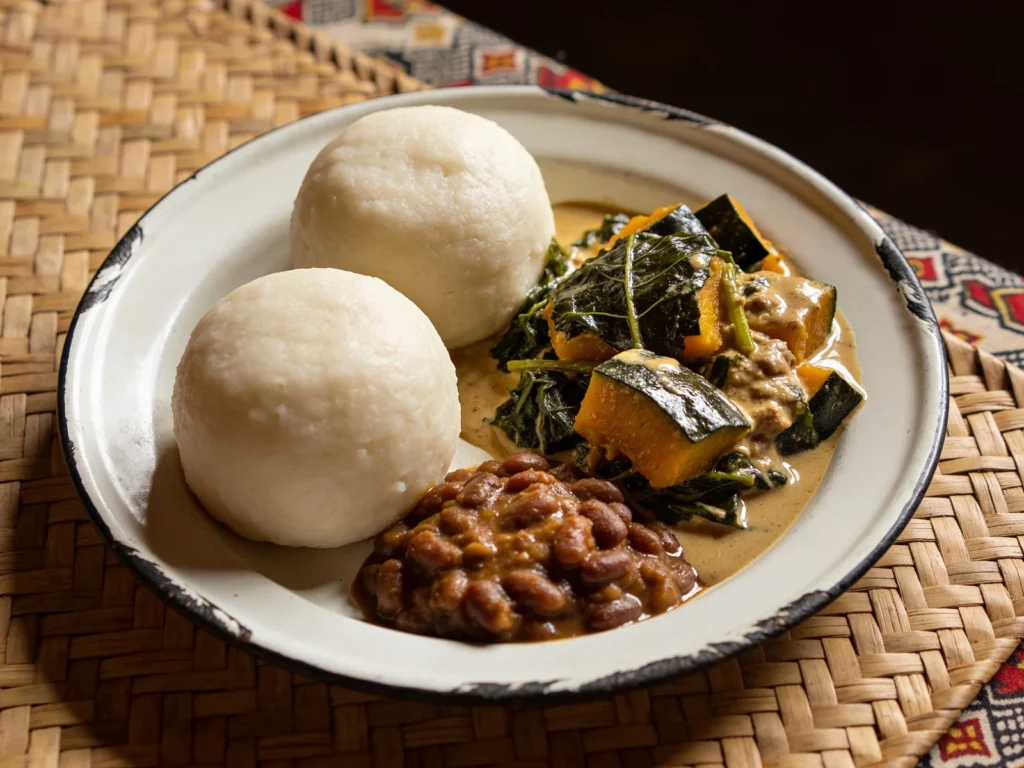

Ingredients
- 500 gufa woyera (fine white maize flour, twice-refined)
- 1.5 litreswater
Equipment
- 1heavy-bottomed pot
- 1mthiko (flat wooden stirring paddle) or a strong wooden spoon
- 1small bowl of cold water, for shaping
To serve
- Ndiwo: braised greens such as rape or pumpkin leaves in groundnut flour sauce
- Beans stewed with tomato and onion
Directions
- Bring 1.2 litres of the water to a rolling boil in a heavy pot.
- Mix 120 g of the maize flour with the remaining 300 ml cold water in a bowl until completely smooth. This slurry is what prevents lumps.
- Pour the slurry into the boiling water, whisking hard, and boil for 5–8 minutes, stirring, until you have a smooth, thin porridge. This stage has its own name, phala, and is eaten as breakfast in its own right.
- Reduce the heat to low. Begin adding the remaining flour a handful at a time, beating each addition in thoroughly with the mthiko before the next.
- As it thickens, change technique: press the paddle down the side of the pot and fold the mass over on itself, working around the pot. The nsima will start to pull away from the sides in one lump.
- Keep adding flour until the mass is stiff enough that the paddle stands briefly on its own. Malawians judge this entirely by feel, not by measurement.
- Cover and steam over the lowest heat for 5–8 minutes, then fold it over once more. This final cook removes any raw, chalky taste from the last of the flour.
- Dip a serving spoon or a small bowl in cold water, scoop a portion of nsima, and roll or press it against the side of the pot into a smooth, rounded patty.
- Turn each patty onto the plate, smooth side up, and serve immediately with ndiwo. Eat with the right hand: pinch off a piece, roll it into a ball, press a dent with the thumb and use it to scoop up the relish.
Technique
- The two-stage method, thin phala first and then thickening, is what makes Malawian nsima smooth. Adding all the flour at once gives lumps that never disappear.
- Ufa woyera is maize flour that has been dehulled, soaked, dried and milled twice, so it is very white and fine. Coarse mgaiwa wholemeal flour makes a darker, nuttier nsima that is more nutritious and was traditionally the everyday grade.
- Nsima is never salted. All the seasoning lives in the ndiwo served alongside it.
- It must be eaten hot and fresh. Cooled nsima goes hard and rubbery, and Malawian households cook it fresh for each meal rather than reheating.
Substitutions
- Outside Malawi, any fine white maize meal sold as mealie meal, ugali flour or masa harina blanca will work; polenta is too coarse and too yellow.
- Mgaiwa, the wholemeal grade, can be used with an extra 100 ml water and 5 minutes of cooking.
- Cassava flour nsima is made in the lakeshore districts and follows exactly the same method.
Variations
- Phala, the thin breakfast porridge made from the first stage alone.
- Nsima ya mgaiwa, the darker wholemeal version.
- Kondowole, the sticky cassava-flour nsima of Nkhata Bay and the northern lakeshore.
History
A stiff, dense maize-meal porridge cooked by gradually stirring maize flour into boiling water until it thickens into a moldable dough, the same basic technique and staple role found across much of East and Southern Africa under different regional names, including sadza in Zimbabwe and ugali in Kenya and Tanzania. Maize became Malawi’s dominant staple only after the crop, originally from the Americas, was introduced along the East African coast through Portuguese trade beginning in the 1500s and 1600s and gradually displaced older staples including sorghum and millet, a shift that intensified further under colonial-era agricultural policy in the 1900s. Nsima remains so central to Malawian daily life that the phrase for eating it is commonly used more broadly in the local Chichewa language to mean simply eating a proper meal.
Frequently asked questions
What is Nsima?
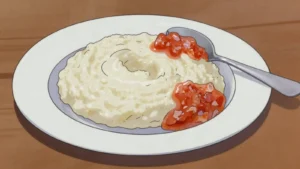
Nsima is a main from Malawi: smooth maize porridge patties, the heart of every Malawian meal. A stiff, dense maize-meal porridge cooked by gradually stirring maize flour into boiling water until it thickens into a moldable dough, the same basic technique and staple role found across much of East and Southern Africa under different regional names, including sadza in Zimbabwe and ugali in Kenya and Tanzania. Maize became Malawi’s dominant staple only after the crop, originally from the Americas, was introduced along the East African coast through Portuguese trade beginning in the 1500s and 1600s and gradually displaced older staples including sorghum and millet, a shift that intensified further under colonial-era agricultural policy in the 1900s. Nsima remains so central to Malawian daily life that the phrase for eating it is commonly used more broadly in the local Chichewa language to mean simply eating a proper meal.
How long does Nsima take to make?
Nsima takes 5 min of preparation and 30 min of cooking. The recipe makes 4 servings. It is rated easy to make.
What can I substitute in Nsima?
Yes, within limits. Outside Malawi, any fine white maize meal sold as mealie meal, ugali flour or masa harina blanca will work; polenta is too coarse and too yellow. Mgaiwa, the wholemeal grade, can be used with an extra 100 ml water and 5 minutes of cooking. Cassava flour nsima is made in the lakeshore districts and follows exactly the same method.
What is the most important thing to get right in Nsima?
The two-stage method, thin phala first and then thickening, is what makes Malawian nsima smooth. Adding all the flour at once gives lumps that never disappear.