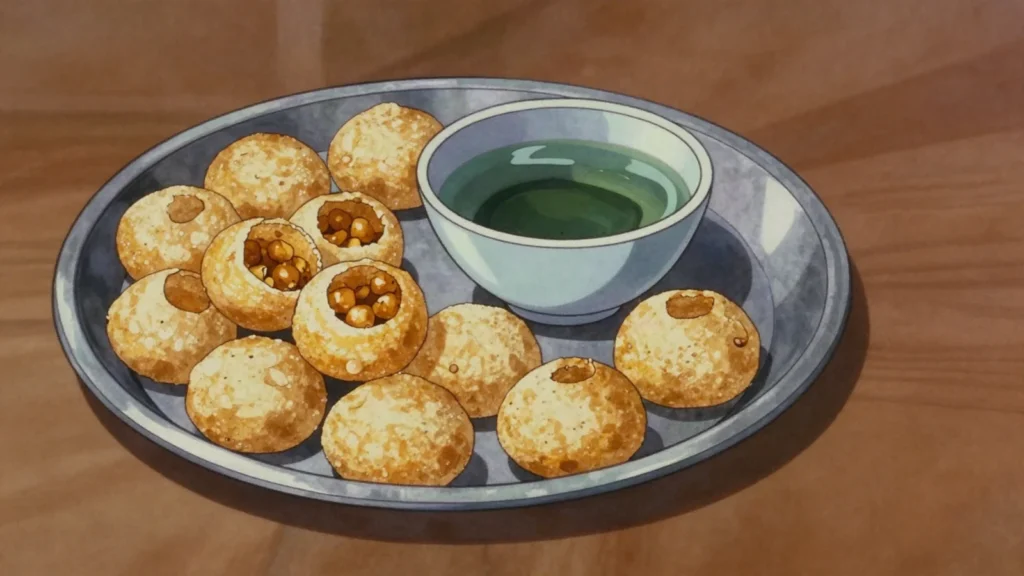

Ingredients
The shells
- 150 gfine semolina
- sooji or rava
- 50 gplain flour
- a quarter teaspoon bicarbonate of soda
- a pinch of salt
- about 100 ml warm water
- or as needed
For frying
- 1 litrevegetable oil
- or enough for 6 cm depth
The pani, the sour water
- a large bunch of mint
- leaves only, about 40 g
- a large bunch of coriander
- about 40 g
- 3green chillies
- or to taste
- a thumb of ginger
- 4 tablespoonstamarind pulp
- soaked and strained
- 2 tablespoonschaat masala
- 1 tablespoonroasted cumin, ground
- 1 teaspoonblack salt
- kala namak
- 1 teaspoonsalt, or to taste
- 2 tablespoonssugar or jaggery
- 1.5 litrescold water
- boiled and cooled
The filling
- 3potatoes, boiled and diced small
- 200 gboiled chickpeas
- or white peas
- 1small onion, finely chopped
- 1 teaspoonchaat masala
- half a teaspoon chilli powder
- salt, to taste
- a handful of coriander, chopped
Sometimes added
- tamarind chutney, thick and sweet
- sev, to scatter
- whisked yoghurt
Directions
- Use water that has been boiled and cooled. Wash the herbs thoroughly before blending. Keep the pani refrigerated until serving. Do not leave it standing warm for hours. Use fine semolina, not coarse. Mix the semolina, flour, bicarbonate and salt. Add warm water gradually. It must be a stiff dough. Knead it hard for a full ten minutes. That develops the dough enough to hold steam.
- Cover it with a damp cloth. Rest it for at least thirty minutes. An hour is better. Knead it again briefly after resting. Roll the whole dough out as one large sheet. Roll it very thin, about one millimetre. Use a bottle cap or a small cutter. Aim for about four centimetres across. Keep the cut circles under a damp cloth. Dry dough does not puff. Use a deep heavy pot.
- Fill it no more than one third full. Never leave hot oil unattended. Keep a lid within reach. If it catches fire, turn off the heat and cover it. Heat the oil to about one hundred and ninety degrees. That is hot. Press each one gently down with a slotted spoon. Hold it under the oil for two seconds. Fry them for about a minute.
- Turn them once. They should be pale golden and rigid. Lift them out and drain them on paper. Let them cool completely. They go soft in humid air within hours. Wash the mint and coriander thoroughly. Pick the mint leaves off the stalks. Blend the herbs with the chillies and ginger.
- Add a little water to help the blades. Blend to a smooth bright green paste. Use cold water and blend in short bursts. Add a couple of ice cubes if you like. That keeps it brighter.
- Soak the tamarind pulp in warm water. Work it with your fingers after twenty minutes. Strain it, pressing hard. That gives thick sour tamarind water. Put the herb paste in a large jug. Add the tamarind water. Add the chaat masala, roasted cumin and black salt. Add the salt and the sugar. Add the cold water gradually. That note is exactly what pani needs.
- Strain it through a sieve for a clear pani. Refrigerate the pani for at least two hours. Boil and dice the potatoes small. Mash them roughly, leaving texture. Add the chickpeas or white peas. Add the chopped onion.
- Add the chaat masala, chilli powder and salt. Add the chopped coriander. Mix it and taste it. It should be well seasoned on its own. Set out the shells, filling and pani. Spoon a little filling in. Do not overfill it. Dip it into the pani, filling it. Put the whole thing in your mouth at once. A spoon of thick sweet tamarind chutney can go in first.
Technique
- Everything is assembled at the last second and eaten in one bite. The shell starts dissolving the moment it is dipped, so fill, dip and eat within seconds — there is no way to take two bites, and that urgency is the experience.
- The dough must be stiff, stiffer than chapati dough and hard work to knead. A soft dough gives flat shells, which is the commonest failure. Knead it ten minutes and rest it at least thirty.
- Roll the whole dough as one thin sheet — about a millimetre — and cut circles from it. Rolling individual balls gives uneven thickness and shells that puff on one side only.
- Use fine semolina, not coarse. Coarse semolina gives shells that will not puff at all.
- Fry at about 190 degrees and press each shell under the oil with a slotted spoon for two seconds. Hot oil creates the instant steam that inflates them; cooler oil gives flat greasy discs. Test one before committing the batch.
- Keep the cut circles under a damp cloth. Dry dough does not puff.
- Do not let the shells brown much. Pale golden and rigid is right; dark shells taste bitter.
- Ready-made shells are sold cheaply by South Asian grocers, they are perfectly good, and a great many households buy them. Making them is genuinely difficult and there is no shame in not.
- Buy black salt, kala namak. Its sulphurous note is the single most characteristic flavour in the pani and ordinary salt does not replace it.
- Make the pani aggressively sour, hot and salty — it should make you catch your breath. A mild pani has failed; push the tamarind, black salt and chilli well past comfortable.
- Blend the herbs with cold water in short bursts, or with a couple of ice cubes. Blending generates heat that dulls the green.
- Pick mint leaves off the stalks, which are bitter. Coriander stalks are fine to use.
- The pani is never boiled after mixing, and street versions have been associated with waterborne illness in South Asia. At home, use boiled-and-cooled or bottled water, wash the herbs thoroughly, keep it refrigerated and do not leave it standing warm. That is a reason to make it carefully rather than a reason to avoid it.
- Store the shells airtight the moment they cool. They go soft in humid air within hours.
Substitutions
- Ready-made shells from a South Asian grocer replace homemade entirely.
- White peas replace chickpeas and are the more traditional filling in many places.
- Lemon juice replaces some of the tamarind for a brighter, sharper pani.
- Jaggery replaces sugar in the pani and gives more depth.
- A sweet tamarind chutney added to each shell makes the sweet-and-sour version.
- Whisked yoghurt in place of the pani makes dahi puri, a different dish from the same shells.
Variations
- Pani puri in Mumbai and puchka in Kolkata are the same street food under other names.
- Dahi puri fills the same shells with yoghurt, chutneys and sev instead of sour water.
- Sev puri and bhel puri use crushed shells in a dry chaat.
- A version with a sweet tamarind water alongside the spiced one is offered by many vendors.
- Ragda-filled shells, using white pea curry, are common in western India.
- Dahi bara and chana chaat are the other standards at the same iftar and snack table.
Frequently asked questions
What is Gol Gappay?
Gol Gappay is a street food from Pakistan: crisp hollow shells filled with spiced potato and sour tamarind water.
How long does Gol Gappay take to make?
Gol Gappay takes 1 hour plus resting of preparation and 30 minutes of cooking. The recipe makes makes about 40, serves 6. It is rated hard to make.
What can I substitute in Gol Gappay?
Yes, within limits. Ready-made shells from a South Asian grocer replace homemade entirely. White peas replace chickpeas and are the more traditional filling in many places. Lemon juice replaces some of the tamarind for a brighter, sharper pani. Jaggery replaces sugar in the pani and gives more depth. A sweet tamarind chutney added to each shell makes the sweet-and-sour version. Whisked yoghurt in place of the pani makes dahi puri, a different dish from the same shells.
What is the most important thing to get right in Gol Gappay?
Use water that has been boiled and cooled. Wash the herbs thoroughly before blending. Keep the pani refrigerated until serving. Do not leave it standing warm for hours. Use fine semolina, not coarse. Mix the semolina, flour, bicarbonate and salt. Add warm water gradually. It must be a stiff dough. Knead it hard for a full ten minutes. That develops the dough enough to hold steam.