
Ingredients
The bases
- 200 gmarzipan
- good quality, high almond
- or 200 g shortbread-style biscuit dough
- icing sugar, for rolling
The marshmallow
- 3egg whites
- about 100 g
- at room temperature
- 250 gcaster sugar
- 100 gglucose syrup
- or golden syrup
- 80 mlwater
- 1 teaspoonvinegar
- or lemon juice
- 1 teaspoonvanilla extract
- a pinch of salt
The coating
- 400 ggood dark chocolate
- or milk chocolate
- at least 55 percent cocoa
- chopped finely
To finish, optional
- desiccated coconut
- chopped pistachios
- freeze-dried raspberry
- sprinkles
Equipment
- a sugar thermometer
- essential
- a stand mixer
- or a strong electric whisk
- a piping bag with a plain nozzle
Directions
- Keep children well away from the pan. Pour it slowly and carefully into the whisking whites. If it touches skin, run cold water over it for twenty minutes. Use very fresh eggs from a reliable source. Use it if you are serving anyone vulnerable. It tastes flat and it is too soft.
- Dust a surface with icing sugar. Roll the marzipan to about four millimetres. Cut discs of about four centimetres. Lay them on a lined tray. A thin crisp shortbread base is also traditional. Bake the discs and cool them completely. Have everything ready before you start. Put the sugar, glucose and water in a heavy pan. Stir once to dissolve the sugar. Then stop stirring entirely.
- Boil it without stirring. Brush the pan sides with a wet pastry brush. Take it to one hundred and seventeen degrees. That is the soft ball stage. Start whisking the whites when the syrup reaches about one hundred degrees. Add the pinch of salt and the vinegar. Whisk them to soft peaks. Do not whisk them to stiff peaks yet.
- Pour it in a thin steady stream. Pour it down the side of the bowl. Now keep whisking. Whisk on high for eight to ten minutes. The mixture becomes thick, white and glossy.
- Add the vanilla near the end. Do not pipe it while it is hot. Whisk until the bowl has cooled. Fill a piping bag with a plain round nozzle. Hold it upright over a base. Squeeze steadily to build a dome. Lift straight up at the end. Smooth any peak with a wet finger. Leave a small margin of base showing.
- Leave them at room temperature for an hour. Do not refrigerate them at this stage. Chop the chocolate finely. Melt two thirds of it over barely simmering water. Do not let the bowl touch the water.
- Melt it to about forty-five degrees. Take it off the heat. Stir in the remaining third, chopped. Stir until it melts and the temperature falls. Bring it down to about thirty-one degrees for dark chocolate. Hold each flødebolle by its base. Dip it into the chocolate, or spoon chocolate over.
- Cover the dome completely. Let the excess drip off. Set it on a lined tray. Scatter coconut or nuts while the chocolate is wet. It sets within a minute or two. Leave them at cool room temperature to set. That takes about thirty minutes. Serve them at room temperature. They keep four days in a cool place. Keep them in a sealed container. The marshmallow dries out if exposed to air.
Technique
- A sugar thermometer is essential, not optional. The syrup must reach 117 degrees exactly — too low and the marshmallow will not hold, too high and it sets hard and chewy.
- Have everything ready before the syrup boils: whites whisking, bases laid out, piping bag prepared. Once it is up to temperature there is no pausing.
- Pour the hot syrup down the side of the bowl, not onto the whisk. Syrup hitting the whisk is thrown around the bowl, sets into hard threads and flings scalding syrup outward.
- The syrup reaches 117 degrees, far hotter than boiling water, and it sticks to skin and keeps burning. Never touch or taste it, keep children away, and run cold water over any contact for twenty minutes.
- Whisk until the bowl feels only just warm. Hot meringue slumps and will not hold a dome — the long whisking is as much about cooling as volume.
- Whisk the whites only to soft peaks before the syrup goes in. Over-whisked whites go grainy and split; if they are ready early, keep the mixer running slowly.
- The bowl and whisk must be completely grease free, and a speck of yolk does the same damage as fat. Separate each egg into a small cup first so one broken yolk does not cost you the batch.
- Use glucose or golden syrup alongside the sugar. It prevents crystallisation and gives a softer, more stable marshmallow.
- Let the piped domes stand an hour at room temperature to form a skin before coating. Do not refrigerate them — condensation ruins the chocolate. Cover them completely down to the base, since any gap lets the marshmallow dry hard.
- Not a drop of water may reach the melting chocolate. One drop seizes it into a solid mass that cannot be used for coating.
- Temper by seeding: melt two thirds to about 45 degrees, take it off the heat, stir in the remaining chopped third and bring it down to about 31 degrees for dark or 30 for milk. Untempered chocolate sets dull, streaky and soft.
- Do not refrigerate the finished sweets. Tempered chocolate blooms and dulls and the marshmallow weeps.
- This is an Italian meringue: the hot syrup raises the whites to perhaps 70 degrees, which is on the borderline of pasteurisation rather than reliably past it. Use very fresh eggs from a reliable source, or cartoned pasteurised whites — which whisk perfectly well — if you are serving anyone pregnant, very young, elderly or immunocompromised.
- Buy marzipan with a high almond content, ideally at least fifty percent. Cheap marzipan is mostly sugar, tastes flat and is too soft to hold a base.
- These contain egg, and with a marzipan base, almonds. Nut allergy can be severe — say so plainly. A biscuit base makes a nut-free version.
Substitutions
- A thin crisp shortbread base replaces marzipan and gives a snap the marzipan lacks, as well as being nut free.
- Pasteurised egg white from a carton replaces fresh whites and whisks perfectly well.
- Golden syrup replaces glucose syrup closely.
- Milk chocolate replaces dark; temper it to about 30 degrees rather than 31.
- Lemon juice replaces vinegar for stabilising the whites.
- Coconut, chopped pistachios or freeze-dried raspberry all work as coatings.
Variations
- Schaumküsse in Germany and skumboller in Norway are the same sweet under other names.
- A version flavoured with liquorice, a Danish favourite, is widely sold.
- Passionfruit or raspberry flavoured marshmallow versions are common in bakeries.
- A coconut-coated version is one of the standard shop varieties.
- Marshmallow piped onto a wafer base is another traditional construction.
- Chokoladeboller and other Danish chocolate sweets belong to the same bakery tradition.
Frequently asked questions
What is Flødeboller?
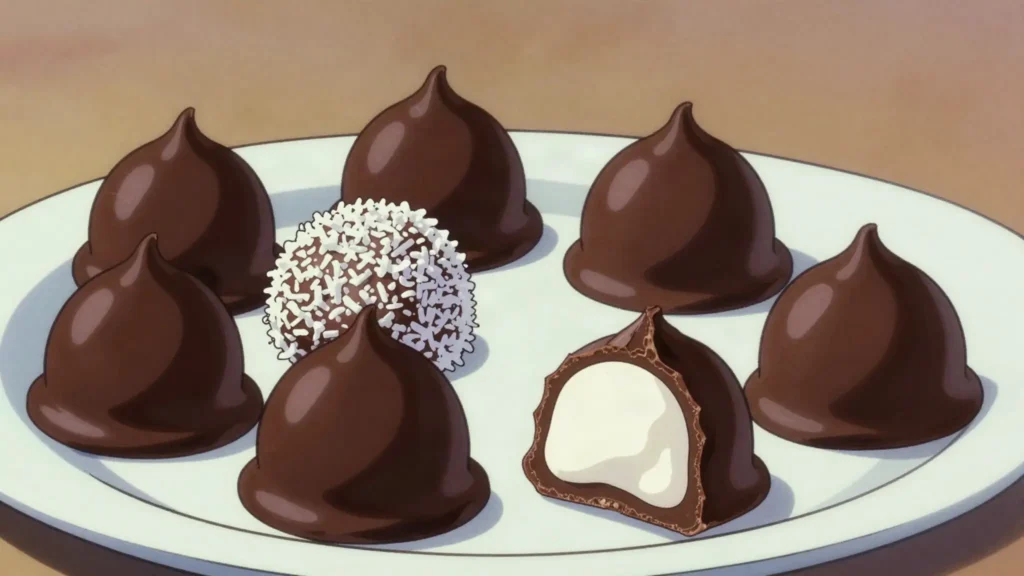
Flødeboller is a snack from Denmark: chocolate-shelled marshmallow domes on marzipan bases.
How long does Flødeboller take to make?
Flødeboller takes 1 hour plus setting of preparation and 20 minutes of cooking. The recipe makes makes about 20. It is rated hard to make.
What can I substitute in Flødeboller?
Yes, within limits. A thin crisp shortbread base replaces marzipan and gives a snap the marzipan lacks, as well as being nut free. Pasteurised egg white from a carton replaces fresh whites and whisks perfectly well. Golden syrup replaces glucose syrup closely. Milk chocolate replaces dark; temper it to about 30 degrees rather than 31. Lemon juice replaces vinegar for stabilising the whites. Coconut, chopped pistachios or freeze-dried raspberry all work as coatings.
What is the most important thing to get right in Flødeboller?
Boil it without stirring. Brush the pan sides with a wet pastry brush. Take it to one hundred and seventeen degrees. That is the soft ball stage. Start whisking the whites when the syrup reaches about one hundred degrees. Add the pinch of salt and the vinegar. Whisk them to soft peaks. Do not whisk them to stiff peaks yet.