
Ingredients
The chillies
- 8to 12 fresh green chillies
- hot ones, stems removed
- or a mixture of green and red
- or 4 dried red chillies
- soaked and drained
The rest
- 2ripe tomatoes
- roasted or raw
- 4 clovesgarlic
- 1small onion, or 2 shallots
- 100 gdatshi
- the fresh Bhutanese cheese
- or feta, or a fresh curd
- crumbled
- 1 teaspoonsalt
- or to taste
The aromatics
- half a teaspoon thingye
- Bhutanese Sichuan pepper
- or Sichuan pepper, ground
- a handful of coriander leaf
- chopped
- juice of half a lime
- optional
- 1 tablespoonoil, optional
- or a little mustard oil
To serve
- with red rice
- alongside any Bhutanese dish
- as a table relish
Directions
- Reduce the chillies if you need to. Take a small amount at first. Datshi is a fresh soft cheese from cow or yak milk.
- Wash hands with soap and oil, then soap again. Do not lean over a blender lid when opening it. Turn them until the skin blackens and blisters. Let them cool and peel off the skin. That takes about ten minutes.
- Put the chillies in the mortar with the salt. Salt acts as an abrasive and helps the pounding.
- Pound them to a rough paste. Add the garlic and pound it in. Add the onion and pound briefly. Add the tomato and crush it in. Crumble the cheese in.
- Fold and press it through rather than pounding hard. Add the ground thingye or Sichuan pepper.
- Add the chopped coriander. Add lime juice if you like. Add a little oil if you want a richer relish. Taste it very carefully with a small amount. Stop while it is still coarse.
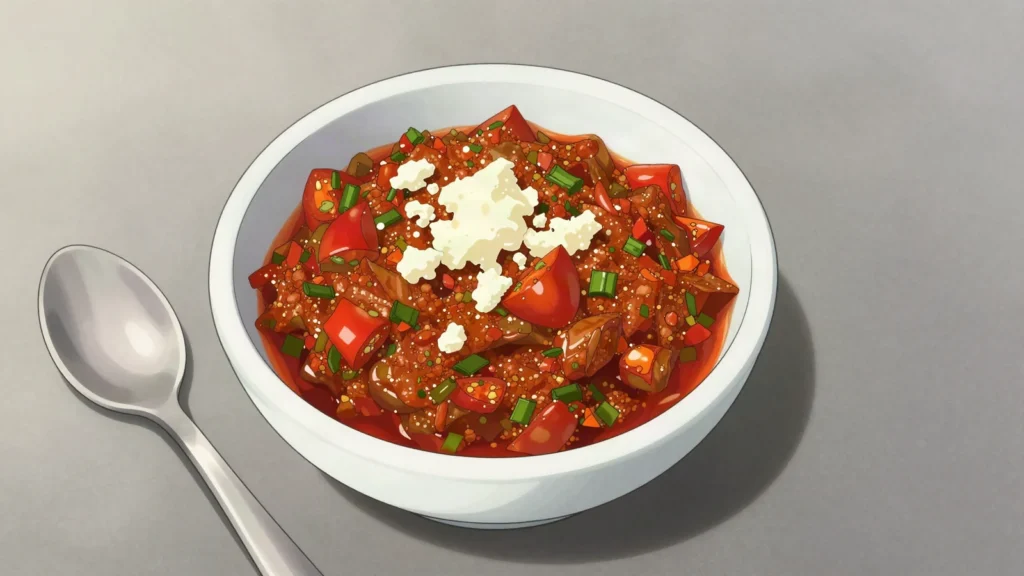
- Add the cheese by hand at the end. It should be a thick coarse paste. Add a little water if it is too stiff. Serve it in a small bowl on the table. Some include tomato and some do not.
Technique
- Pound it in a mortar rather than blending. Pounding crushes and tears instead of chopping, giving the coarse uneven texture that ezay should have; if you use a blender, pulse it and stop while it is still rough.
- Fold the cheese in by hand at the end rather than pounding it. You want visible crumbled pieces — a uniform paste loses the character entirely.
- This is genuinely hot by any standard and it is meant to be. Take a small amount at first; visitors consistently underestimate Bhutanese heat, and you can always add more.
- Wear gloves for this quantity of chillies and do not rub your eyes afterwards. Capsaicin clings to skin for hours and plain water does not remove it — wash with soap, then oil, then soap again.
- Open a window before pounding or blending. The fumes from a large quantity of chilli irritate eyes and throat, and do not lean over a blender lid when opening it.
- Salt in the mortar from the start acts as an abrasive and helps the pounding along.
- Roasting the tomatoes and chillies gives a sweeter, smokier relish; raw gives a fresher, sharper one. Both are made in Bhutan and neither is the correct version.
- Feta is the nearest substitute for datshi but it is saltier, so cut back the added salt. Any mild fresh crumbling curd works; ricotta needs draining first.
- Not every ezay contains cheese. Many are simply chilli, tomato, garlic and salt, and the cheese version is one among several.
- Thingye, the Bhutanese Sichuan pepper, gives a citrus aroma and a numbing tingle quite distinct from chilli heat — the two together are the characteristic Bhutanese sensation. Sichuan pepper substitutes closely and is worth including.
- Bhutan treats chilli as a vegetable rather than a seasoning. Ema datshi, whole chillies cooked in cheese, is the national dish, and chillies dried on rooftops in autumn are a common village sight.
- Ezay is not one recipe. Households vary it with roasted peanuts, ground sesame, fermented cheese, dried or fresh chillies, tomato or none — the atlas records the range rather than fixing a version.
Substitutions
- Feta, paneer or any mild fresh curd replaces datshi; drain ricotta well if you use it.
- Dried red chillies, soaked, replace fresh and give a deeper, smokier heat.
- Sichuan pepper replaces thingye closely.
- Roasted tomatoes replace raw for a sweeter relish, or the tomato can be left out entirely.
- Lime juice adds brightness and is optional.
- Leave the cheese out for a plainer and longer-keeping relish.
Variations
- Ema datshi, whole chillies cooked in cheese, is Bhutan’s national dish and the same two ingredients cooked instead of pounded.
- A version with roasted peanuts or ground sesame worked in is made in some households.
- Ezay made with dried chillies alone is darker and smokier.
- Goen hogay, the cucumber salad with chilli and datshi, uses the same flavours in a fresh salad.
- Nepali and Tibetan chutneys made in the same mortar are close relatives.
- Some cooks add a fermented cheese for a considerably stronger relish.
Frequently asked questions
What is Ezay?
Ezay is a sauce & condiment from Bhutan: raw chilli pounded with cheese, tomato, garlic and Sichuan pepper as a table relish.
How long does Ezay take to make?
Ezay takes 20 minutes of preparation and none, or 10 minutes of cooking. The recipe makes makes about 1 bowl. It is rated easy to make.
What can I substitute in Ezay?
Yes, within limits. Feta, paneer or any mild fresh curd replaces datshi; drain ricotta well if you use it. Dried red chillies, soaked, replace fresh and give a deeper, smokier heat. Sichuan pepper replaces thingye closely. Roasted tomatoes replace raw for a sweeter relish, or the tomato can be left out entirely. Lime juice adds brightness and is optional. Leave the cheese out for a plainer and longer-keeping relish.
What is the most important thing to get right in Ezay?
Wash hands with soap and oil, then soap again. Do not lean over a blender lid when opening it. Turn them until the skin blackens and blisters. Let them cool and peel off the skin. That takes about ten minutes.