
Ingredients
Parcels
- 1.5 kgcocoyam, peeled
- 40cocoyam leaves, or large spinach leaves
- salt and ground pepper
Pot
- 300 mlpalm oil
- 200 gsmoked fish, flaked
- 150 gdried crayfish, ground
- 200 gbeef, cubed
- 100 gponmo, optional
- 2onions, sliced
- 3 tbspground pepper
- 2stock cubes
- 1 litrewater
- salt
Directions
- Wear gloves to peel and grate the cocoyam, or oil your hands well first.
- Raw cocoyam contains calcium oxalate crystals that irritate skin and throat badly, which is why it makes bare hands itch. Thorough cooking destroys them entirely and this dish cooks for well over an hour, but the raw handling is worth protecting yourself from.
- Grate the peeled cocoyam finely into a smooth sticky paste and season it with a little salt and ground pepper.
- Wash the cocoyam leaves, cut out the thick central ribs, and cut each leaf into strips about 8 cm wide.
- Put a small spoonful of the grated paste onto each strip and roll it up into a small parcel.
- Pack the parcels tightly into a heavy pot in layers, seam side down.
- Pack them tightly. Loosely stacked they unroll as the pot bubbles and you end up with cocoyam porridge, which tastes perfectly good and is not ekwang.
- Add the beef, ponmo, smoked fish, ground crayfish, sliced onion, pepper and stock cubes over and between the layers.
- Pour in the water and the palm oil.
- Cover and simmer for 1 hour 30 minutes without stirring at any point, shaking the pot gently instead if you need to move things.
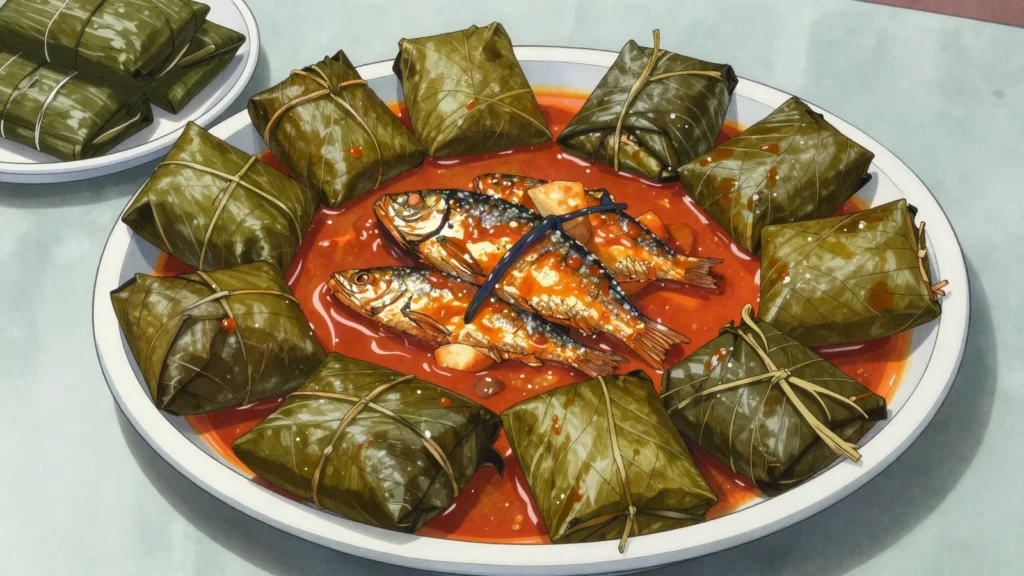
- It is ready when the parcels are soft and sticky and the sauce has reduced to a deep orange.
- Serve hot straight from the pot. It is the signature dish of Southwest Cameroon and it is eaten with the fingers.
Technique
- Never stir it. The parcels are fragile until they have set, and a spoon through the pot undoes an hour of rolling.
- Grating a kilo and a half of cocoyam by hand is the real work, and it is why ekwang is made for occasions.
- The sauce should end up thick and clinging rather than soupy, so keep the lid on and the heat low.
Substitutions
- Taro, which is the same root under another name and behaves identically.
- Large spinach or chard leaves in place of cocoyam leaves.
- A food processor for grating, which saves an hour and gives a slightly wetter paste.
Variations
- With more smoked fish and no beef.
- With crayfish alone, for a lighter pot.
- Made as one large parcel rather than many small ones, which is quicker and less good.
History
Grated cocoyam wrapped in cocoyam leaves and simmered in palm oil, the signature dish of Southwest Cameroon.
Frequently asked questions
What is Ekwang?
Ekwang is a main from Cameroon: grated cocoyam parcels in leaves, simmered with palm oil and smoked fish. Grated cocoyam wrapped in cocoyam leaves and simmered in palm oil, the signature dish of Southwest Cameroon.
How long does Ekwang take to make?
Ekwang takes 1 hr 30 min of preparation and 1 hr 30 min of cooking. The recipe makes 8 servings. It is rated hard to make.
What can I substitute in Ekwang?
Yes, within limits. Taro, which is the same root under another name and behaves identically. Large spinach or chard leaves in place of cocoyam leaves. A food processor for grating, which saves an hour and gives a slightly wetter paste.
What is the most important thing to get right in Ekwang?
Raw cocoyam contains calcium oxalate crystals that irritate skin and throat badly, which is why it makes bare hands itch. Thorough cooking destroys them entirely and this dish cooks for well over an hour, but the raw handling is worth protecting yourself from.