
Ingredients
Fruit
- 1whole durian
Equipment
- heavy gloves
- a sturdy knife
Directions
- Choose by smell and sound rather than by looks. A ripe durian smells strongly at the stem end, and shaking it should produce a faint knock as the flesh loosens from the husk.
- Look at the stem. A fresh one is moist and pale where it was cut, and a dry brown stem means the fruit has been sitting for a while.
- Wear heavy gloves. The spines are genuinely sharp and a slip while opening one is a real risk rather than a theoretical one.
- Find the seam by looking at the base of the fruit for a faint five-pointed star where the segments meet.
- Push the tip of a knife into the centre of the base and lever, working along one seam at a time, then pull the husk apart with your hands.
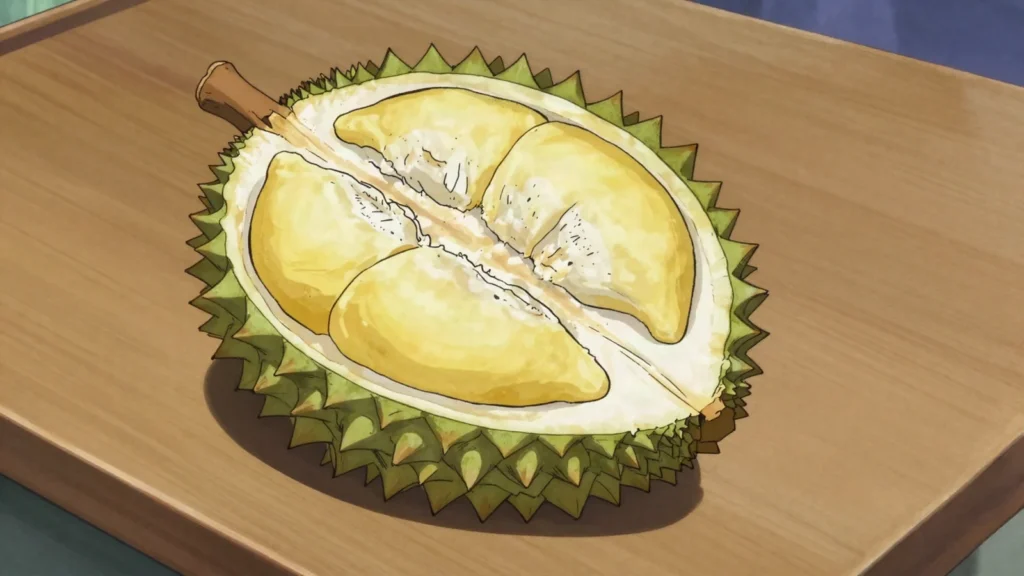
- Lift the pale segments out whole. Each holds a large seed, which is not eaten raw.
- Eat the flesh at room temperature with your fingers, and expect anything from custardy and sweet to bitter and faintly alcoholic depending on variety and ripeness.
- On alcohol: durian and drink together are traditionally avoided across South-East Asia and there is a real basis for it. Compounds in the fruit inhibit the enzyme that clears acetaldehyde, so drinking alongside it can produce a fierce reaction. The folk warning turns out to be sound.
- Do not carry it onto a plane, a train or into a hotel. Many airlines, hotels and metro systems ban it outright, and the smell genuinely lingers for days.
- Wash your hands afterwards using water poured into the empty husk, which is a local trick and works considerably better than soap.
Technique
- Musang King is the premium Malaysian variety and commands high export prices to China, with individual fruit priced accordingly.
- The smell and the taste are not the same experience. Plenty of people who cannot stand the smell like the fruit.
- Eat it the day it is opened. Once cut, it deteriorates fast and the smell gets worse rather than better.
Substitutions
- Frozen durian flesh, sold in vacuum packs, which is how most of it travels and is perfectly good.
- Durian paste for cooking, sold in Asian grocers.
Variations
- With sticky rice and coconut milk, in the Thai manner.
- Folded into dodol, ice cream or pancakes.
- Tempoyak, the fermented Malay preparation, which is a condiment rather than a fruit dish.
History
Malaysia’s Musang King variety commands premium export prices to China; hotels, airlines and metro systems ban the fruit for its smell.
Frequently asked questions
What is Durian?
Durian is a snack from Malaysia: custardy tropical fruit with a spiked husk and famously overpowering aroma. Malaysia’s Musang King variety commands premium export prices to China; hotels, airlines and metro systems ban the fruit for its smell.
How long does Durian take to make?
Durian takes 10 min of preparation and no cooking at all. The recipe makes 1 fruit. It is rated medium to make.
What can I substitute in Durian?
Yes, within limits. Frozen durian flesh, sold in vacuum packs, which is how most of it travels and is perfectly good. Durian paste for cooking, sold in Asian grocers.
What is the most important thing to get right in Durian?
Choose by smell and sound rather than by looks. A ripe durian smells strongly at the stem end, and shaking it should produce a faint knock as the flesh loosens from the husk.