
Ingredients
Ferment
- 1 kgdried nere seeds (Parkia biglobosa, locust bean), picked over for stones
- 6 litreswater for the first boil, plus more for topping up
- 300 gclean coarse sand or wood ash, for rubbing off the hulls (optional but traditional)
- 1 handfulof fresh banana or nere leaves, washed and wilted over the fire, for wrapping
Finishing
- 1 tbspfine salt, only if you want a salted style
- 1clean woven basket or calabash, lined with the leaves
- 1heavy wooden mortar and pestle
Directions
- Boil the seeds in plenty of water for 10 to 12 hours, topping up as it evaporates, until the hard black hulls have swollen and slip when squeezed between finger and thumb.
- Tip the hot seeds into a basin, cover with cold water and leave overnight. Next morning, rub them by handfuls against sand or ash in the water; the hulls float off and the yellow cotyledons sink. Rinse in several changes of water until the water runs clear and only clean yellow kernels remain.
- Boil the cleaned kernels again for 1 to 2 hours until a kernel crushes to a paste between the fingers with no chalky centre.
- Drain thoroughly and spread on a mat for 20–30 minutes so the surface steams dry. Wet seeds ferment sour instead of savoury.
- While still hand-hot, pack the kernels 8–10 cm deep into a leaf-lined basket, fold the leaves over, cover with a cloth and stand it in the warmest sheltered corner you have, ideally 35–40°C (95–105°F).
- Ferment 2 to 4 days. From the second day the mass smells strongly of ammonia, the seeds soften and a sticky, stringy white coating appears when you lift a handful; that thread is the sign the Bacillus culture has taken.
- Pound the fermented seeds in a wooden mortar, in batches, into a coarse dark brown paste that holds its shape. Work in the salt now if using.
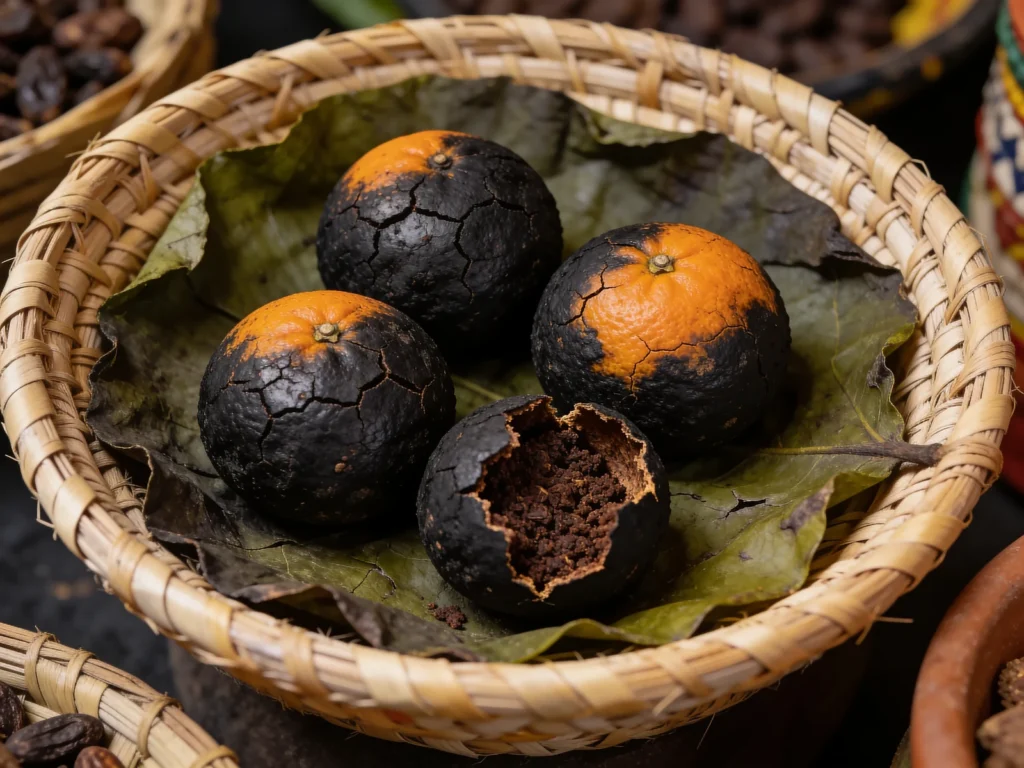
- Shape into balls the size of a small orange, or flatten into thick cakes, and dry in full sun on mats for 2 to 3 days, turning twice a day, until they are hard and almost black outside.
- Store dry, hung in a basket. To use, break off a piece and crush it into sauces, or dissolve a walnut-sized lump in a stew as the salt-and-savoury base.
Technique
- This is a controlled alkaline fermentation driven by Bacillus subtilis, the same organism behind Japanese natto and Nigerian iru. The ammonia smell and the sticky threads are the process working correctly, not spoilage.
- Food safety turns on the second boil and on cleanliness. Ferment hot seeds packed tight and covered, so the Bacillus dominates before moulds or coliforms can settle. Discard anything that develops black, green or pink mould, sliminess with a sour vinegar smell, or a bitter taste.
- Fully sun-dried balls keep six months or more in a dry place. Fresh, undried paste keeps only a few days.
- Some households ferment in a clay pot buried in hot ash rather than a basket; the result is milder and less ammoniac.
Substitutions
- No nere seeds: soybeans fermented the same way give a workable stand-in, sold as soumbala de soja in Bamako markets, but the flavour is cleaner and less funky.
- At a pinch, Nigerian iru or Ghanaian dawadawa is the same product under another name and can be bought ready-made.
- No sun: a 50°C (120°F) oven or dehydrator for 12–18 hours will dry the balls, though they take on a slightly baked note.
Variations
- Soumbala en boules is the dark hard trading form; the softer fresh paste sold in leaf packets is used the same day.
- A salted, oiled version is pressed into thin cakes that dissolve faster into tô sauces.
History
Made from Parkia biglobosa seeds boiled and fermented for days; Burkinabè women’s cooperatives are among West Africa’s main producers.
Frequently asked questions
What is Soumbala?
Soumbala is a fermented & pickled from Burkina Faso: pungent black balls of fermented locust bean, crumbled into every sauce. Made from Parkia biglobosa seeds boiled and fermented for days; Burkinabè women’s cooperatives are among West Africa’s main producers.
How long does Soumbala take to make?
Soumbala takes 1 hr 30 min of active work of preparation and 24 hr boiling and soaking, 3 days fermenting, 3 days drying of cooking. The recipe makes about 400 g of pressed balls. It is rated hard to make.
What can I substitute in Soumbala?
Yes, within limits. No nere seeds: soybeans fermented the same way give a workable stand-in, sold as soumbala de soja in Bamako markets, but the flavour is cleaner and less funky. At a pinch, Nigerian iru or Ghanaian dawadawa is the same product under another name and can be bought ready-made. No sun: a 50°C (120°F) oven or dehydrator for 12–18 hours will dry the balls, though they take on a slightly baked note.
What is the most important thing to get right in Soumbala?
Drain thoroughly and spread on a mat for 20–30 minutes so the surface steams dry. Wet seeds ferment sour instead of savoury.