
Ingredients
Cabbage
- 8 kgwhite cabbage — half shredded, half left as whole heads
- 160 gcoarse non-iodised salt for the shredded — 2% of its weight
- 300 gcoarse salt for the cores of the whole heads
Brine, for the whole heads
- 4 litreswater
- 200 gcoarse non-iodised salt — 5%
Aromatics
- 2 tbspblack peppercorns
- 2 tbspcaraway seed
- 6bay leaves
- 2quinces, quartered
- 1 handfulmaize kernels
- 1horseradish root, sliced
Directions
- For the whole heads: cut a deep cone out of each core and pack the cavity with coarse salt. This is how salt reaches the middle of a head that is never cut open, and those heads are what give you pliable leaves for töltött káposzta.
- Shred the other half of the cabbage finely, weigh it, and take 2% of that weight in salt. Toss with half the caraway and work it hard by the handful for ten minutes until it collapses into its own liquid.
- Stand the whole heads core-up in the bottom of the crock and pack the squeezed shredded cabbage tightly around and over them.
- Tuck the peppercorns, bay, remaining caraway, quince, maize and horseradish through the layers. The maize is traditional and does real work — its starch feeds the bacteria in the first days.
- Dissolve the 200 g of salt in the 4 litres of water and pour it over until everything is covered by 5 cm. Weight it all down under a scrubbed plate or stone.
- Once a week, draw several litres of brine off the bottom and pour it back over the top. Without this the salt sinks, the top of the crock sits under-brined and goes slimy, and the batch is lost.
- Ferment somewhere cold — 10 to 15°C (50 to 59°F) — for four to six weeks, until the leaves are translucent and sharply sour and pliable enough to roll without cracking.
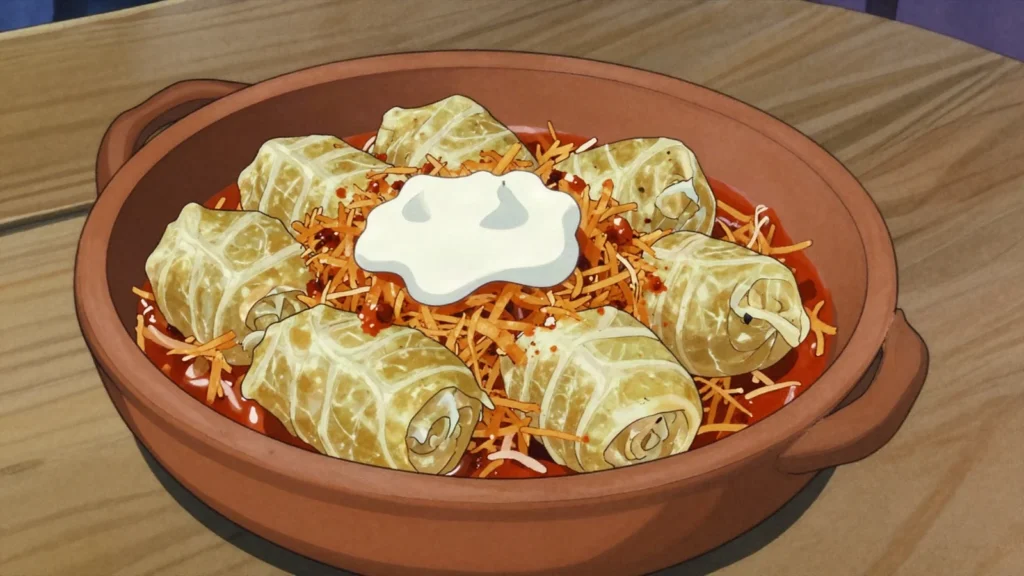
- Keep cold through the winter. Peel whole leaves for töltött káposzta, use the shredded for székelykáposzta, and drink the brine cold.
Technique
- The weekly brine circulation is not optional. It is the single reason a crock succeeds or fails.
- Cold and slow. Fermented warm the leaves go brittle and tear the moment you try to roll them.
- Anything above the brine will mould. Check the weight every time you circulate.
Substitutions
- A food-grade plastic bucket in place of a crock, which is what most households now use.
- Shredded only, in jars, if you have no cold space — but then there are no whole leaves for stuffing.
Variations
- Vecsés built an industry on this and its version is protected by a Hungarian geographical indication.
- The Czech kysané zelí, Croatian kiseli kupus and Bulgarian kiselo zele are the same preserve.
History
Central to Hungarian winter cooking; Vecsés near Budapest built a whole industry on it.
Frequently asked questions
What is Savanyu kaposzta?
Savanyu kaposzta is a fermented & pickled from Hungary: sauerkraut fermented in barrels, stewed with pork or rolled for töltött káposzta. Central to Hungarian winter cooking; Vecsés near Budapest built a whole industry on it.
How long does Savanyu kaposzta take to make?
Savanyu kaposzta takes 1 hour plus 4 to 6 weeks fermenting of preparation and no cooking at all. The recipe makes fills a 10-litre crock. It is rated medium to make.
What can I substitute in Savanyu kaposzta?
Yes, within limits. A food-grade plastic bucket in place of a crock, which is what most households now use. Shredded only, in jars, if you have no cold space — but then there are no whole leaves for stuffing.
What is the most important thing to get right in Savanyu kaposzta?
For the whole heads: cut a deep cone out of each core and pack the cavity with coarse salt. This is how salt reaches the middle of a head that is never cut open, and those heads are what give you pliable leaves for töltött káposzta.