
Ingredients
Sauerkraut
- 3 kgwhite cabbage, shredded fine
- 60 gcoarse non-iodised salt — 2% of the cabbage weight
- 1 tbspcaraway seed
- 1carrot, grated
To stew
- 800 gof the finished sauerkraut, drained
- 500 gpork belly or spare ribs, in pieces
- 1onion, chopped
- 1 tbsplard or oil
- 1 tbspbarley or pearl barley
- 1 tspcaraway seed
- 300 mlwater or stock
- salt and black pepper
Directions
- Shred the cabbage finely and weigh it, then take 2% of that weight in salt. Toss together with the caraway and grated carrot.
- Leave 30 minutes, then work it hard by the handful for ten minutes, squeezing until the cabbage has collapsed and sits in a pool of its own liquid. This is the only real labour and it is what makes the brine.
- Pack into the crock, pressing each handful down firmly so the liquid rises above the cabbage, and weight it down.
- Ferment at cool room temperature, around 18°C (64°F), for three to four weeks, skimming any white film off the surface. When it is properly sour, move it somewhere cold.
- To make the dish: brown the pork in the lard, then add the onion and cook until golden.
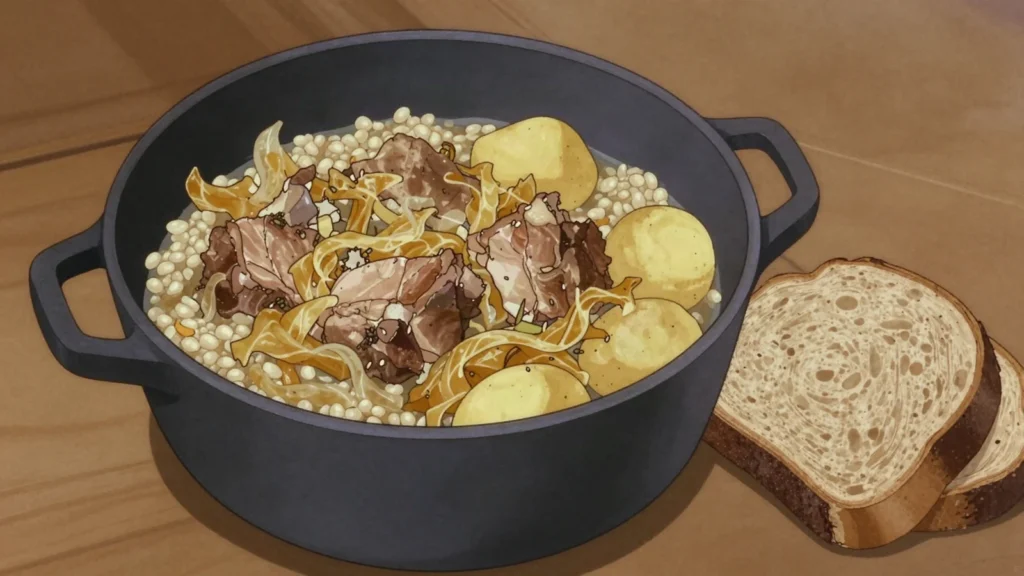
- Add the drained sauerkraut, barley, caraway and water, cover, and stew very gently for an hour to an hour and a half, until the pork is falling apart and the barley has swollen and thickened everything.
- Season with salt and pepper and serve with boiled potatoes and dark bread, as it appears on the Estonian Christmas table.
Technique
- Two percent by weight, measured. Salt judged by handful gives a crock that is either too salty to ferment or too weak to protect itself.
- If the cabbage has not made enough liquid to cover itself within a few hours, it was not squeezed hard enough. Top up with a 2% brine rather than leaving it dry.
- The barley is what makes this a stew rather than a side. It thickens the liquid and stops the sauerkraut tasting thin.
Substitutions
- Bought sauerkraut, drained, if you want the dish without the month’s wait.
- Smoked pork instead of fresh, which is common and adds depth.
Variations
- Cooked with goose or duck instead of pork, which is done for Christmas in some households.
- The Finnish hapankaali and Latvian skābēti kāposti are the same preserve.
History
Estonian households fermented barrels of cabbage each autumn; it anchors the Christmas dinner with roast pork.
Frequently asked questions
What is Hapukapsas?
Hapukapsas is a fermented & pickled from Estonia: salt-fermented cabbage stewed with pork for the Christmas table. Estonian households fermented barrels of cabbage each autumn; it anchors the Christmas dinner with roast pork.
How long does Hapukapsas take to make?
Hapukapsas takes 40 min plus 4 weeks fermenting of preparation and 1 hour 30 minutes of cooking. The recipe makes fills a 5-litre crock, then serves 6 as a side. It is rated easy to make.
What can I substitute in Hapukapsas?
Yes, within limits. Bought sauerkraut, drained, if you want the dish without the month’s wait. Smoked pork instead of fresh, which is common and adds depth.
What is the most important thing to get right in Hapukapsas?
Leave 30 minutes, then work it hard by the handful for ten minutes, squeezing until the cabbage has collapsed and sits in a pool of its own liquid. This is the only real labour and it is what makes the brine.