
Ingredients
Chikanda
- 500 gchikanda orchid tubers (or 400 g peeled, boiled and pounded tuber)
- 400 graw groundnuts (peanuts), skins on
- 1 tspbicarbonate of soda
- 2 tspfine salt
- 2 tspchilli powder or 4 crushed dried bird’s eye chillies
- 800 mlwater
To serve
- lemon wedges
- extra chilli powder
Directions
- Scrub the tubers hard, boil them whole in unsalted water for 25 minutes until a knife goes through easily, then drain and peel off the dark skins while still hot.
- Pound the peeled tubers in a heavy mortar, or blitz them, into a smooth sticky white paste with no lumps.
- Dry-roast the groundnuts in a heavy pan over medium heat for 10 minutes, shaking often, until the skins blister and the nuts smell toasted and go golden inside.
- Rub the nuts in a cloth to loosen the skins, winnow them off, then grind the nuts to a fine flour; stop before they turn to butter.
- Bring 800 ml of water to a boil with the salt and bicarbonate of soda, which is what fixes the pink-grey colour and firms the set.
- Whisk in the groundnut flour and cook, stirring constantly with a wooden spoon, for 10 minutes until it thickens and the raw peanut smell disappears.
- Beat in the tuber paste and the chilli and keep stirring over low heat for a further 12 to 15 minutes; it goes from pourable to a stiff dough that pulls cleanly away from the sides of the pot.
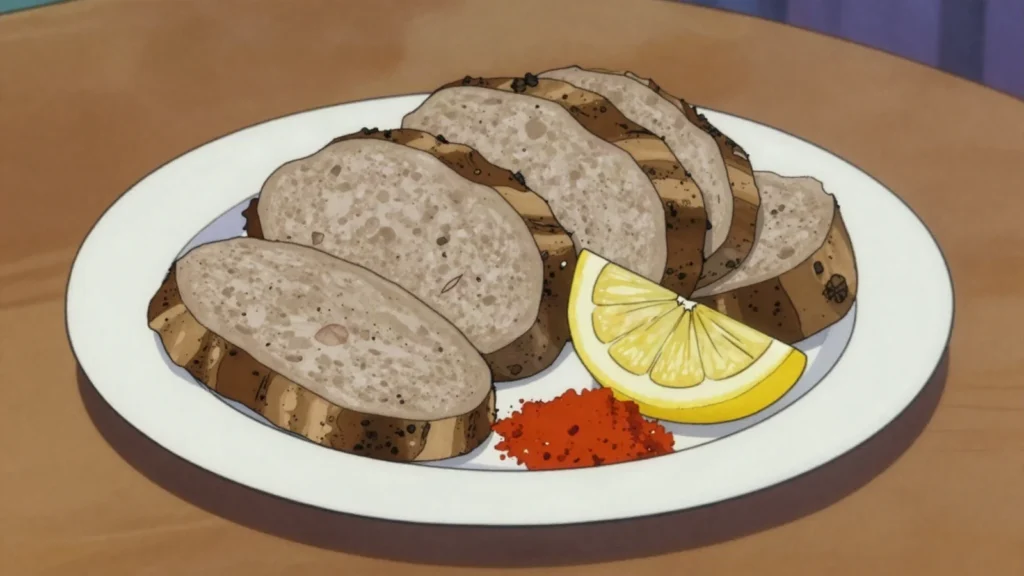
- Scrape it into an oiled loaf tin or a bowl, press the surface flat, cool to room temperature and then chill for 2 hours until it sets to the firmness of a firm polony.
- Turn out and cut into thick slices with a wet knife, and serve cold with lemon and extra chilli, as it is sold on the street in Lusaka and on the Copperbelt.
Technique
- Chikanda is called African polony for the sliceable, springy texture, not for any resemblance in flavour; it tastes of roasted groundnut and earth, with a chilli sting.
- The bicarbonate is doing chemistry, not seasoning. It raises the pH so the tuber’s mucilage and the peanut protein set together into a sliceable block.
- The wild terrestrial orchids the tubers come from, mostly Disa and Satyrium species, are being harvested to the point of collapse across Zambia, Malawi and Tanzania, and cross-border trade is now restricted. Cultivated tubers or a substitute is the responsible choice.
- Traditionally a Bemba dish from the Northern Province, it moved to the cities as a snack sold by the slice at bus stations.
Substitutions
- No orchid tuber: Zambian cooks in the diaspora make a very close version with 400 g of boiled, mashed potato plus 2 tsp of konjac or a little cornflour for spring. The texture is right even if the earthy note is missing.
Variations
- Some Copperbelt cooks add a little tomato and onion paste for colour and a sweeter finish.
- A milder version leaves out the chilli entirely and is sold to children as a filling snack.
History
Wild orchid tubers pounded with peanut and chili and set like a sausage; demand has stripped orchid populations across Zambia and Tanzania.
Frequently asked questions
What is Chikanda?
Chikanda is a snack from Zambia: wild orchid tuber and peanut ‘African polony’, sliced and shared. Wild orchid tubers pounded with peanut and chili and set like a sausage; demand has stripped orchid populations across Zambia and Tanzania.
How long does Chikanda take to make?
Chikanda takes 30 min of preparation and 50 min plus 2 hr setting of cooking. The recipe makes 8 slices. It is rated medium to make.
What can I substitute in Chikanda?
Yes, within limits. No orchid tuber: Zambian cooks in the diaspora make a very close version with 400 g of boiled, mashed potato plus 2 tsp of konjac or a little cornflour for spring. The texture is right even if the earthy note is missing.
What is the most important thing to get right in Chikanda?
The wild terrestrial orchids the tubers come from, mostly Disa and Satyrium species, are being harvested to the point of collapse across Zambia, Malawi and Tanzania, and cross-border trade is now restricted. Cultivated tubers or a substitute is the responsible choice.