
Ingredients
Ferment
- 12mature breadfruit (mā), firm and full-sized but not yet soft-ripe, about 15 kg
- Fresh banana and breadfruit leaves, washed and passed over a flame until limp, for lining
- Clean coconut fronds and woven mats, for covering
- Clean stones and sand, for weighting and sealing
To bake
- 1whole mature coconut, grated and squeezed to 300 ml thick coconut cream
- 1 tspsalt
- Fresh banana leaves and strips of coconut frond midrib, for wrapping and tying
Directions
- Pick the breadfruit at full size while the skin is still green and the flesh firm, and use it the same day. Over-ripe fruit ferments to a sour sludge.
- Peel each fruit with a shell scraper or a knife, cut out the core, and cut the flesh into large chunks. Rinse in sea water or salted water to wash off the sticky latex.
- Dig or clear a pit about 1 metre across and 70 cm deep, or use a large clean crock. Line it completely with two or three layers of wilted leaves, overlapping so no soil touches the fruit.
- Pack the breadfruit in tightly, treading it down layer by layer so that no air pockets remain. Air is what turns the ferment mouldy rather than sour-sweet.
- Fold the leaves over the top, cover with mats and coconut fronds, then weight with stones and, in the traditional pit, cover with sand to seal.
- Leave 4 weeks at minimum. The starch converts and the mass drops to a soft, dense, cheesy-smelling paste, cream to pale brown. Well-made bwiro in a sealed pit keeps for years and is opened in times of storm or drought.
- To serve, dig out the paste you need and reseal the pit. Knead the paste smooth by hand with the salt and enough coconut cream to make it pliable, like a firm dough.
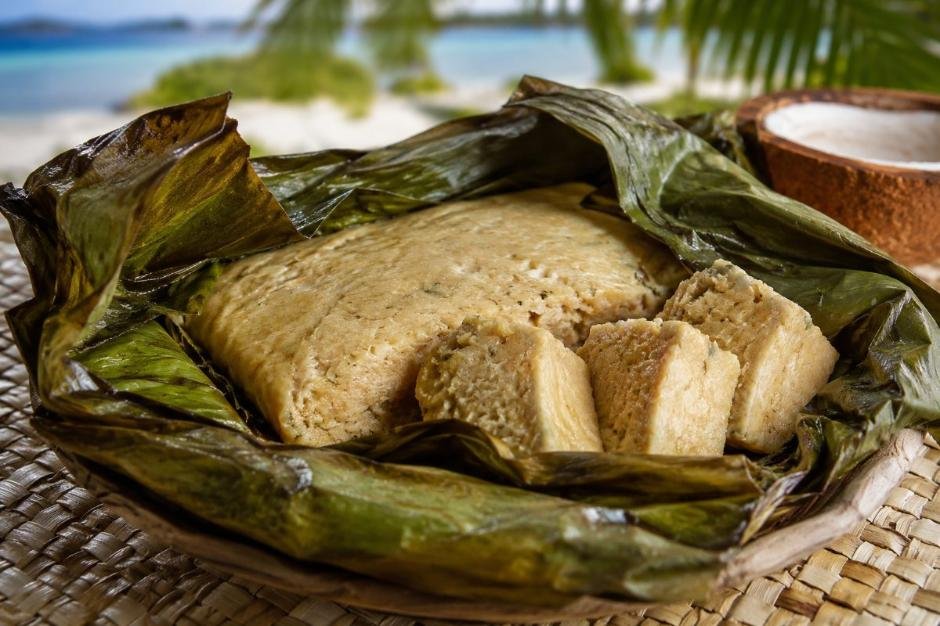
- Shape into flat cakes about 15 cm across and 3 cm thick, wrap each snugly in two layers of banana leaf and tie with frond strips.
- Bake the parcels in an earth oven on hot stones under leaves and sand for 1 hour 30 minutes, or on a rack in a 200°C (400°F) oven for 50–60 minutes, until the parcels smell nutty and the leaf has scorched.
- Open at the table and eat hot with more coconut cream poured over, or cold in slices the next day.
Technique
- This is a lactic anaerobic ferment, the Pacific answer to storing a crop that all ripens at once. The sharp, cheesy smell is correct; slimy grey rot, fuzzy mould or a putrid smell means air got in and the batch is spoiled.
- Every layer between fruit and soil must be leaf. Marshallese cooks are meticulous about lining and sealing the pit, and about never opening it in the rain.
- Once a pit is opened, use the exposed paste within a week or two and reseal carefully, or the whole store will spoil from the surface down.
- Bwiro is festival and famine food at once, brought out for church feasts, weddings and Kamolol, and relied on after typhoons.
Substitutions
- No pit: a food-grade bucket or glazed crock, lined with leaves, packed airtight and weighted under a lid, ferments in 4–6 weeks at tropical room temperature and is the standard household method today.
- No breadfruit: mature green plantain or taro can be fermented the same way, though the paste is grainier and less sweet.
- No earth oven: a 200°C (400°F) conventional oven with the parcels double-wrapped in banana leaf and foil is the closest home substitute.
Variations
- Bwiro mixed with grated coconut and a little sugar before baking is the sweeter festive form.
- In the Marshalls the paste is also thinned with coconut cream into a soft porridge for elders and small children.
History
A preserved breadfruit paste, made by fermenting and pounding breadfruit into a dense, storable mass, developed across the Marshall Islands and neighboring Pacific atoll nations as a critical food preservation technique, allowing a seasonal breadfruit harvest to be stored and eaten over extended periods, an important adaptation for small, resource-limited coral atolls with limited land for agriculture and historically no refrigeration. Its fermentation process, allowing the mashed breadfruit to sour and preserve over weeks, reflects a sophisticated traditional food-preservation technology developed independently across the wider Pacific Islands region wherever breadfruit is a significant crop. Bwiro remains an important traditional food across the Marshall Islands, particularly valued historically as a hedge against seasonal food scarcity.
Frequently asked questions
What is Bwiro?
Bwiro is a salad & side from Marshall Islands: fermented breadfruit paste wrapped in leaves and baked, festive staple. A preserved breadfruit paste, made by fermenting and pounding breadfruit into a dense, storable mass, developed across the Marshall Islands and neighboring Pacific atoll nations as a critical food preservation technique, allowing a seasonal breadfruit harvest to be stored and eaten over extended periods, an important adaptation for small, resource-limited coral atolls with limited land for agriculture and historically no refrigeration. Its fermentation process, allowing the mashed breadfruit to sour and preserve over weeks, reflects a sophisticated traditional food-preservation technology developed independently across the wider Pacific Islands region wherever breadfruit is a significant crop. Bwiro remains an important traditional food across the Marshall Islands, particularly valued historically as a hedge against seasonal food scarcity.
How long does Bwiro take to make?
Bwiro takes 2 hr of active work of preparation and 4 weeks to several months fermenting, then 1 hr 30 min baking of cooking. The recipe makes enough for a family gathering, about 3 kg of paste. It is rated hard to make.
What can I substitute in Bwiro?
Yes, within limits. No pit: a food-grade bucket or glazed crock, lined with leaves, packed airtight and weighted under a lid, ferments in 4–6 weeks at tropical room temperature and is the standard household method today. No breadfruit: mature green plantain or taro can be fermented the same way, though the paste is grainier and less sweet. No earth oven: a 200°C (400°F) conventional oven with the parcels double-wrapped in banana leaf and foil is the closest home substitute.
What is the most important thing to get right in Bwiro?
Pack the breadfruit in tightly, treading it down layer by layer so that no air pockets remain. Air is what turns the ferment mouldy rather than sour-sweet.