
Ingredients
Dough
- 500 gplain flour
- 1 tspfine salt
- 2 tbspcondensed milk
- 1 tbspcaster sugar
- 280 mlwarm water
- 3 tbspmelted ghee or margarine
For resting and stretching
- 150 gghee or margarine, softened, for coating and laminating
- 100 mlneutral oil, for the resting tray
To cook
- 60 gghee, for the griddle
To serve
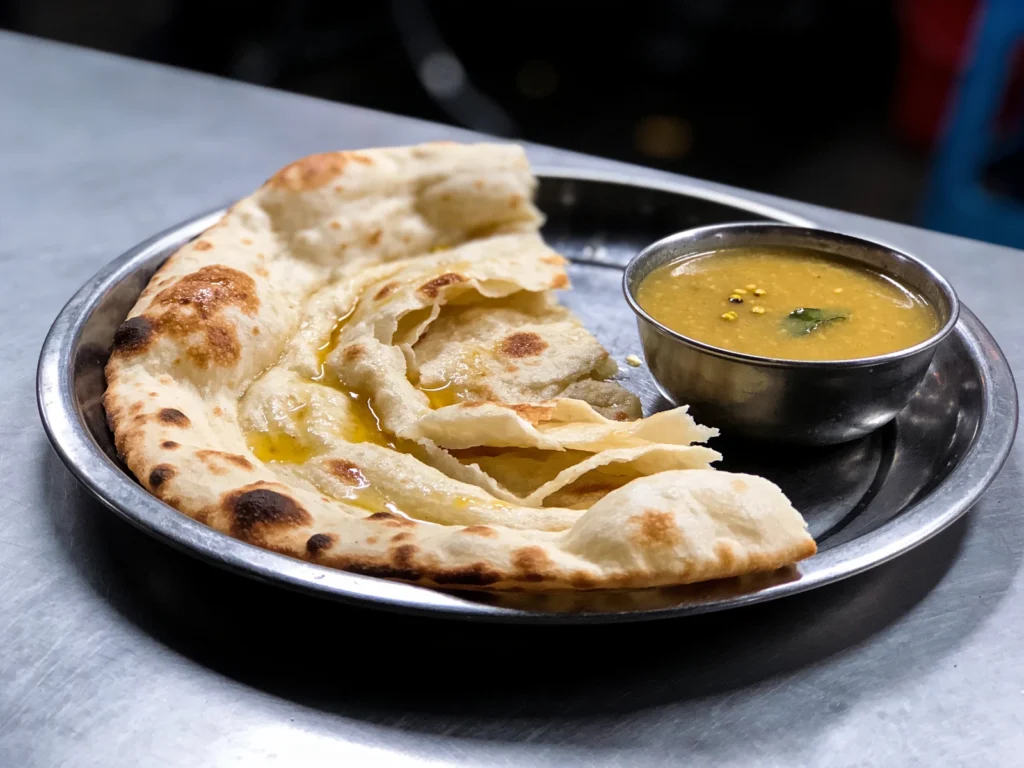
- Dhal curry, made with 200 g yellow lentils, mustard seed, curry leaves, turmeric and coconut milk
- Vegetable kurma or a sambal, on the side
Directions
- Dissolve the salt, sugar and condensed milk in the warm water. Add to the flour with the melted ghee and mix to a shaggy dough.
- Knead for 12–15 minutes, by hand or 8 minutes in a mixer, until the dough is smooth, glossy and very extensible. It should pass a windowpane test: a small piece stretched between the fingers goes translucent without tearing.
- Divide into 6 balls. Roll each in softened ghee until thickly coated, place in an oiled tray with space between them, cover and rest at room temperature for at least 6 hours, or overnight in the fridge. This long rest is what makes the dough stretchable to transparency; two hours is not enough.
- Oil a large smooth work surface generously. Take one ball and flatten it with your palm into a disc.
- Now stretch: lift the dough and throw it in a flat arc so centrifugal force pulls it outward, or, if you are not confident, push it outward from the centre with oiled fingertips, working around the disc until it is a paper-thin sheet 50–60 cm across. You should be able to read print through it.
- Fold the paper-thin edges inward, then take the far edge and gather the sheet into loose ribbons, ruffling it as you go.
- Coil the ribboned rope into a spiral like a snail shell, tuck the end underneath and press down lightly. Rest 5 minutes so it relaxes.
- Flatten the coil to a 20 cm round with your palm, never a rolling pin, which would crush the layers you just built.
- Cook on a griddle or heavy flat pan over medium-high heat with a little ghee, 2 minutes a side, until blistered, brown-freckled and puffed. Add a spoon of ghee at the end to crisp the surface.
- Take the hot roti in both hands and clap it inward two or three times, which shatters the layers apart and makes it flaky. Serve immediately with dhal for dipping.
Technique
- The long rest is non-negotiable. Gluten needs hours to relax before it will stretch to transparency, and the ghee coating stops the surface drying out while it does.
- Fat between the layers is what makes roti canai flaky rather than merely thin. Skimping on the ghee gives a chewy bread with no shatter.
- The throw is showmanship at mamak stalls but it is also genuinely efficient. Fingertip stretching on a well-oiled bench produces the same result more slowly and with fewer holes.
- The name is disputed: some trace canai to Chennai, others to the Malay canai meaning to roll or knead. The bread came to Malaysia with Indian Muslim migrants and is now completely Malaysian.
Substitutions
- Ghee gives the best flavour, but the mamak stall standard is actually a vegetable margarine and it works perfectly.
- No condensed milk: use 3 tbsp whole milk plus 1 extra tbsp sugar.
- A non-stick frying pan works if you have no flat griddle, though the roti will be smaller and less evenly blistered.
Variations
- Roti telur, with an egg spread over the stretched sheet before folding.
- Roti bawang, with finely chopped onion scattered on before coiling.
- Roti tisu, stretched even thinner, cooked crisp and built into a tall cone with sugar.
History
A flaky, pan-fried flatbread whose technique, stretching and folding an oiled dough into thin layers before cooking, closely echoes South Indian parotta, brought to Malaysia by Tamil Muslim immigrants from South India during British colonial-era labor migration in the 1800s and early 1900s. Its name is generally explained as referring to Chennai, the South Indian city long romanized as Madras and known by other names including Channai or Canai, marking the bread’s South Indian origin directly in its Malaysian name. The dramatic hand-stretching and tossing technique used to thin the dough before cooking, often performed as a visible skill at roti stalls, became a recognizable feature of Malaysian and Singaporean mamak, or Indian-Muslim, food stalls specifically.
Frequently asked questions
What is Roti Canai?
Roti Canai is a breakfast from Malaysia: flaky flipped flatbread dipped in dhal or curry, mamak staple. A flaky, pan-fried flatbread whose technique, stretching and folding an oiled dough into thin layers before cooking, closely echoes South Indian parotta, brought to Malaysia by Tamil Muslim immigrants from South India during British colonial-era labor migration in the 1800s and early 1900s. Its name is generally explained as referring to Chennai, the South Indian city long romanized as Madras and known by other names including Channai or Canai, marking the bread’s South Indian origin directly in its Malaysian name. The dramatic hand-stretching and tossing technique used to thin the dough before cooking, often performed as a visible skill at roti stalls, became a recognizable feature of Malaysian and Singaporean mamak, or Indian-Muslim, food stalls specifically.
How long does Roti Canai take to make?
Roti Canai takes 30 min plus 6 hr resting of preparation and 20 min of cooking. The recipe makes 6 breads. It is rated hard to make.
What can I substitute in Roti Canai?
Yes, within limits. Ghee gives the best flavour, but the mamak stall standard is actually a vegetable margarine and it works perfectly. No condensed milk: use 3 tbsp whole milk plus 1 extra tbsp sugar. A non-stick frying pan works if you have no flat griddle, though the roti will be smaller and less evenly blistered.
What is the most important thing to get right in Roti Canai?
Flatten the coil to a 20 cm round with your palm, never a rolling pin, which would crush the layers you just built.