
Ingredients
Leaves
- 1 kgfresh young cassava leaves, stems removed, or 800 g frozen pounded ravitoto
- 1 litrewater
Stew
- 800 gfatty pork belly or shoulder, cut into 3 cm cubes
- 2onions, finely chopped
- 6garlic cloves, crushed
- 30 gfresh ginger, grated
- 2 tbspoil or pork fat
- 2 tspsalt
- 1 tspblack pepper
- 400 mlwater
Ravitoto sy voanio, optional
- 200 mlthick coconut milk
To serve
- 600 glong-grain rice, steamed
- Rougail: 3 tomatoes, 1 onion and 2 chillies, chopped raw with salt and lemon juice
- Ranovola (water boiled with the toasted rice crust from the pot)
Directions
- Strip the leaves from the stems and wash them well. Pound them in a heavy wooden mortar in batches for 10–15 minutes each, until reduced to a fine, wet, dark green mass with no leaf shapes left. This pounding gives the dish its name: ravitoto means pounded leaves.
- Boil the pounded leaf hard in 1 litre of water, uncovered, for 20–25 minutes, stirring often. Cassava leaves contain cyanogenic glycosides and this open boil is what drives them off. Then drain well.
- In a heavy pot, render the pork over medium heat in the oil for 12–15 minutes, until the fat has run and the cubes are browned on all sides. Do not drain the fat off; it is the flavour of the dish.
- Add the onion, garlic and ginger and fry 8 minutes until soft and fragrant.
- Add the drained cassava leaf, the salt and pepper, and stir hard so that every strand is coated in the pork fat.
- Pour in 400 ml water, bring to a simmer, cover and cook over low heat for 50–60 minutes, stirring every 15 minutes and scraping the base.
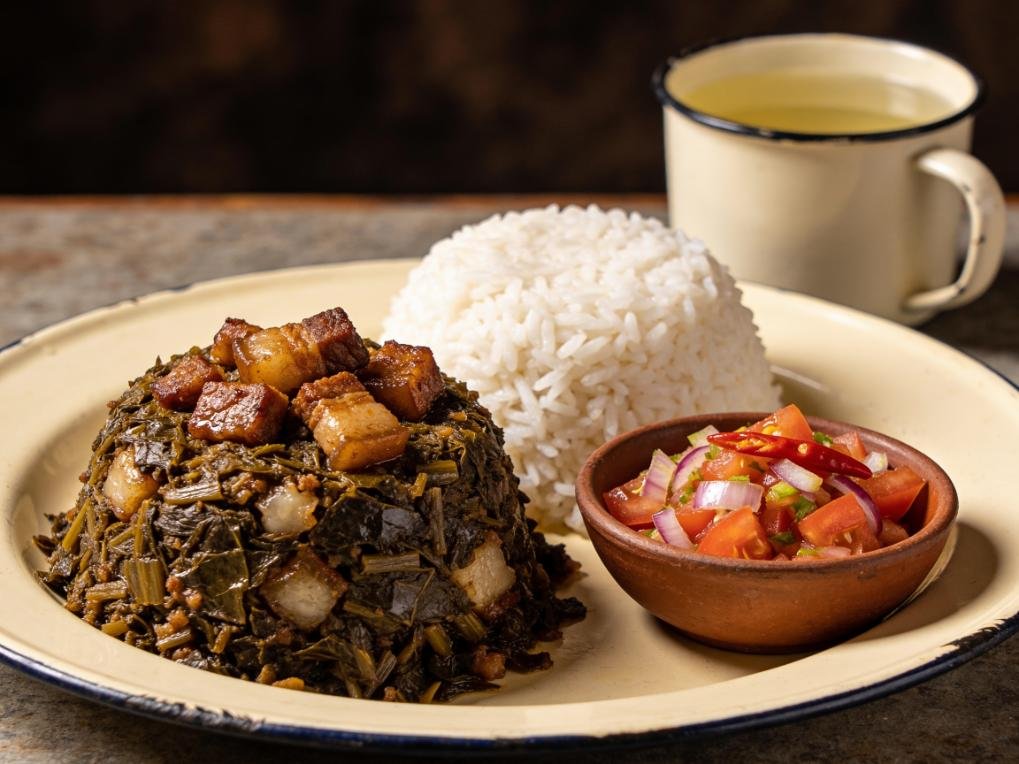
- Uncover for the last 15 minutes and let the liquid cook away. The ravitoto is ready when it is dark khaki-brown rather than green, the pork is meltingly tender, and the fat glistens through the leaf without any watery liquid pooling.
- For ravitoto sy voanio, stir in the coconut milk in the final 10 minutes and simmer until it is absorbed and the stew turns creamy and a shade paler.
- Serve in a mound beside plenty of hot rice, with fresh rougail on the side and a cup of ranovola to drink, the standard Malagasy midday plate.
Technique
- The hard open boil is a food-safety step, not a texture step. Never eat cassava leaves raw or lightly cooked.
- Fatty pork is essential. Lean pork gives a dry, bitter ravitoto; the leaf needs fat to soften its edge and carry its flavour.
- Pounding by hand in a laona, the tall wooden mortar, breaks the cell walls in a way a blender does not, releasing more flavour and giving the correct clinging texture.
- Malagasy cooks judge it by colour: bright green means undercooked, deep brown-olive means it has had its time on the fire.
Substitutions
- Frozen pounded cassava leaf from an African or Malagasy grocer is what most people use outside the island; skip straight to the boiling step.
- No cassava leaves at all: pounded sweet potato leaves or, at a stretch, very finely pounded kale plus a handful of watercress, though the flavour is far milder.
- Zebu beef or smoked pork can replace fresh pork; adjust the simmer to 90 minutes for beef.
Variations
- Ravitoto sy henakisoa, the classic with pork, the everyday version.
- Ravitoto sy voanio, finished with coconut milk, favoured on the east coast.
- Ravitoto with smoked zebu, a highland speciality.
History
Cassava leaves pounded in a mortar for hours and cooked with pork fat; the pounding is what distinguishes it from simply boiled leaves.
Frequently asked questions
What is Ravitoto?
Ravitoto is a main from Madagascar: pounded cassava leaves stewed with fatty pork, served over rice. Cassava leaves pounded in a mortar for hours and cooked with pork fat; the pounding is what distinguishes it from simply boiled leaves.
How long does Ravitoto take to make?
Ravitoto takes 40 min of preparation and 1 hr 30 min of cooking. The recipe makes 6 servings. It is rated medium to make.
What can I substitute in Ravitoto?
Yes, within limits. Frozen pounded cassava leaf from an African or Malagasy grocer is what most people use outside the island; skip straight to the boiling step. No cassava leaves at all: pounded sweet potato leaves or, at a stretch, very finely pounded kale plus a handful of watercress, though the flavour is far milder. Zebu beef or smoked pork can replace fresh pork; adjust the simmer to 90 minutes for beef.
What is the most important thing to get right in Ravitoto?
In a heavy pot, render the pork over medium heat in the oil for 12–15 minutes, until the fat has run and the cubes are browned on all sides. Do not drain the fat off; it is the flavour of the dish.